By the time voters in Prince George’s County, Maryland, headed to the polls for the state’s June primary, Karima Williams had become fixated on a decidedly old-school piece of political machinery: the slate card.
Williams had been building a website for a local candidate when she began researching how campaigns win elections across the Washington, D.C., Maryland and Virginia region. In Prince George’s County, she says she was surprised by how much influence the printed cards—typically distributed by candidates, campaigns and political organizations to tell voters whom they endorse—could still carry.
“At first, I thought, ‘Are you serious? That’s the way people are voting?’” Williams tells ESSENCE. “Then I realized it’s a lot to do with the age of people voting, and at that point, I set out on a mission to kill slate cards.”
It was a provocative way of describing a much more practical goal: Williams wanted voters to have another option.
That question of access is heavy in Prince George’s County. Located just outside Washington, D.C., the Maryland county is home to an estimated 970,000 residents, according to the U.S. Census Bureau, with Black residents accounting for more than 60 percent of its population. The county’s 2026 primary ballot stretched from statewide contests to legislative, judicial and local races, leaving voters to make decisions about offices that often receive a fraction of the attention devoted to presidential politics.
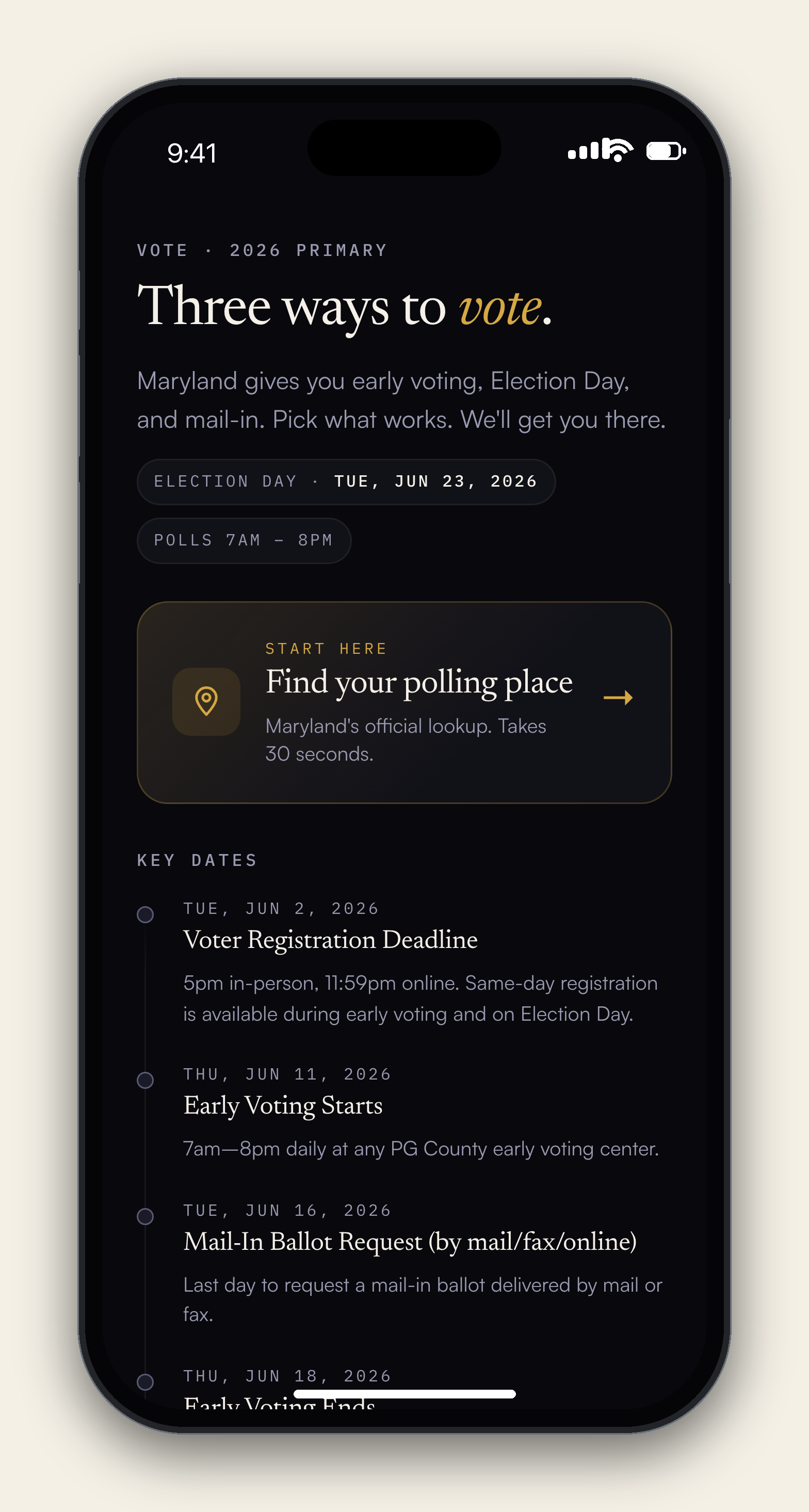
Maryland held its gubernatorial primary on June 23, following an early-voting period from June 11 through June 18. Official election results show just how complicated some down-ballot decisions could become. In one Prince George’s County legislative district, Democratic voters were asked to choose up to three delegates from a field of eight candidates. Countywide contests also presented voters with multiple candidates to consider.
Williams believed the challenge wasn’t that people didn’t care. It was that researching all of those choices required time, familiarity and access to information that many voters simply didn’t have.
“The biggest barrier was just access to information,” she says. “There is a lack of access to organized information.”
For Williams, that gap was especially apparent when thinking about younger and less-frequent voters. Campaigns, she says, often have an incentive to focus resources on people who already have established voting habits rather than people who must first be persuaded to participate.
So she decided to build something for them.
There was just one problem: Williams wasn’t a coder.
“I do not have any previous coding experience,” she says.
What she did have was experience working with mobile apps, studying consumer behavior and experimenting with artificial intelligence. With Election Day approaching, Williams decided she didn’t have time to wait for a developer to translate her idea into a product.
“I knew that it needed to get out the door ASAP,” she says. “I couldn’t really wait for anybody else to be the bottleneck. I knew I had to get it done.”
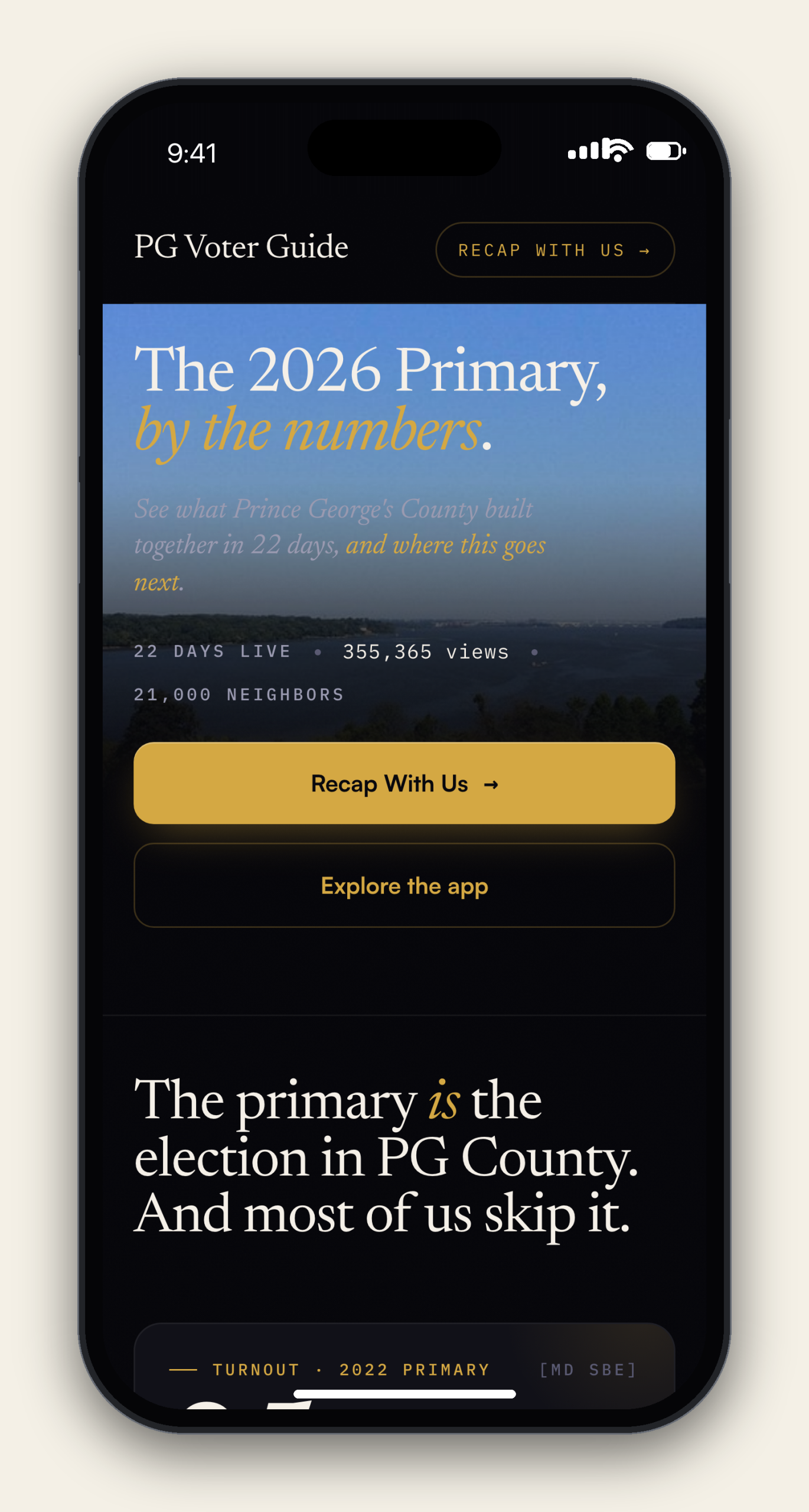
The result was an interactive voter guide built with the assistance of Anthropic’s Claude Code. Instead of designing another dense election website, Williams borrowed from the digital experiences already competing for people’s attention.
“People swipe on Tinder. They’re used to swiping and they’re used to tapping,” she says. “I can get them swiping and tapping, then I can help them better navigate through all the information and not be overwhelmed.”
That thinking shaped a guide that allowed users to move through election information in ways reminiscent of Instagram Stories and dating apps. Williams says she assembled roughly 255 candidate profiles while also incorporating information about issues residents encounter in their everyday lives, including education, schools, crime, traffic and data centers.
Some races, she says, had more than 20 candidates.
“When I built the app, the goal was to re-educate people on what these roles were responsible for and how they would impact their daily life,” Williams says. “Sometimes you can easily lose sight of how these roles and offices really do impact your life on a day-to-day basis.”
That may be one of the less-discussed challenges of voter engagement in America. Registration drives and turnout campaigns tend to focus on getting eligible voters onto the rolls and ultimately into a voting booth. But between those two points is another responsibility: asking people to understand a sprawling collection of candidates, offices, ballot questions and levels of government—often while juggling work, children, bills and everything else happening in their lives.
“People really want to participate. They do,” Williams says. “They want to be informed. They want to be a part of the process. They are just overwhelmed, trying to pay their bills and take care of their families.”
Her solution, however, introduces another complication into an already complicated election environment: artificial intelligence.
AI’s growing role in politics has generated concern precisely because elections depend on trustworthy information. Generative AI can produce convincing falsehoods, while synthetic audio, images and video have introduced new avenues for misleading voters. Williams’ experiment raises a different question: Can the same technology creating new information risks also be used to make reliable civic information easier to access?
For Williams, that meant treating the voter guide less like a website and more like a data project.
“The heart of it is the accuracy of the data that’s on the app,” she says.
Williams says candidate information was gathered from Board of Elections listings, candidates’ websites and other publicly available material. AI tools helped collect and organize that information, but the process wasn’t flawless. After an early version of the guide went live, a friend running for office told Williams that some information was close, but not entirely accurate.
She went back to the data.
Williams says she used multiple AI passes to cross-reference candidate profiles, required the systems to identify the sources behind information and then checked those sources. She also contacted candidates directly, sometimes more than once, asking them to review their profiles and flag inaccuracies.
The corrections did not stop after launch.
As more residents began using the guide, Williams says they sometimes spotted mistakes themselves. Instead of interpreting that feedback as failure, she saw it as evidence that people were actually engaging deeply enough with the tool to scrutinize what they were reading.
“I would immediately make sure I would fix it as soon as I knew about it,” she says, “because, again, it was important for me to provide the cleanest experience with the data that I could for all the residents.”
Williams also says she designed the guide with privacy in mind. Information such as a user’s candidate selections and address remained on the user’s device rather than being collected by her, a decision she considered especially important given the sensitivity of political and location data.
Then people started showing up.
Williams says the guide reached roughly 21,000 people in the weeks surrounding its launch, with about 5,000 using it to create personalized voter guides. She remembers lying down for a nap after posting an early video about the project and waking up to discover that a prominent local radio personality had shared it.
The social media account dedicated to the project, she says, went from zero to roughly 1,000 followers in a day.
But the clearest sign that the project had moved beyond Williams’ computer came later.
At an event, she says several candidates told her voters had printed their personalized guides and arrived at polling places with them in hand.
“I still can’t even believe that was happening,” Williams says. “People printed that stuff out and came to the polls ready.”
For her, those pieces of paper represented something larger than the success of an app.
“It let me know that people just needed an easier way to access information,” she says.
Williams’ experience also complicates the increasingly binary debate over artificial intelligence. She isn’t suggesting that an AI model should be entrusted to independently tell voters what is true or whom to support. In fact, after building the first version largely by herself, she sees more human involvement—not less—as essential to taking the project further.
“If I were to continue this project, I would want to hire help, hire real human data scrapers, and hire for verification and things of that nature,” she says.
For Williams, AI was a way to get an idea out of her head and into the hands of voters quickly enough to determine whether there was a need for it.
“It’s not about using AI to take you all the way there,” she says. “It’s about using AI to bring a concept to life, to show people what’s possible, and get the support to make it real and scale it.”
That distinction could become increasingly important as political organizations, campaigns, journalists and voters wrestle with how artificial intelligence fits into the democratic process. The technology itself cannot resolve longstanding questions about trust, access or civic participation. But Williams’ project suggests that technology can, at minimum, force us to reconsider whether the systems voters have inherited are actually serving them.
Her ambitions now extend beyond one Maryland primary.
“It would be my dream come true to disrupt the voting process and put the power back in people’s hands by making information so easily accessible that voting feels like a no-brainer,” Williams says.
Scaling that vision would require resources, human verification and, perhaps most importantly, trust. Williams also knows that building technology isn’t enough. People have to know it exists, believe it is useful and share it with others.
Prince George’s County became her proof of concept.
“If this could happen with one person and her computer,” Williams says, “imagine what it would look like with the right kind of resources put behind it.”
For all the attention paid to convincing Americans to care about elections, Williams came away from the experiment believing that may be the wrong assumption to begin with.
People already care.
Sometimes, they just need someone to make the information easier to reach.

Author: Shelby Stewart
Read the original article on Essence.
Leave a Reply