
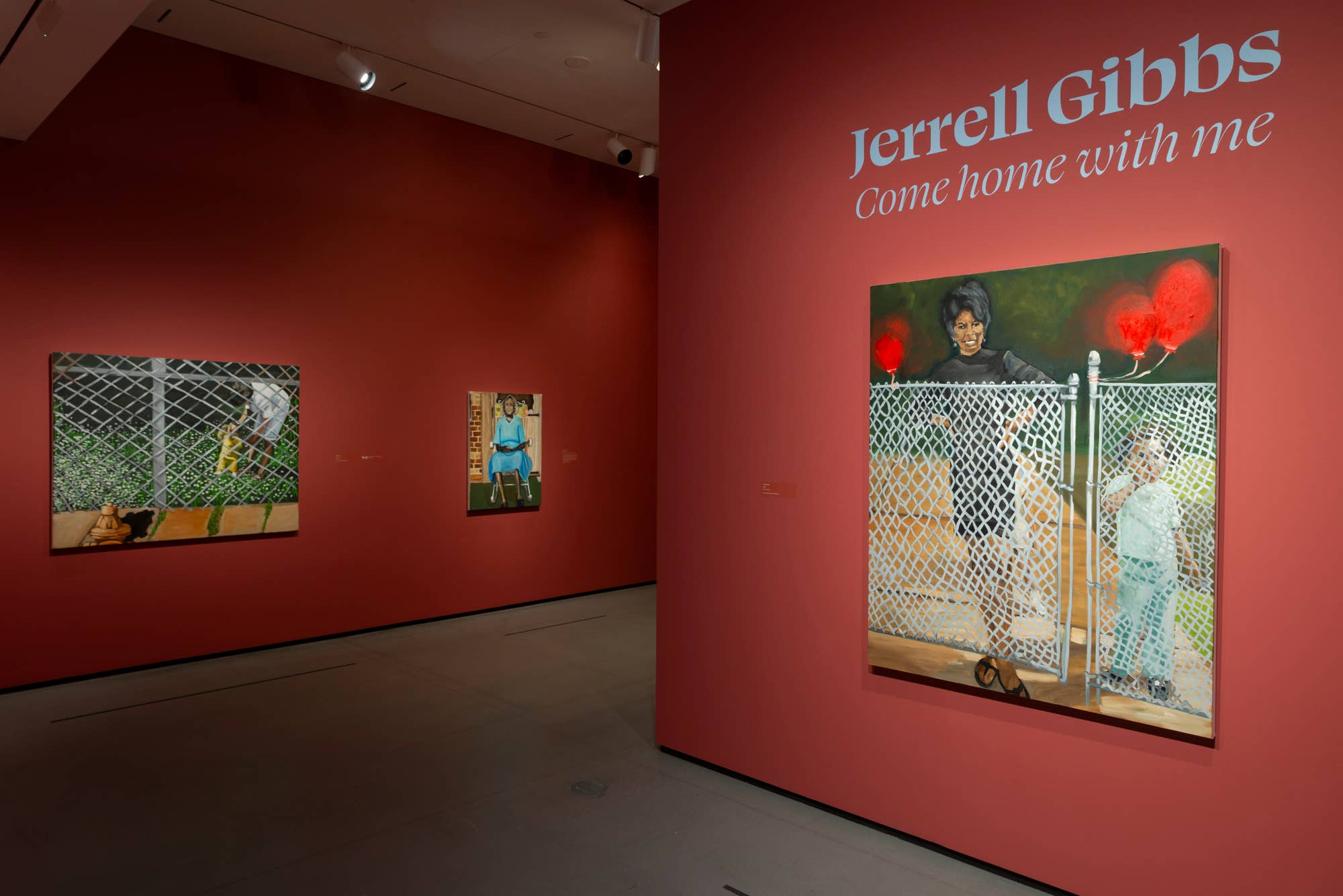
The home of Jerrell Gibbs’ Aunt Ella provides the starting point for his highly-anticipated museum exhibition, Come home with me. The Baltimore-based painter returns to the home where he spent time with family, using its rooms to organize approximately 35 new paintings at the Baltimore Museum of Art. On view through May 2, 2027, the exhibition invites visitors to follow a familiar route from the porch into the living room, then further into the spaces where everyday life unfolded.
Gibbs often begins with family photographs, but his paintings allow him to reconsider what those images preserve. His brushwork combines recognizable figures with passages of abstraction, giving him room to interpret a photograph rather than reproduce it. A person’s expression or the arrangement of a room can become a way to revisit an experience whose details have changed in his recollection. In this exhibition, the photographs themselves also appear in the basement section, offering another view of the family history behind the work.
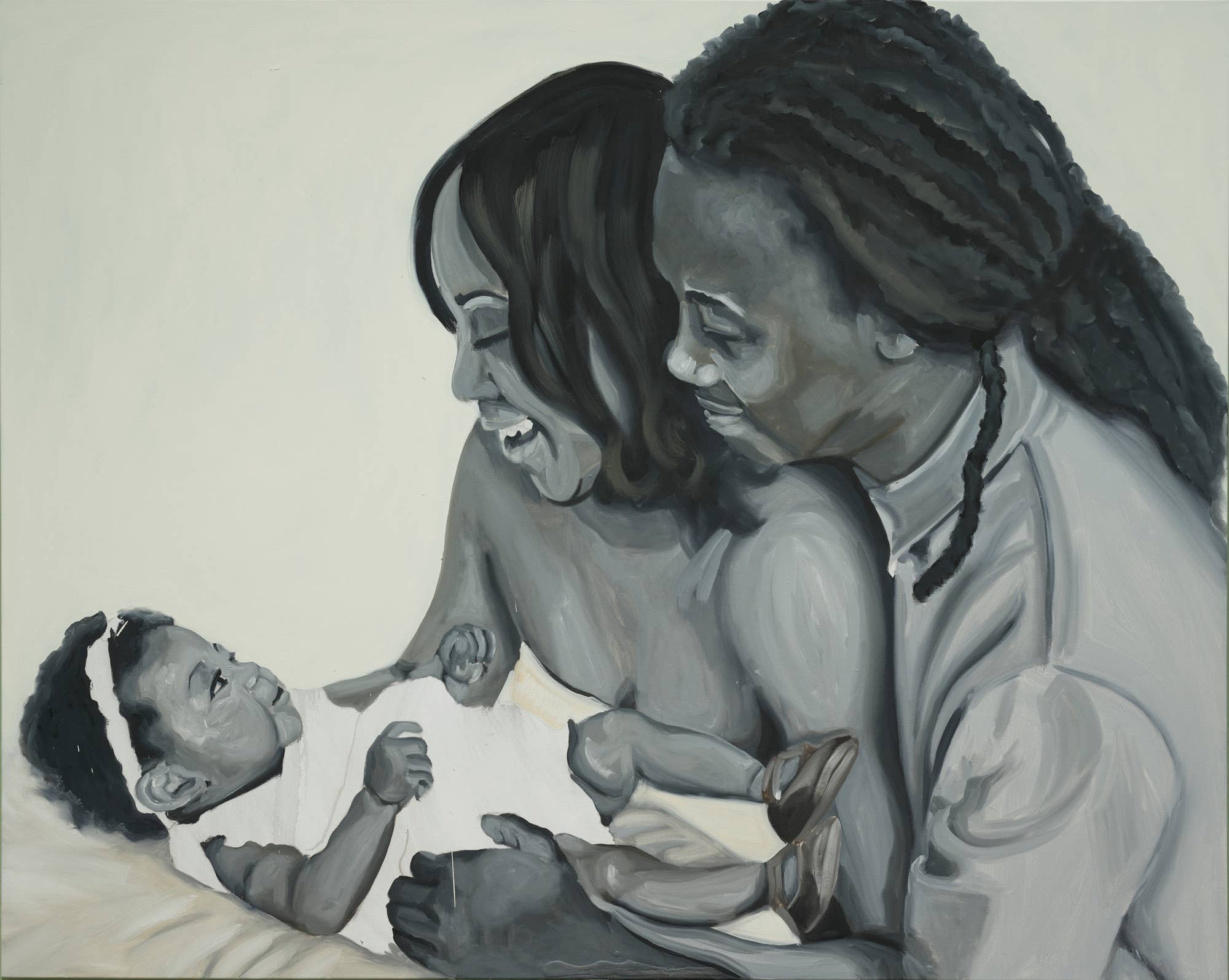
The paintings introduce visitors to the house through scenes of Black domestic life. In Auntie’s Mother, an elderly woman sits in a rocking chair against the exteriors of Baltimore rowhomes. Inside the living room, Portrait of a family presents Gibbs’ immediate family on a monumental scale. Placing the portrait in this section connects a longstanding painting tradition to the family pictures people display in their own homes.
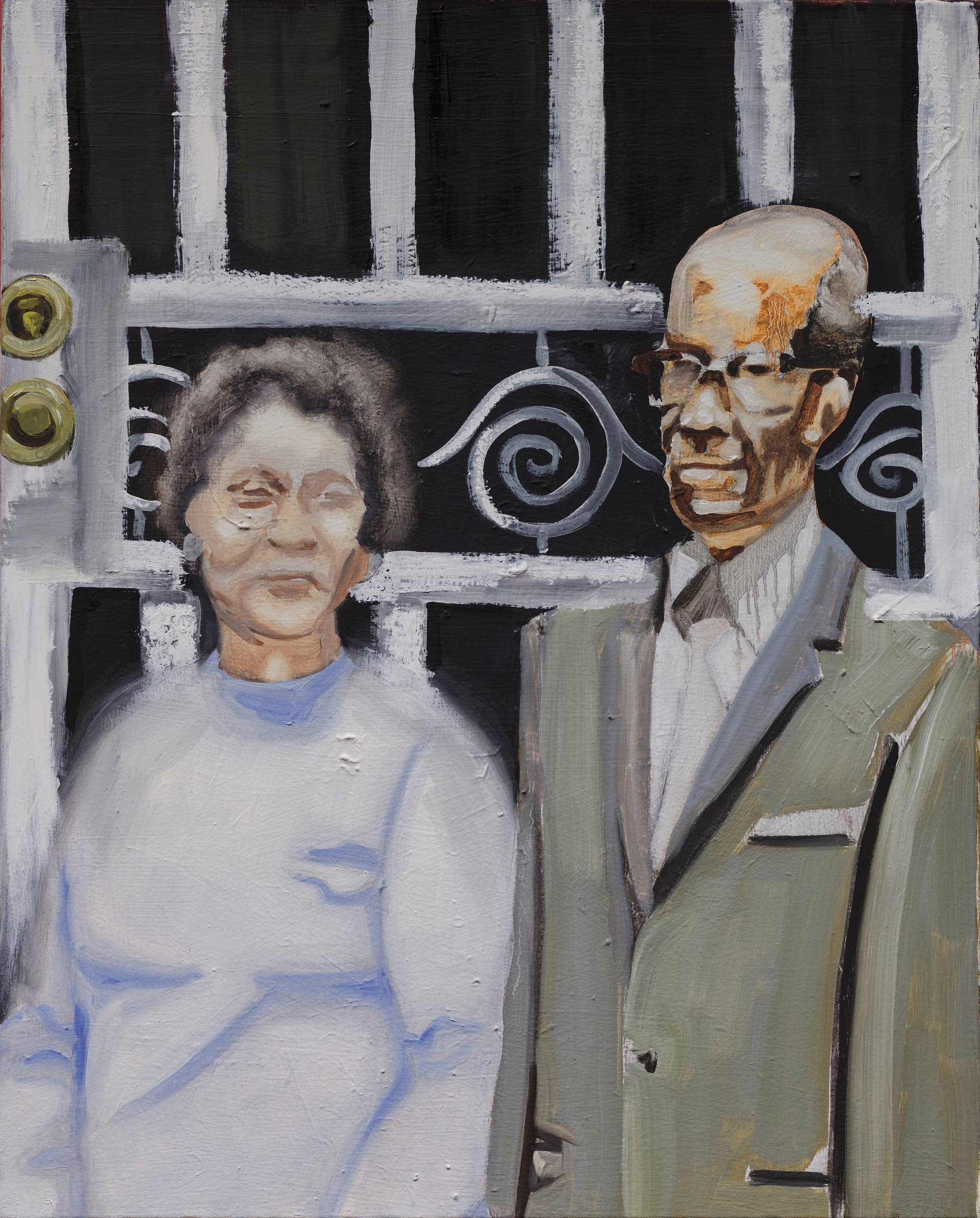
Gibbs also looks beyond his personal archive, drawing from European and American painters to develop new compositions. His American Colonial revisits Grant Wood’s American Gothic through Black domestic experience, while Chardin depicts a child occupied with bubbles. These references bring his family’s world into conversation with works from art history, giving familiar subjects another life through his perspective.
The exhibition’s layout gives each painting a relationship to a particular part of the house. The backyard makes room for childhood play, while the kitchen and basement extend the visit into other shared spaces. Together, the sections offer a way to consider how a home becomes a record of the people who spend time there, including the experiences no photograph can fully preserve.
Come home with me offers a useful introduction to Gibbs’ approach to painting. The following interview offers an opportunity to hear from the artist about the work behind his invitation for all to see at BMA.
ESSENCE: Come Home With Me—what inspired that title for this new exhibition?
Jerrell Gibbs: “Come Home With Me,” it was actually a track from off of Cam’Ron’s album of the same name. I used to listen to that track a lot. It spoke to me when I was growing up for real. And I also would listen to it when I was getting ready for football games. So it naturally resonated with me, that title. And then just thinking about how I wanted the show to go, I wanted people, specifically viewers who come to see the work to be able to get to experience what my home environment, what it felt like, what it smelled like, what it looked like growing up and how home is something that we all have memories of and thinking of these different ideas that make up the home. When you come to someone’s home, it’s an opportunity for you to really show off and do good for the people who you invite over to your place and your space.
I wanted the people that came to the show to get that vibe. Okay, I’m going over to Jerrell’s house. How would I be greeted? How would I be invited into the space? And everybody has their own way of doing it, but I think there’s some universal stories that connect us all to how we invite people over to our space and how we receive people. I know down south, Southern hospitality is a real thing and we still have a bit of that here in Baltimore as well because the north is part of the south, so we still have that bit of southern hospitality. So we like to do things in a way that celebrates people and shows love to our neighbors. So I thought it’d be a good idea to create a show centered around that.
Talk to me about your Aunt Ella and why her home was such an important place for you growing up.
JG: Her home was very important to me because it felt comfortable. It felt safe. It was a space where I felt loved, holistically. I learned so much from my aunt. I learned how to handle money. I learned how to take care of my home. I learned how to cook by just watching. I learned how to just chill on the porch and be quiet and listen to elders talk because that was expected. When they had time and they were chilling, you were just supposed to sit around and if you were invited to be in the space, you had to sit down and listen. It was a place where I learned so much and it was just so fruitful as a place for me to just grow and explore and to see what the future could look like for me and the possibilities of just home ownership. So it was a learning experience for me.
The exhibition is kind of broken down into three sections, but I wanted to really talk about “The Porch.” Why did you feel the need to create an entire part of the exhibition for it?
JG: The porch was a significant place. One, because it’s weird—it’s like you’re inside and you’re still outside at the same time. When you’re on the porch, you just also feel like you are in the crib. You got that level of safety, but at the same time you got access to everything going outside. And it was an opportunity for you to build with your community, but still be in your own space.
It is the same in Baltimore City. We sit on the street, we sit on a porch, and you talk across the yard to your neighbors. Depending on what part of the city you grew up in, some of them you had direct access, some had fences or gates for real, but for the most part, everything was right next to each other. And you would just parlay on the porch. You would talk to your neighbors, you see people walking up and down the street, going wherever they’re going. You greet them as they’re going, greeting them as they come back. It was an extension to the house that you really took advantage of. We ate on the porch, and when it was hot in the crib, you go outside, sit on the porch to cool down from that. It was a place that you could really learn. Everything was about learning too at my aunt’s house and the porch was a part of that. It was an extension of that learning.
…and then what went into the decision to choose these three areas, the porch, the living room and the backyard as opposed to the kitchen or the bedroom or the backyard? What was the significance of these three areas to you?
JG: Yeah, these three areas were the spots where we as family and friends engaged with each other the most. Those were the spaces that were offered as a place to commune—the kitchen was locked down. You couldn’t be doing too much in our kitchen and auntie’s kitchen. So that was really off limits for real. But when you walk in the house, you can sit on the porch. That was always open. You go in the living room, you could sit. If you want to sit down, you can chill, watch TV or typically the old heads were sitting around talking about whatever they were talking about. You can say “hello” and chop it up with them for a little bit. And then outside, you can go in the backyard and just be free, have fun, run around, play as long as you’re not near the grill.
I specifically chose those three locations because those are the places that family, community, friends would come and you can actually engage without having to worry about being told to go somewhere else.
Now, I don’t remember the exact title of the painting, but I know Henri Matisse was the first artist I remember seeing as a child. I know you referenced him, as well as Grant Wood in your exhibition. What interested you about those two particular artists?
JG: Henri Matisse was a big inspiration for me because of his ability to really paint his life and make it interesting, which I thought was cool. It wasn’t anything extraordinary. It was just everyday living and he painted it in a way that made it extraordinary and beautiful. And that’s what I like to do with my work. I like to focus on these moments that we all experience, and he was really able to do that in a way that really captured my imagination and allowed me to find a way to add to the lineage of painting someone’s life in a way that’s interesting.
In Come Home With Me, you have a portrait of family. What did you want to capture about your own family when you were doing that painting?
JG: I was really interested in just this depiction of family, and I wanted the title to be “Portrait of a Family” so that when people read it, they didn’t think about, “Oh, what’s the color of this family? Who are they?” I didn’t want them to think about identity. When you looked at this portrait and you looked at this painting, I wanted you to think of Black family, but I wanted that to be normal, if that makes sense. I wanted the idea of the portrait of a family to be a Black family and it to be normal without even being said. Because what I’ve noticed is, especially as it relates to historical works, if there’s a painting that’s of a family or if it’s a painting of an athlete or somebody that’s doing something normal, there has to be this association with the ethnicity of the person. So for this, I wanted it to be a portrait of a family, and I wanted that to be able to stand for the title without including Black. But I wanted people to see that this is what a portrait of a family looks like. It’s a Black family, simply, in a painting.
How does it feel to have this exhibition open at the Baltimore Museum of Art, your hometown museum?
JG: It’s a dream come true. It’s still kind of hard to process that this is a reality right now, just coming from Baltimore and thinking about how I started and thinking, one, it hasn’t even taken that long when I sit down and just reflect and think about my journey. It means so much because I’m able to bring my stories of Baltimore to the Baltimore Museum of Art, and then I’m able to bring the people of Baltimore to the BMA that may not have really experienced it in this capacity before. I’m also allowing others that know me through the art world to come to Baltimore to see Baltimore tenfold at the BMA. The work originated here in Baltimore. It’s from Baltimore experiences and it’s going to be fully immersed with Baltimore people. So I’m just super excited about the opportunity for us to come together and really just celebrate this opportunity of just engaging with the city on a real personal and a real authentic level.

Author: Okla Jones III
Read the original article on Essence.
Leave a Reply