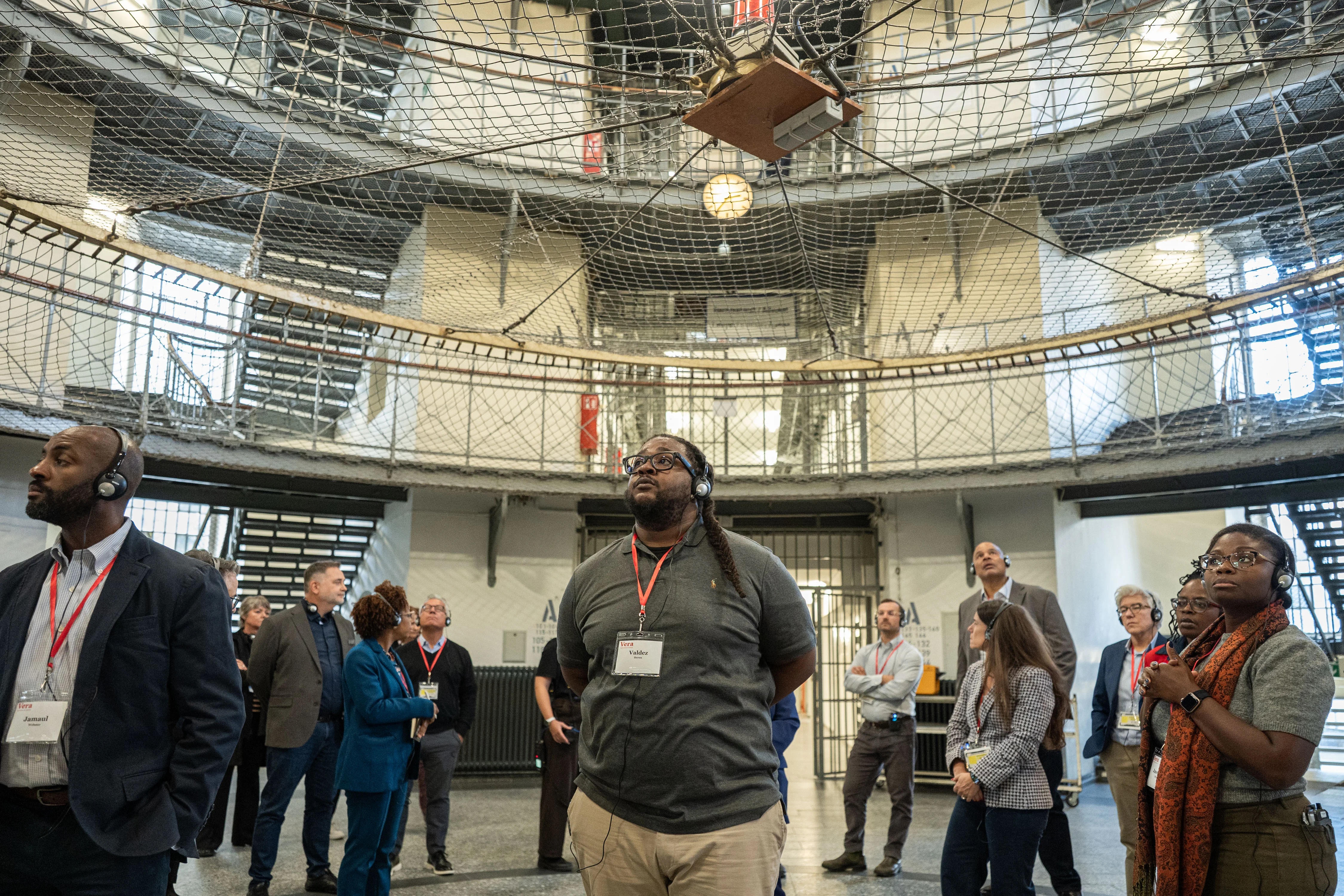
American prison officials are looking to European nations like Germany and Norway for a roadmap on how to design a prison that emphasizes rehabilitation and a successful return to life on the outside.
(Image credit: Lena Mucha)

Source: NPR.

American prison officials are looking to European nations like Germany and Norway for a roadmap on how to design a prison that emphasizes rehabilitation and a successful return to life on the outside.
(Image credit: Lena Mucha)
Source: NPR.
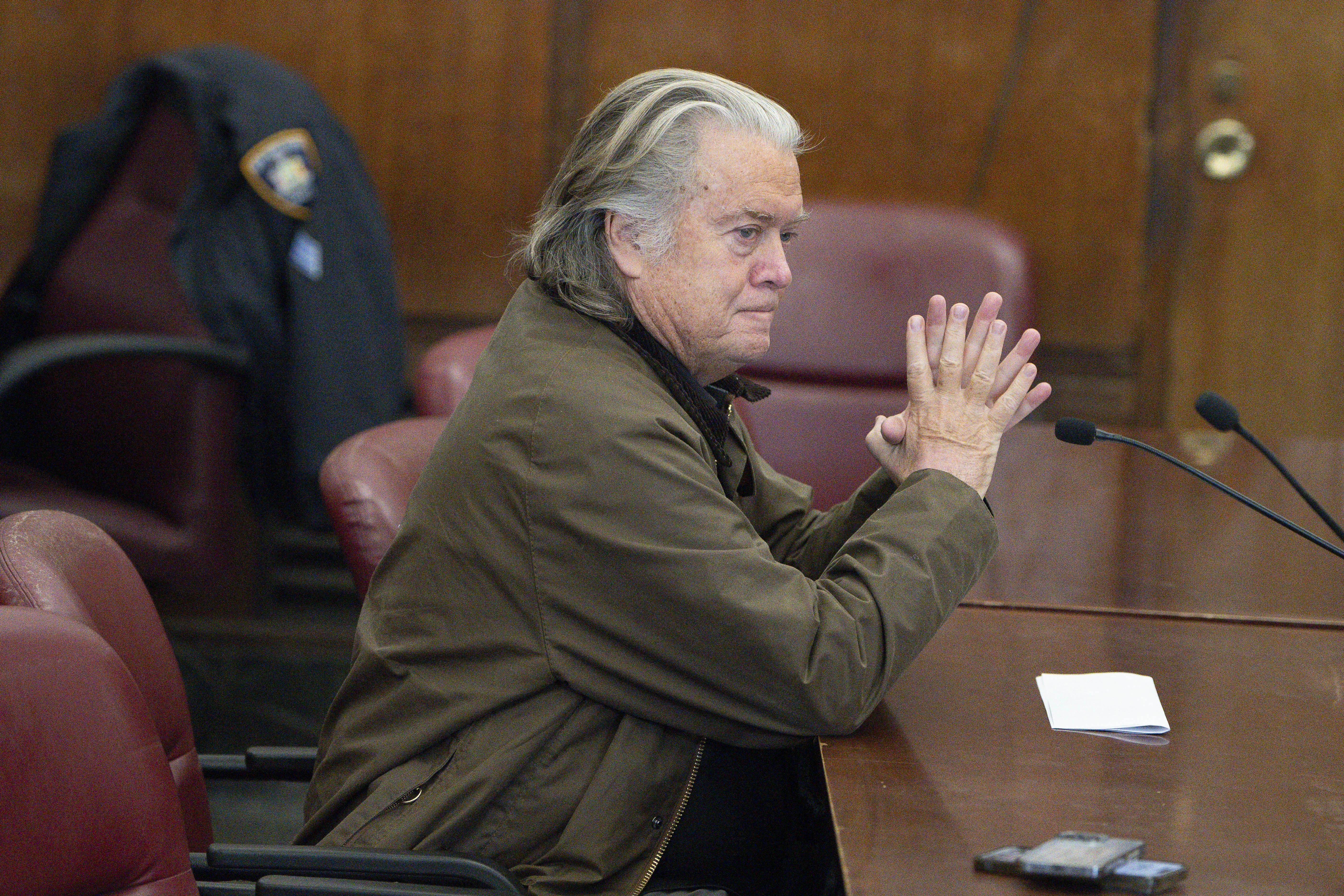
The DOJ moved to dismiss criminal convictions of former Trump adviser Steve Bannon and of the Oath Keepers, in what it calls “the interests of justice.” Critics are crying foul.
(Image credit: Steven Hirsch)

Source: NPR.

Swatters are increasingly using AI technology that creates synthetic voices or sound effects to generate remarkably believable fake emergency calls to law enforcement.
(Image credit: Alex Edelman/AFP via Getty Images)

Source: NPR.

Whether you’re hosting friendsgiving or Thanksgiving, we’ve got foolproof turkey recipes, advice on how to stay present while hosting, and directions on how to create a stunning floral arrangement.
(Image credit: filadendron/Getty Images)

Source: NPR.

Volunteer musicians play for veterans and others who are hospitalized. They’re part of Musicians On Call, a group that spreads the healing power of music.
(Image credit: Tyrone Turner/WAMU for NPR)

Source: NPR.
A new era of Black political power is coming to Washington.
Minority Leader Hakeem Jeffries is on track to become the first Black speaker of the House. A record number of Black senators will take office in January. And the Congressional Black Caucus, which spent the past year bracing for losses, will instead begin the next Congress with more members than ever.
Black voters helped make it all happen, fueling Democratic gains deep into Republican territory in last week’s midterm elections. The results have set the stage for one of the most influential classes of the caucus since its founding in 1971.
Caucus members had expected to lose ground. A nationwide redistricting push, combined with a Supreme Court ruling that made racial gerrymandering nearly impossible to challenge, put several of their seats at risk. Instead, the total number of Black lawmakers will only be one shy of the current record of 68 if Scott Colom wins his Senate race in Mississippi, and fall just two people short of it if he loses. And because Democrats, who made significant gains last week, have dominated the caucus’s ranks in recent years, its incoming chairman says the group will be the largest in its history.
For Rep. Troy Carter, D-La., who is running unopposed to lead the caucus, the milestone evokes “a powerful emotion of fairness.”
“So many people had given up hope” under “the ugliness and the hate-filled actions of the Trump administration,” Carter said, pointing to cuts to federal healthcare programs, food assistance and student loans. “Tuesday’s election brought back hope that there is an opportunity to restore the rule of law.”
President Donald Trump’s record-low approval rating helped Democrats flip Republican seats, including in states that had been GOP strongholds for decades. “He caused a lot of pain,” Carter said. “We’re ready to get to work.”
In interviews, more than a half-dozen incoming freshmen in the caucus, which is made up entirely of Democrats, said they expect the group to once again champion the John R. Lewis Voting Rights Act. They will have a powerful ally in Jeffries. Their biggest obstacle will be Trump, who has praised the Supreme Court’s decision to gut the original 1965 law as a “big win for equal protection.”
Democrats would need Republican support to pass the bill with a veto-proof majority, but its supporters want a vote regardless.
For Sen.-elect Juliana Stratton of Illinois, one of at least six Black senators set to be sworn in, the fight is personal. Her late father marched from Selma to Montgomery to protect voting discrimination.
“I’m going to fight every day to make sure my father’s memory and what he did for this country is not in vain,” Stratton said of the bill named for Lewis.
Stratton said she was not surprised by the energy of Black voters in the midterms. “When you try to come for our voting rights that our ancestors fought for; people who are still here, walking the Earth,” she said, “I knew that was going to be a motivating force.”
In North Carolina, Rep.-elect LaKesha Womack defeated the former Republican state House speaker, an architect of a redistricting plan designed to benefit the GOP. The state’s House delegation flipped from 10 Republicans and four Democrats to 10 Democrats and four Republicans.
“Even the gerrymandering, I think, helped us to deliver historic wins,” Womack said. “It just really showed that you know when you run good candidates, then they’re gonna win, but we do need to fight for fair maps.”
A ‘more powerful’ caucus
Nearly all Black members of Congress will belong to the Democratic majorities in both chambers in 2027, noted Dedrick Asante-Muhammad, president of the Joint Center for Political and Economic Studies, which tracks Black representation on Capitol Hill.
“In that way, it’s a much more powerful representation than even occurred at the 119th Congress,” Asante-Muhammad said.
No Republicans are expected to be a part of the Congressional Black Caucus next year. South Carolina Sen. Tim Scott, the only Black Republican returning to Congress, has never sought to become a member since arriving in 2011. That leaves the caucus without a Republican member, which it hasn’t had since 2018, who could serve as a liaison to the White House.
Jeffries has already met with Jared Kushner, Trump’s son-in-law and Middle East adviser, to discuss possible areas of compromise with a Democratic-led House, a meeting that drew some blowback within his party.
Others are less hopeful. Delegate-elect Janelle Sarauw, D-V.I., who will be a non-voting member, was blunt about the caucus’s prospects with the White House after Trump named Stephen Miller, a conservative hardliner, his new chief of staff.. “Unless there’s some miracle, I don’t see a harmonious relationship at all,” Sarauw said.
Caucus members also plan to push for investment in the South ahead of 2028, as Democrats try to build on gains in states such as Texas and South Carolina.
“One thing is for certain: the Republicans noticed the strength of the South,” said Carter. “They saw it like I saw it. Unfortunately, some of our Democratic leaders did not. Now they do. I intend to keep the light as bright and the sound as loud as possible to encourage a continued investment in the South.”
‘New generation’
The incoming class reflects broader shifts within the Democratic Party. At least four new members identify as democratic socialists: Melat Kiros of Colorado, Donavan McKinney of Michigan, Darializa Avila Chevalier of New York and Chris Rabb of Pennsylvania.
Carter said he welcomes the ideas of the party’s new progressives, even as ideological divisions begin to complicate Jeffries’s bid for speaker, which Carter strongly backs. Womack said she is waiting to see whether anyone else enters the race.
“There’s an ongoing, very divisive effort to break us up,” Carter told MS NOW’s “Politics Nation with Al Sharpton” on Sunday. “I will tell you that those people that are working to challenge our leader and soon-to-be Speaker of the House will realize what an incredible leader he is.”
The caucus will see younger faces join their ranks, too. Kiros, 29, will be the first woman from Generation Z, roughly those born between 1997 and 2012, to serve in Congress. Rep.-elect Adrian Boafo, a 32-year-old Maryland Democrat, said 2027 is “a moment for a new generation of leadership,” adding that “the passing of the guard” was a key theme in this year’s election.
“I’ve seen a lot of folks in which we’re in the same generation,” said Rep.-elect Cyril Jefferson, D-N.C., another millennial at 34, but “those who are older than us, they’re just as fired up and ready to go.”
Rabb hopes Democrats pursue a populist agenda that especially benefits Black women, who he said were “behind this blue tsunami.”
“If you take care of Black women, you take care of America,” Rabb said.
Asked about his hopes for the group’s goals next year, Rep.-elect Oliver Gilbert simply pointed to its long-standing mission of being “the conscience of the Congress.”
“They keep reminding folks that the American dream has to be real for every American.”
Hannah Marr contributed.
The post Against the odds, Black political power rises on Capitol Hill appeared first on MS NOW.
From MS Now.
Last Tuesday was a rough night for conservatives. But Terry Schilling, president of the American Principles Project, says there was one bright spot.
Ballot measures restricting transgender kids’ participation in girls’ sports passed in all four states where they were on the ballot, including Democratic-leaning Washington and Colorado. Schilling called them “the only good thing that happened on Tuesday.”
The measures, which put the question directly to voters for the first time, won 56% of the vote in Washington and 52% in Colorado. In the battleground state of Arizona, a measure amending state law to expand an existing ban passed with the support of 59% of voters. The widest margin came in Nebraska, where nearly 68% backed the measure to enshrine the state’s existing ban into the constitution.
“We have now confirmed that these issues are actually more popular than Democrats,” Schilling told MS NOW.
Now, as the GOP faces a reckoning over its future, more than a half dozen conservative leaders and strategists tell MS NOW that the measures’ success proves the party should double down on the issue. Several said they are already plotting which states to target next.
“We hope to pass these measures in more states and legislatures, and, where available, on state ballots as well,” said Craig DeRoche, the president and CEO of the Family Policy Alliance, a conservative Christian public policy organization that he describes as being at the forefront of the measures. “The conversations are beginning already.”
With the Supreme Court having ruled earlier this year that those bans can proceed, supporters of the measures feel emboldened.
Megan Burke, co-founder of the group Athletes for Action, which put more than $50,000 behind the Colorado measure, said her organization “wants to get this in every state.”
Conservative leaders say they plan to focus next on states where citizens can initiate ballot measures without the input of legislatures, which in blue states may be more resistant to the prospect of restricting the participation of trans kids in sports. Nineteen states plus the District of Columbia presently lack bans on transgender student participation in women and girls’ sports. Of those 19, seven allow citizens to initiate ballot measures to propose state laws or constitutional amendments, according to MS NOW’s review of databases maintained by the Movement Advancement Project, a nonprofit think tank focused on LGBTQ+ equity, and the National Conference of State Legislatures.
DeRoche and three other conservative strategists singled out California as a potential target, though they acknowledged that a campaign there would be expensive given the state’s size. As evidence that a sizable share of California voters support what they describe as socially conservative policies, they pointed to the recent failure of the state’s “billionaire tax” ballot measure and to Gov. Gavin Newsom’s comments after the 2024 election that it is “deeply unfair” for trans athletes to compete in women’s sports.
If the issue wound up on the ballot there, DeRoche suggested that Newsom, a likely 2028 presidential contender, could find himself in a bind.
“It’d be hard to run for president in California and oppose a ballot measure there at the same time,” DeRoche said. “I would say states as big as California would be fairly easy for us to win.”
Erin Friday, an attorney and co-founder of Protect Kids California, which fell short of the signatures needed to put a measure on the state’s 2024 ballot, said “there’s a lot of interest” in trying again in 2028, especially after last week’s wins in blue states.
“If you can do it in Colorado,” she said, “you can do it in other states.”
Corey DeAngelis, a research fellow at the Heritage Foundation, described Michigan as “low-hanging fruit.” Paul Jacob, president of the Liberty Initiative Fund, an advocacy group that works on ballot measures, said he has “talked to people in Michigan who have expressed interest,” though he declined to identify them.
In Maine, Leyland Streiff, founder of Protect Girls Sports in Maine, is mounting another push to get the issue on the ballot next year after falling about 500 signatures short this year. Last week’s results, Streiff told MS NOW, “give people permission to say, ‘We can still be a progressive state and still stand with common sense.’”
With the four new measures, 29 states now restrict trans kids’ participation in sports, according to the Movement Advancement Project. Republicans, including President Donald Trump, have made the issue central to a broader effort to curtail trans rights, even though trans people make up only about 1% of the U.S. population, and trans kids on youth sports teams are likely a far smaller group still.
In Washington state, for example, where the newly passed measure will require healthcare providers to verify the sex of anyone who wants to play on a girls’ sports team, trans or not, the state’s Interscholastic Activities Association estimates there are only about 10 trans kids statewide playing on school teams, though supporters of the measure say that is likely an undercount. (Parents and trans advocates there have already challenged the measure in court.)
Republicans’ confidence in the issue rests largely on polling. In a survey conducted before the midterms by The 19th and YouGov, nearly half of adults said they were more likely to support a candidate who backs banning trans athletes from girls’ and women’s teams, including more than three-quarters of Republicans and 37% of Democrats. A Gallup poll last year found that nearly 70% of adults, including 45% of Democrats, believe trans athletes should play on teams that match their sex at birth.
Some strategists also cite Democrats’ retreat from past positions as evidence that the GOP has pulled its opponents toward its side. After Republicans spent nearly $40 million on ads attacking Texas Democratic Sen.-elect James Talarico over his support for trans kids, Talarico said on Fox News that he would “oppose trans athletes playing in girls sports if it endangers safety or fairness,” reversing the position he held as a state representative.
But that shift among Democrats — which has not been limited to Talarico — could also make it harder for Republicans to claim the issue as their own.
“If Democrats run away from the issue toward the middle,” DeAngelis said, “Republicans will be less successful.”
Other factors complicate the GOP’s bet. Ticket-splitting is common with ballot measures, meaning voters can back trans sports bans while still electing Democrats, as they did last week in Colorado, Arizona and Washington.
The issue could also backfire on Republicans in the long run, as same-sex marriage did. Voters approved more than 30 ballot measures banning same-sex marriage in the 1990s and 2000s, which the Supreme Court struck down in its 2015 Obergefell v. Hodges decision. As public opinion shifted toward greater acceptance of same-sex marriage and LGBTQ+ people, the GOP’s opposition left it out of step with voters and the party struggled to move past it.
Two decades later, some advocates say Republicans are poised to make the same mistake.
“People do not want their leaders to be focused on discriminating against folks,” said Tyler Hack, executive director of the Christopher Street Project, a political advocacy organization supporting issues affecting trans people.
Barbara Simon, spokesperson for the LGBTQ+ advocacy organization GLAAD, told MS NOW that trans sports bans are “not the 80-20 issue” that some on the right believe they are.
Simon pointed to a poll of more than 2,000 voters conducted by GLAAD and Morning Consult, which found that 37% of midterm voters reported being less likely to support candidates who ran ads on trans issues, compared to only 18% who were more likely. According to GLAAD, Republicans spent more than $187 million on anti-trans campaign ads, mostly in Texas and Ohio.
“They lit $200 million on fire, and they’re trying to find a bright spot,” Simon said.
The poll also found that nearly 60% of voters were cynical about why politicians focus on trans issues.
“I think, once again, the Republican party is learning the wrong lesson,” Hack said. “Talking about trans kids in sports is not an excuse for a complete absence of solutions to the problems that are affecting most Americans.”
On that point, even some conservatives agree.
In a September memo to GOP candidates, Schilling’s American Principles Project warned them to offer “a compelling economic alternative” to Democrats rather than simply highlight their differences on trans issues.
“These culture war issues work,” Schilling told MS NOW this week. “But if you really want to win nationally, you have to have an economy that works for young people and working families.”
The post ‘The only good thing that happened’: Conservatives double down on trans sports bans appeared first on MS NOW.
From MS Now.

Less than three weeks before a national election that could catapult the far right to power, Spain’s workers are striking on Wednesday to demand that the government remedy the nation’s housing crisis.
(Image credit: Francisco Seco)

Source: NPR.
Police confirm they asked Brand to leave his ex-girlfriend’s house after she reported an alleged assault.
Source: BBC.
The publisher of Usman Khawaja’s autobiography denies his promotional tour has been cancelled but says there have been “adjustments” to the schedule.
Source: BBC.
American skier Lindsey Vonn has her ninth operation after her crash during the 2026 Winter Olympics in Cortina.
Source: BBC.
British TV presenter Jonathan Ross has landed himself in some hot water over the past week for his past association with both David Walliams and Russell Brand. The Guardian and ITV News’ report into allegations against Walliams including from teenagers referenced a joke Ross made at the 2004 British Comedy Awards. “The comedy awards is […]
Source: Deadline.