Tobey Maguire’s quick reflexes in Spider-Man are NOT movie magic.



When the Founding Fathers began their work to unify the colonies, America’s religious landscape looked nothing like today’s marketplace of ideas. Mainline Protestants — Anglicans, Presbyterians, Congregationalists, Puritans, Quakers, and Lutherans — dominated the budding nation, and Protestant Christianity was fused with public life.
To talk of religious liberty back then was a question of how to handle these various Protestant denominations and, essentially, keep them from killing or oppressing each other. There were hardly any Catholics; there were very few Jewish people; there were essentially no Muslims, Hindus, or Buddhists. What the Founding Fathers eventually arrived at was a plan for tolerance — an early version of freedom from official religions and a freedom to exercise faith without being punished.
Yet a new draft report from a Trump administration task force presents a competing vision of America’s tradition of religious liberty — one that argues that the founders wanted as much religion, everywhere, as possible — and that makes the case that our understanding of religious freedom has been corrupted by 20th-century European secularists and radical progressives aiming to eliminate religion from public life.
Late last week, the Trump administration’s Religious Liberty Commission, housed within the Department of Justice, released a draft 224-page report pushing the idea that belief in God should be the bedrock of American law and society, and proposing dozens of policy proposals and legal recommendations to restore the place of religion in daily life. It argues that when the Founders chose to declare independence, drafted up the Constitution, and debated the Bill of Rights, they “drew from religious traditions of man being made in the image of God,” and that belief in a Christian God was the starting point for individual rights. “The uniquely American approach to religious liberty,” they argue, is one “in which religion is not merely indulged by the government, but rather honored as a natural right, fundamental to the flourishing of a free society.”
It’s this privileged position for religion that was corrupted in the 20th century by “a new [European] philosophy,” which “laid the intellectual foundations for threats to American religious liberty which persist even today.” In this telling, it’s philosophers like Friedrich Nietzsche, Michel Foucault, and Jean-Paul Sartre who rejected God, inspired American thinkers and leaders to embrace relativism, and constructed a “‘Berlin wall’ of separation” that restricts religious life today and must be corrected. As a result, the government took an “increasingly hostile view towards those who embrace Judeo-Christian values” and interpreted the law to shut down practices like school prayer and open displays of religious texts in public buildings.
Using this history, the commission calls for the creation of a national religious liberty violation hotline, creating a DOJ task force to enforce freedom and hear claims of violations, and appointing federal judges who err on the side of religious liberty, as they define it.
They cite examples of religious oppression and anti-Christian bias in schools, workplaces, the military, and the healthcare system: restrictions on teachers, coaches, and students leading prayers, limits on students wearing religious symbols and delivering religious speech, limits on displaying the Ten Commandments in public schools, the pushing of “gender ideology” on Christian students, and requirements for faith-based college groups to accept non-believers. They cite COVID-19 vaccine mandates as violations of religious liberty in the military, coercion for religious medical providers to offer care that conflicts with their beliefs, and overly restrictive rules for military chaplains.
In all, it calls for a plethora of policy and legal changes rooted in an alternative history that government should be welcoming religion into daily public life, not concerned with limiting or restricting it, even if it’s in the name of religious pluralism. To deny this is to attack religious liberty.
But this history is wrong.
The federal government has grown more secular in some ways since its founding. But the story of America’s relationship with religion is the story of the Founders’ vision in action, of religious pluralism at work and evolving with a changing nation. It’s a tale of how political and legal leaders tried to apply those core values in response to growing and new religious communities in America who arrived after the revolution.
At its core, the report argues that American law and society have veered too far away from what the Founders intended, that they have been infected with the ideology of liberal secularism, and that the government has gone too far in subsuming the church to the state. That Jeffersonian wall of separation between church and state, they argue, is a myth, and religion instead should have a privileged place that creates a “bridge” between the faithful and the government.
But that’s a fundamental misreading of both colonial views of religious liberty and the modern landscape that they are critiquing, historians argue.
Let’s start with where they all agree. These commissioners are right to point out that Protestant Christianity did infuse every part of American life in the colonial era, and that colonists believed it should continue to do so, the historian Matthew A. Sutton told me.
“You can find example after example of the government endorsement of not just religion, but a very particular kind of religion, Protestant Christianity,” he said. “But there really wasn’t religious liberty for those too far outside the boundaries.”
The commission’s document acknowledges this context, but goes on to argue that the founders took a more pluralistic approach while still advocating for a government that encourages widespread public adoption of faith.
It pulls the story of the First Continental Congress in 1774, where colonial leaders gathered, put aside their religious differences, and, inspired by Samuel Adams, prayed together as they prepared for war. In retelling the writing of the Declaration of Independence, they similarly argue that belief in a Christian God was the bedrock of individual liberty and the cause for independence. And in drafting the Constitution, religious liberty was the “first freedom” from which other liberties could flow.
But Sutton, whose new book “Chosen Land: How Christianity Made America and Americans Remade Christianity” traces this history, told me that this historical account of colonial America and the Framers’ intent is oversold. The thinkers who helped to establish America were responding to very real and practical concerns — how to unite the colonies — not necessarily to push a unified vision of religious pluralism, with state encouragement for faith.
“The First Amendment is also about a practical response to the fact that you have 13 colonies that you need to unify, and many of them have established churches, but they’re different churches,” Sutton said. “The First Amendment is not this kind of high ideal about freedom of religion. It’s simply about how can we keep these people from killing each other when we know for the last 300 years, different groups of Christians have killed each other in Europe.”
In trying to figure out how to keep these various colonies together in a united nation, they reached a negative clause, Sutton said: “There will be no establishment of religion.”
Sutton told me that the reference to the First Continental Congress’s prayer is selective — just a couple of years later, Benjamin Franklin’s suggestion to start the meetings of the Constitutional Convention with prayer would be shot down.
“In 1774, it’s not clear there’s going to be a revolution. They have not left, and the clergyman they chose for this prayer is a member of the Church of England. They were trying to signal to England that they did want to maintain their unity, that they wanted to keep their religious bonds together. It was very practical,” Sutton said. “But this is the selective cherry-picking that the Trump people do. They didn’t have a prayer at the Constitutional Convention. So you can’t have it both ways. If you’re going to talk about when you do, you need to talk about when you don’t and see those as equally valid.”
To speak of the founders wanting anything in common is itself a bit preposterous, the politics and religion scholar Dave Campbell, a professor at the University of Notre Dame, told me, since the leading thinkers of the time had different visions of the relationship between the government and various churches: Jefferson wanted the wall of separation; Washington wanted mutual support between the state and Protestant Christianity in general; Madison wanted competition between sects and a marketplace of ideas free from government punishment. And all of these are very different from both the version of religious liberty we have today and the one the commissioners claim has been distorted.
“It’s a misnomer to speak of the Founders as though they had one view. They had different views, but they did agree, even though they had to compromise, on the wording of the First Amendment,” Campbell said. “Whatever this amorphous group that the Founders is, they disagreed, and yet they nonetheless could come to consensus that there should be no established religion, which was very novel at the time, and there should be as much latitude given to the free exercise of religion as possible.”
It’s this “latitude” that the commission argues has been overly restricted since the turn of the 20th century. And they argue that European existentialists and post-modern continental philosophers have perverted religious liberty in the quest to destroy organized religion.
“This new [secular] ideology gave ‘complete prioritization…to individual autonomy, [the idea] that we decide value, we decide meaning, we decide purpose,” the report’s authors write, and it’s this dangerous ideology that has led to a crisis of religious oppression today, the commissioners argue.
But this retelling is ahistorical, Sutton told me. The driving force behind a more secular interpretation of the law was that America’s religious makeup changed, with millions of Catholics and Jews entering the country in the 19th and early 20th century, along with the spread of new religions like Mormonism. American leaders and thinkers were responding to these trends, not modern and postmodern European intellectuals.
“It’s ridiculous. It’s definitely not those guys,” Sutton said. “The courts were moving in the 1880s, 1890s, toward slowly recognizing that the nation is growing more diverse, and as they do that, they begin to think about the ways in which the free exercise clause can be protected, guaranteed, and applied.”
Instead of this being some project of post-war secular liberals to try to rein in organized religion and religious practices, Sutton and Campbell told me the modern iteration of religious liberty was more of a practical and realist project from American legislators and courts: Protestant Christians were no longer the only group that needed protection.
“It starts in the 1880s, 1890s, where some of the states are working towards taking out established prayers from public schools and reducing the kinds of explicit Protestant curriculum in their education,” Sutton said. “And so it’s not European intellectuals or secularists or any kind of global conspiracy that are driving this. It’s about how do you build laws to govern an ever more diverse country.”
This shift continued into the 20th century, and especially in post-World War II America, when demonstrating tolerance in contrast to hateful and antisemitic Nazi Germany became a more urgent priority. By then, the country had further integrated its newer immigrants and religious groups across generations, which helped reinforce the idea of secularism as a sign of mutual respect between differing faiths, rather than an attack on religion.
To the authors of the White House-led report, this modern trend has been a new kind of oppression: a stripping of faith of all kinds from the public space.
But a major reason these newer interpretations of secularism and religious liberty took off was a concern over how a predominant faith could end up dictating or setting the rules of engagement for other minority religions, particularly as new faith traditions entered the fray. Without this more neutral approach, a majority faith community might still be able to, in practice, define what a pro-religious government policy or attitude could look like. In America, this typically means Protestant Christianity.
That tension continues to this day: many of the religious liberty disputes the report cites involve the dynamic of a Protestant community action being roped back a bit because of the potential infringement it could have on non-Protestant Christians. In an overwhelmingly Protestant community, school prayer in practice could be used to pressure or isolate non-Protestants with different prayers or rituals. Displaying the Ten Commandments in a community where religious minorities are facing prejudice could end up infringing the ability for non-Christians to freely exist in their faiths. In Texas, for example, leaders are pursuing mandated Bible excerpts in schools at the same time there’s a statewide political backlash against Muslim communities.
That’s one reason there has been so much suspicion of this particular commission, which was presented as an interfaith group but was dominated by members who neatly fit into the stream of Christian nationalist sentiment that has infused the White House and its partnerships in the Trump era. In many cases, adherents support linking the US to a specific interpretation of Christianity as the nation’s state religion, of rooting laws and regulations in Biblical teaching, and of prioritizing and elevating Protestant evangelicalism as the preferred way to view Christianity.
“To them, religious freedom means not respecting all religions equally, but instead ensuring that Christianity and particularly their flavor of Christianity has a favored place in the public square and in law,” Campbell said.
This is the context in which the report is landing. Though not an explicitly Christian nationalist document, it fits into the social, legal, and political framework that has been ascendant in the second Trump term.
“The Bremerton decision on the high school football coach being allowed to pray [at games], the recent debates about whether or not Christian charter schools are going to receive state financing, debates about the Ten Commandments on school grounds — we can see just a concerted effort by attorneys through these religious organizations that have made this kind of document essentially marching orders and used it to try to reestablish or bring us back to a world in which the Protestant majority can try to impose its will on everybody else,” Sutton told me. “The courts seem more open to that than they have been in a couple of generations.”
The version of religious liberty the Founders ended up signing might have been written in an era when intra-Protestant conflicts were their chief concern, but it proved flexible enough to protect the growth of non-Protestant faith traditions. That protection is now being tested, but as we celebrate 250 years of our nation’s history, it has survived until now alongside a still-thriving faith community that’s unique to our country.
“You don’t have to read Tocqueville for that,” Campbell told me. “Just ask these people visiting for the World Cup, and they’ll say, ‘Oh my gosh, there’s a lot of religion around here.’”
TEHRAN, Iran (AP) — Iran’s top officials and brothers of the country’s new supreme leader emerged into public view Sunday to attend the funeral prayers for the late Ayatollah Ali Khamenei, signaling a new confidence in their safety as calls grew for the killing of U.S. President Donald Trump.
Their presence before hundreds of thousands of people in the capital Tehran would have been unthinkable during the Iran war, which saw airstrikes in its opening moments on Feb. 28 kill the 86-year-old Khamenei, his family members and other officials.
Israel also targeted others who appeared publicly during the war, in at least one case likely using their public appearance to fix their position for a strike.
But still unseen was Iran’s new supreme leader, Ayatollah Mojtaba Khamenei. He is believed to be in hiding after reportedly being wounded in the airstrike that killed his father. Israel has threatened to kill him as well as he leads a theocracy now negotiating with the United States over a permanent end to the war and over Iran strangling traffic through the Strait of Hormuz, disrupting global energy supplies.
Ziba Naderi, a 42-year-old nurse attending the funeral Sunday, said Iran needed to follow whatever Mojtaba Khamenei commands in regards to the nation.
“I heard the call for revenge, but our leader should say what we need to do,” she said. “And we must listen to him.”
Ayatollah Jafar Sobhani, a 97-year-old Shiite cleric, led the prayers at Tehran’s Grand Mosalla for Khamenei and his late family members.
On hand were Khamenei’s sons Masoud, Meysam and Mostafa, who haven’t been seen since the war. Revolutionary Guard head Gen. Ahmad Vahidi, who only had been photographed for the first time since the war on Thursday, could be seen in the crowd by Associated Press journalists, flanked by plainclothes security forces as he wore a black baseball cap.
Iran’s President Masoud Pezeshkian, Parliament speaker Mohammad Bagher Qalibaf and Esmail Qaani, who leads the Guard’s expeditionary Quds Force, also attended.
Their appearances came as posters and graffiti at the Grand Mosalla called for the killing of Trump and Israeli Prime Minister Benjamin Netanyahu.
Mohammad Rasouli, a poet who emceed the event prior to the prayers, drew calls of “Death to America!” and “Death to Israel!”
Speaking to the crowd over loudspeakers at the funeral, Rasouli asked, referring to Trump, “Why is the most bastard man in the world still alive?”
The question drew cheers from the crowd, and again when Rasouli said “the world is no longer a good place for” Trump. It marked the first, direct threat to Trump’s life by an official during the funeral.
The American president was giving a speech at the same time across the world in Washington, D.C., for the 250th anniversary of America’s founding.
“We’ve had tremendous success,” Trump said about the U.S. military. “You look at Venezuela, you look at Iran. We wiped it out, wiped out their military.”
A far-larger crowd for the funeral than the day before attended Sunday. Mourners dressed in black walked to the site, carrying banners and flags honoring Khamenei and also calling for Trump’s killing.
“I came here to shout and seek revenge,” said Gholamreza Sabooni, 29-year-old man who works in a grocery. “They killed our imam, we should kill their leader, Trump.”
U.S. federal authorities have been tracking Iranian threats against Trump and other administration officials for years. That stems from Trump ordering the 2020 killing of Gen. Qassem Soleimani, who had led the Quds Force. Iran repeatedly has denied plotting to kill Trump, though hard-line propaganda footage long has suggested Trump was in Tehran’s crosshairs.
Trump meanwhile promised to destroy Iran’s very civilization during the war among a variety of other threats.
Khamenei’s body will be transported to cities in Iran and neighboring Iraq, with authorities planning to drive his casket and others through the streets of Tehran on Monday. Authorities have shut down streets, airspace and daily life for the mourning, which will end Thursday as he is buried at the Imam Reza shrine in Mashhad, Khamenei’s place of birth.
Authorities offered no attendance count for the event Saturday and Sunday. Other cities across Iran also held mourning ceremonies.
For now, talks over reaching a permanent end to the war are on hold until the end of the funeral. Having a major turnout could prove important as Iran tries to leverage its hold on the Strait of Hormuz in negotiations as concern lingers that Israel could attack again.
“Our foreign policy should not be shaped in a way that allows our martyred leader’s blood to be dishonored and other countries can afford to do such things, without any serious response from our government and diplomatic system,” mourner Mohammad Reza Sharifi said.
The post Top Iranian officials attend funeral of late Ayatollah Ali Khamenei in Tehran appeared first on MS NOW.
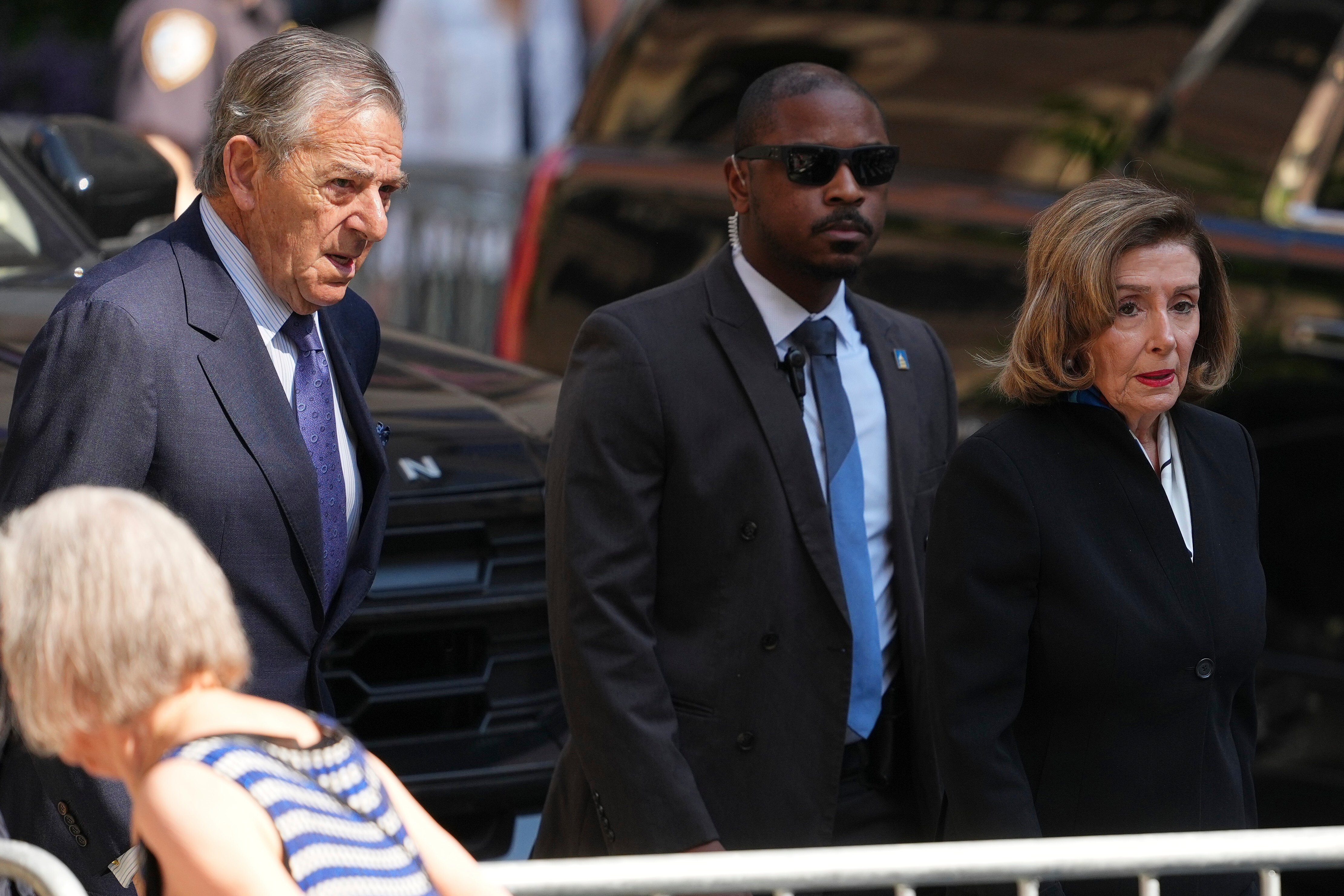
The husband of former House Speaker Nancy Pelosi was involved in a hit-and-run in California that left a parked car with “major” damage, authorities said Saturday.
(Image credit: Adam Gray)

WASHINGTON (AP) — President Donald Trump mixed partisan politics with patriotic appeals on Saturday as he commemorated the 250th anniversary of American independence, a moment he declared “one of the most joyous and glorious milestones of all time.”
Speaking in Washington after storms prompted a roughly two-hour evacuation of the National Mall, Trump honored veterans, including several from World War II and one of the first Black officers to lead a Special Forces team in combat in Vietnam. They appeared before flags that symbolized some of the most significant and challenging moments in American history, from the one that was draped over Abraham Lincoln’s casket to the one that flew on the plane piloted by the Wright Brothers.
Yet Trump also leaned into partisan territory unusual for an Independence Day address, which presidents typically use as a moment to unify the country. Instead, he stumped again for the SAVE America Act, an elections bill that’s encountering challenges even from Trump’s fellow Republicans in Congress. He highlighted his support for the Second Amendment and revived denunciations of communism, which are becoming an increasingly central part of Trump’s message ahead of the November midterms.
The speech capped a holiday that Trump has gone to great lengths to shape to his own tastes. He was introduced by two musical performers who often appear at his trademark rallies, including Lee Greenwood, who performed “God Bless the USA.” The event organizers were largely aligned with the White House, supplanting a bipartisan organization that was launched by Congress a decade ago.
“We will always be on top,” Trump said. “We will never let our country fall. We will always be the best.”
Trump didn’t talk about himself as much as he does during his normal rally speeches. Still, he still found time to include a joke about seeking a third presidential term and about World War II’s “greatest generation.”
“They are the greatest generation,” Trump said. “I hate to admit that, but they are.”
Anticipation for the milestone holiday has been building for much of the year, serving as an opportunity for Americans to reflect on their complicated history as onetime colonists of an empire who became a superpower of their own. Organizers of celebrations months in the making had to adjust or cancel activities entirely as much of the East Coast sweltered under heat that approached and in many cases surpassed triple digits.
Severe weather prompted the cancellation of celebrations in Hartford, Connecticut, along with Harrisburg and Wilkes-Barre, Pennsylvania. Spectators at Boston’s fireworks and concert were told to briefly seek shelter before events later resumed. An evacuation was also ordered in Philadelphia. New York and Pittsburgh moved forward with fireworks but shifted the time to accommodate the shifting weather.
The disruption was particularly acute in Washington, where signs at the Great American State Fair posted an alert shortly after 7 p.m. ET encouraging participants to leave the area. Crowds gathered in museums, subway stations and federal buildings near the Mall. At the Ronald Reagan Building and International Trade Center they waited in chairs and sat on the floor to cool off in the air conditioning.
Crowds were building in the area several hours before the evacuation. Tina Hale, 58, of Cohoes, New York, watched three of her grandchildren children dip their hands into a pool of water near a museum. Hale pointed toward the sky and urged them to look up as three military jets roared above the crowd.
“If that doesn’t make you proud to be an American,” she said.
David Koshko, 42, and his wife, Jennifer Koskho, of Harrisburg, Pennsylvania, came to Washington for a baseball game but planned to stay for the city’s fireworks show. After baking in the heat for hours during the Pittsburgh Pirates’ win over the Washington Nationals, they took a break in the shade of an overpass near the National Mall to plot their next stop.
“Just to be a part of the 250 years (anniversary) is an amazing thing,” said David Koshko, a commercial driver and veteran of the Marine Corps reserves.
In Philadelphia, fireworks began to crack as early as midday in the birthplace of the nation near the site where the Declaration of Independence was adopted by delegates to the Second Continental Congress. Hundreds of visitors were gathering at Independence Hall in the sweltering heat to await the celebrations coinciding with the France-Paraguay World Cup knockout game at Philadelphia Stadium, which began with commemorations of the holiday.
“It’s one big party in here,” Carlos Alban, who traveled to Philadelphia from Chicago to watch the match, said as he arrived at the stadium, adding that he spotted a fan in the parking lot dressed as one of the Founding Fathers.
In New York, tall ships, with their masts, rigging and white sails outlined against a blue sky, made a procession around the Statue of Liberty and up the Hudson River, recalling the fanfare around America’s 200th anniversary in 1976.
The 43 ships were followed by a display of aerial might with a stealth bomber and the Navy’s Blue Angels. Patrouille de France, the French Air Force’s acrobatic teams, flew over New York Harbor with their red, white and blue trails, evoking images of the American flag.
“We got up early and just rode our bikes about a mile down here to come see the scene,” said Oona Moore, a Jersey City, New Jersey, resident who took in the New York festivities. “We saw the tall ships and we saw the planes, you know, all different manner of military aircraft. I’ve never seen it so close and in the sky at the same time.”
At George Washington’s Mount Vernon, people took the Oath of Allegiance to become U.S. citizens. They stood with eyes closed and hands over hearts for the national anthem.
In Phoenix, Steven Dortch, 25, and his brother JayLn Dortch, 23, gathered at Granada Park to try to forge a new July 4 cookout tradition. JayLn Dortch said young people in the U.S. give him hope by thinking for themselves and not taking the words from older people at face value.
He said the country needs to keep in mind the everyday, hardworking people who “keep America going.”
The post Trump mixes patriotism with partisanship as he celebrates America’s ‘joyous’ 250th anniversary appeared first on MS NOW.
In 2009, every big hit sounded like a version of “I Gotta Feeling,” by the Black Eyed Peas.
The Supreme Court split along its 6-3 ideological lines in nearly a quarter of the argued cases this term. The battles were big and small, from President Trump’s agenda to thorny disputes over the meaning of securities statutes. All but two came down in June, the final month of opinion season. Meanwhile, nearly half the cases…
The growing wave of primary victories by democratic socialists is poised to pose a major challenge for House Minority Leader Hakeem Jeffries (D-N.Y.) if Democrats retake the House in the midterms. He will likely need to contend with an increasingly restive and energized left flank as he mounts a bid for the Speakership and attempts…
The Democratic groups built to elect women have spent decades hoping to unseat Maine’s five-term Republican senator, Susan Collins. Now, they have a real shot — and to take it, they will have to help a man dogged by allegations about his treatment of women get elected to the U.S. Senate.
The man is Graham Platner, the oysterman and political newcomer whose profile has rocketed to national attention, driven by the combination of his unorthodox background and magnetic stage presence.
That appeal, however, has been shadowed by his conduct toward women. Platner has been accused of writing derogatory posts on Reddit about women and victims of rape (he has apologized for those comments, and asked voters not to judge him by “the worst thing I said on the internet on my worst day 14 years ago”). He has admitted to sexting women other than his wife early in his marriage (which, he said, spurred him to seek counseling). And he has been accused by past girlfriends of demeaning them, including at least one accusation that he physically threatened her, which he has denied.
None of it has been enough to stop his campaign. On June 9, he won Maine’s Democratic primary in a landslide.
That has left Democratic women in Maine with a choice that, for some, feels like a compromise no matter how they make it: line up behind a man accused of mistreating women, or withhold their support and risk handing a sixth term to the senator many blame for the loss of federal abortion rights.
“Susan Collins is someone who has talked for decades, you know, in her career in the Senate about reproductive rights, has been supported in the past by Planned Parenthood,” said Debbie Walsh, director of the Center for American Women and Politics at Rutgers University. “And there is this deep sense of betrayal posed, post the Kavanaugh vote, that she did not stand up when it really mattered.”
Collins voted in 2018 to confirm Brett Kavanaugh to the Supreme Court. Four years later, he was part of the conservative majority that overturned Roe v. Wade. That vote — a raw wound for many women in Maine and beyond — has become a centerpiece of Platner’s attack ads.
“Susan Collins told us she would protect Roe v. Wade,” a narrator says in one recent ad, which hit airwaves after Platner won Maine’s primary. “She was wrong. Now she won’t even admit she was wrong.
But for some women, the messenger is not unburdened either.
“Women have been put in a terrible position,” said Walsh. Women “who care both about reproductive freedom but also have strong beliefs about issues around sexual harassment, sexual violence, misogyny … the kind of behavior that we’ve been hearing about from him — it’s a terrible position women have been put in.”
Platner’s campaign did not respond to MS NOW’s request for comment for this article.
For some abortion rights advocates, Platner — who supports codifying abortion rights in federal law and covering reproductive care under Medicare for All — has become the best available vehicle for a closely divided Senate that many hope will expand abortion access nationally after Dobbs. Last week, the Planned Parenthood Action Fund endorsed him after supporting Maine Gov. Janet Mills earlier in the primary. At a news conference, the fund’s president and CEO, Alexis McGill Johnson, characterized Collins as “a fair-weather feminist,” and voiced confidence that Platner would be a strong supporter of abortion rights in the Senate.
A person at Planned Parenthood Action Fund familiar with the endorsement process told MS NOW that it “felt important” for the organization to back Platner both on the week of the four-year anniversary of the Dobbs ruling and on the heels of Collins’ recent defense of her vote for Kavanaugh. The person, who was granted anonymity by MS NOW to speak freely about the endorsement process, added that Platner sat for an interview with officials at the national organization as well as the board of the local Planned Parenthood before PPAF decided to back him, and that those conversations convinced officials he was worthy of their endorsement.
“Susan Collins has caused a lot of damage,” the person said. “Women have died [due to abortion bans], are going to continue to die, and so for us, there’s just wasn’t an option to not be involved here.”
But Collins’ record was only part of it. Asked whether Platner’s controversies gave the group any pause, the staffer would only say that McGill Johnson emphasized in a direct conversation with Platner the “trust” women place in the organization, and that she asked “for some reassurance around certain things, and he gave us that.”
Not everyone is reassured.
“On one hand, I kind of laugh,” said Darcy Halvorsen, a lifelong Democratic organizer and voter in Maine, of PPAF’s Platner endorsement. “He’s never run for office before, he’s never held an office … he’s never even held a town council seat. And so I kind of laugh because it’s like, how can you be a ‘reproductive champion’? He really hasn’t done anything for choice.”
Other reproductive rights advocacy groups seem to be having a harder time squaring what they see as the need to oust Collins with Platner’s own checkered past. Reproductive Freedom for All — which announced a $23.5 million midterms strategy last week, including backing some Democratic candidates — declined to comment on the Maine Senate race in response to MS NOW’s inquiries. A staffer with All in Action Fund, the political arm of the reproductive justice organization All* Above All, told MS NOW the organization has yet to determine whether it will endorse Platner, due in part to his controversies.
“We are clearly and narrowly focused on leaders who are committed and fighting for access to reproductive health,” the person said, adding that they also weigh concerns around “integrity and track record.”
Some groups have drawn a harder line. One day after The New York Times published a report in June in which one of Platner’s ex-girlfriends accused him of physically threatening her while they were dating, the National Organization for Women sent an email blast urging voters in Maine to elect Mills in the primary, despite the fact she suspended her campaign in April.
“Feminists who have been working so hard for gender equality and the Equal Rights Amendment have seen this script before — the qualified woman is passed over, the Democratic party rallies around the damaged male ‘star,’ and we are told to be quiet about it for the greater good,” NOW’s statement said. “If a woman had even a fraction of Platner’s record, she would have been forced out on day one.”
Kathy Bonk, the president of the Maine chapter of NOW, said she cast her ballot for Mills, and suggested that the “progressive wing of the Democratic Party” was to blame for “pushing” candidates like Platner “without vetting them.” “If they did vet them and they had that background on women, that’s even worse,” she said.
How a candidate with Platner’s record got that far, that fast, is itself a source of recrimination. The Wall Street Journal reported that Dan Moraff, a progressive strategist and the architect of Platner’s campaign, spurned the typical weekslong background-check process in favor of a faster and more cost-effective option. The fast-track research, the Journal reported, did not uncover many of the controversies that later engulfed Platner’s campaign.
For some, it highlights a more pervasive problem with how male politicians treat women. “It crosses all political parties,” said Deidre Malone, the president of the National Women’s Political Caucus, which endorsed Mills early in the primary season. “When you look at, you know, Platner, but you look at also Eric Swalwell, you look at Tony Gonzales, you know, Cory Mills — I mean, every party, it seems like has some type of scandal associated with either sexual harassment or something … that is inappropriate.” Swalwell, a California Democrat, and Gonzales, a Texas Republican, both resigned from Congress this spring amid sexual misconduct allegations. Both, along with Rep. Cory Mills, R-Fla., faced House Ethics Committee investigations.
Halvorsen cast her primary ballot for Platner during early voting — before the extramarital sexting allegations became public.
Asked if she plans to vote the same way in the general election, Halvorsen said she is considering not voting for the first time in her adult life.
“It’s really, it’s damning, I think, of a candidate,” she said. “I wonder about what else, what else there is? Is there going to be something else? Is another woman going to come forward?”
Kevin Frey contributed to this report.
The post Platner’s primary win leaves some Democratic women with a tough choice appeared first on MS NOW.
The Supreme Court ruled Tuesday that the 14th Amendment’s birthright citizenship clause does, in fact, apply to all people born in the United States. Only five justices reached that conclusion — a much closer decision than it should have been. (The sixth, Brett Kavanaugh, joined the majority on purely statutory grounds.) The primary dissent from Justice Clarence Thomas accused his colleagues of expanding the meaning of a clause narrowly tailored to help newly emancipated Black Americans.
The dissent was yet another bit of ahistorical storytelling from Thomas, which Justice Ketanji Brown Jackson was simply not willing to abide. Though Jackson joined Chief Justice John Robert’s majority opinion defending the constitutionality of universal birthright citizenship, she also filed her own concurring opinion on the case. In 20 pages, the most junior justice on the bench provided a tour de force of narrative history to counter her oldest colleague’s claims.
The dissent was yet another bit of ahistorical storytelling from Thomas, which Justice Ketanji Brown Jackson was simply not willing to abide.
Jackson has long used the history and context behind the drafting of the Constitution and its amendments as an intellectual counterweight to so-called “originalist” legal scholars. From their standpoint, laws must only be interpreted as their drafters intended.
Soon after her confirmation in 2022, Jackson explained during a hearing on a case involving the Voting Rights Act that, counter to her conservative colleagues’ claims, there was no justification for reading the Reconstruction Amendments, ratified after the Civil War, as being blind to race. As she explained at the time: “[W]hen I drilled down to that level of analysis, it became clear to me that the framers themselves adopted the equal protection clause, the Fourteenth Amendment, the Fifteenth Amendment, in a race-conscious way.”
Jackson has continued to press that viewpoint even as Thomas and Justice Samuel Alito have worked to tear down many of the protections Congress passed over the years to prevent discrimination against minorities. The two men have crafted an informal doctrine that, in essence, says any law passed specifically addressing race is unconstitutional under the 14th Amendment. In a case last month on the so-called “shadow docket” of emergency petitions, the court’s conservatives gave a nod to “our colorblind Constitution” in allowing Alabama to eliminate a congressional district held by a Black representative.
With the birthright citizenship clause, though, Thomas found the rare exception. He wrote that the court’s ruling “adds to the sad history of the Fourteenth Amendment, which was designed and understood to secure equal rights for the freed blacks but has instead been repurposed for political projects that the Reconstruction Congress did not support.” In other words, the 14th Amendment was only meant to deal with making sure formerly enslaved Blacks were granted citizenship and nobody else. Anyone who is not “domiciled” in the U.S., including undocumented immigrants, doesn’t fall under that aegis in Thomas’ view.

In her concurrence, Jackson wiped the floor with Thomas’ blatant cherry-picking of history. “The Court’s conception of a color-blind Constitution and the Government’s (and principal dissent’s) cramped, group-specific reading of the Citizenship Clause are two sides of the same coin, stemming from a basic misunderstanding of the relevant history,” she wrote.
Meetings of freed Blacks before and during the Civil War came together to produce the “political and intellectual scaffolding” that would be incorporated into the 14th Amendment and, much later, the Black Civil Rights Movement, Jackson noted. In the attendees’ discussions, there was little doubt that they were already Americans, albeit ones deprived of their rights.
“The citizenship thesis of the Colored Conventions was thus not that some new status should be created and conferred on freed Blacks,” Jackson wrote. “It was instead that freed Blacks already had a rightful claim to citizenship because they had been born on American soil.”
The overwhelming sentiment from those gatherings and the subsequent debates in Congress completely rejected Thomas’ argument for a narrow scope for birthright citizenship.
Jackson has effectively become the chief historian of the court’s liberal wing
“That bears repeating,” Jackson wrote, “Freed Blacks did not advocate for a unique set of rules that catered only to their situation. Nor did they seek to advance their own position relative to, or at the expense and exclusion of, other marginalized groups. Instead, those whose gatherings helped galvanize the push for full equality understood that ‘[a] diverse origin does not disprove a common nature, nor does it disprove a united destiny.’”
Jackson also noted that during debates over the amendment in the Reconstruction Congress, there were arguments made toward limiting the 14th Amendment’s scope. Chinese and Roma immigrants were held up as potential exceptions that should be made to allowing anyone born here to be citizens. Those concerns were rejected and, as Jackson put it, “the Citizenship Clause thus vindicated the universalist vision of the delegates at the Colored Conventions and their allies in Congress.”
In her brief time on the court, Jackson has proved herself to be a vital balance to Thomas and Alito’s assertion that only conservatives can lay claim to arguments regarding America’s “history and traditions.” Because while it is said it is the victors who write history, there will always be those willing to twist reality into a story for their own ends.
Jackson has effectively become the chief historian of the court’s liberal wing, and her concurrence in this case showcases the importance of that role. Her clear-eyed reading of the thinking behind Reconstruction, America’s second founding, is vital to keeping the Supreme Court honest about the actual intent of those radical Republicans, who gave us the blueprint for a country free from antebellum America’s worst sins.
The post Ketanji Brown Jackson eviscerated Clarence Thomas’ ‘colorblind Constitution’ fantasy appeared first on MS NOW.
Victor Willis, a lead singer for the Village People who died Tuesday, insisted that the 1978 hit “YMCA,” the group’s most famous song, was not a gay anthem. Never mind its innuendo — its description of the YMCA as a place that has “everything for young men to enjoy/You can hang out with all the boys” and “do whatever you feel.”
Jacques Morali, the openly gay French music producer who helped create the group, said he did so after thinking to himself that “gay people have no group,” but Willis, who was the straight frontman dressed as a police officer surrounded by gay costumed bandmates, said “YMCA” was merely about young men having a place to clear their minds at the gym in the comfpany of other men. He said the songs “Macho Man” and “In the Navy” weren’t about gay life, either.
Willis said “YMCA” was merely about young men having a place to clear their minds at the gym.
Maybe that’s what Willis needed to tell himself to justify becoming a closing act at MAGA rallies. Willis performed “YMCA” the night before President Donald Trump’s second inauguration alongside a new group of band members, as Trump twisted at the waist and pumped his fists instead of doing the simple hand motions fans created to spell out the letters. To many people, Willis aligning himself with MAGA, including his performance at the inauguration, felt like a betrayal, but Willis maintained the month before that performance that “YMCA” was for everyone and that after he decided to entertain MAGA “the financial benefits have been great.”
Willis was right about one thing. Like the cultural institution that gives the song its title, “YMCA” is for everyone. It’s a fun, upbeat song with a catchy hook and a ridiculous dance that everyone responds to and in which everyone finds their own meanings. The song resonates on multiple levels because the YMCA itself does, too.
Founded in 19th century London to provide a haven and moral guidance to men who had relocated there during the Industrial Revolution, the Young Men’s Christian Association’s religious conversion mission gave way to the need to attract a large clientele, and it became a becoming a pioneer in gym memberships, fitness training and even body-building. The YMCA is now recognized as a messy social experiment that has provided everything from emergency assistance, afterschool programming, summer day camps, transitional housing, the aforementioned gym memberships and swim lessons, a unique community center in the heart of the blasé metropolis. There are many things people associate with the YMCA, and cruising remains one of them.

For most of us, hearing the catchy tune that is “YMCA” once a year at a New Year’s Eve party is sufficient, but Trump and MAGA can’t seem to get enough of it. MAGA is inherently nostalgic and Trump’s tastes appear to be stuck in the 1980s, the end of the disco era that produced hits like “YMCA.” His dancing to it in public is his attempt to latch on to its popularity, if not its double entendres.
But it’s under his administration that the YMCA is having a hard time. The YMCA is of the nation’s leaders in providing affordable afterschool care and food to young children and teenagers. It’s a private nonprofit organization that receives substantial federal aid to support that programming, but the widespread cuts to public spending that Trump boasted of last year led to reports that some branches may have to close. How ironic it would be if the president who makes a spectacle of dancing to “YMCA” was responsible for its demise.
“YMCA” gets most of us singing and dancing because nostalgia appeals to all of us.
“YMCA” gets most of us singing and dancing along, if only begrudgingly, because nostalgia appeals to all of us. We remember the swim lessons and summer camps. But we may also be aware of how the YMCA continues to function today as a social anchor for public life — including for the gay community.
Willis is a part of the history because of the iconic music he helped create, but once he helped create it, the song belonged to the people, not just him or the Village People, and certainly not just MAGA. “YMCA” is innocent, fun and comedically subversive, depending on who’s listening. It’s a celebration of public life in all its shades. Willis left us that gift even if he later tried to take it back.
The post What Victor Willis got wrong, and right, about ‘YMCA’ appeared first on MS NOW.
