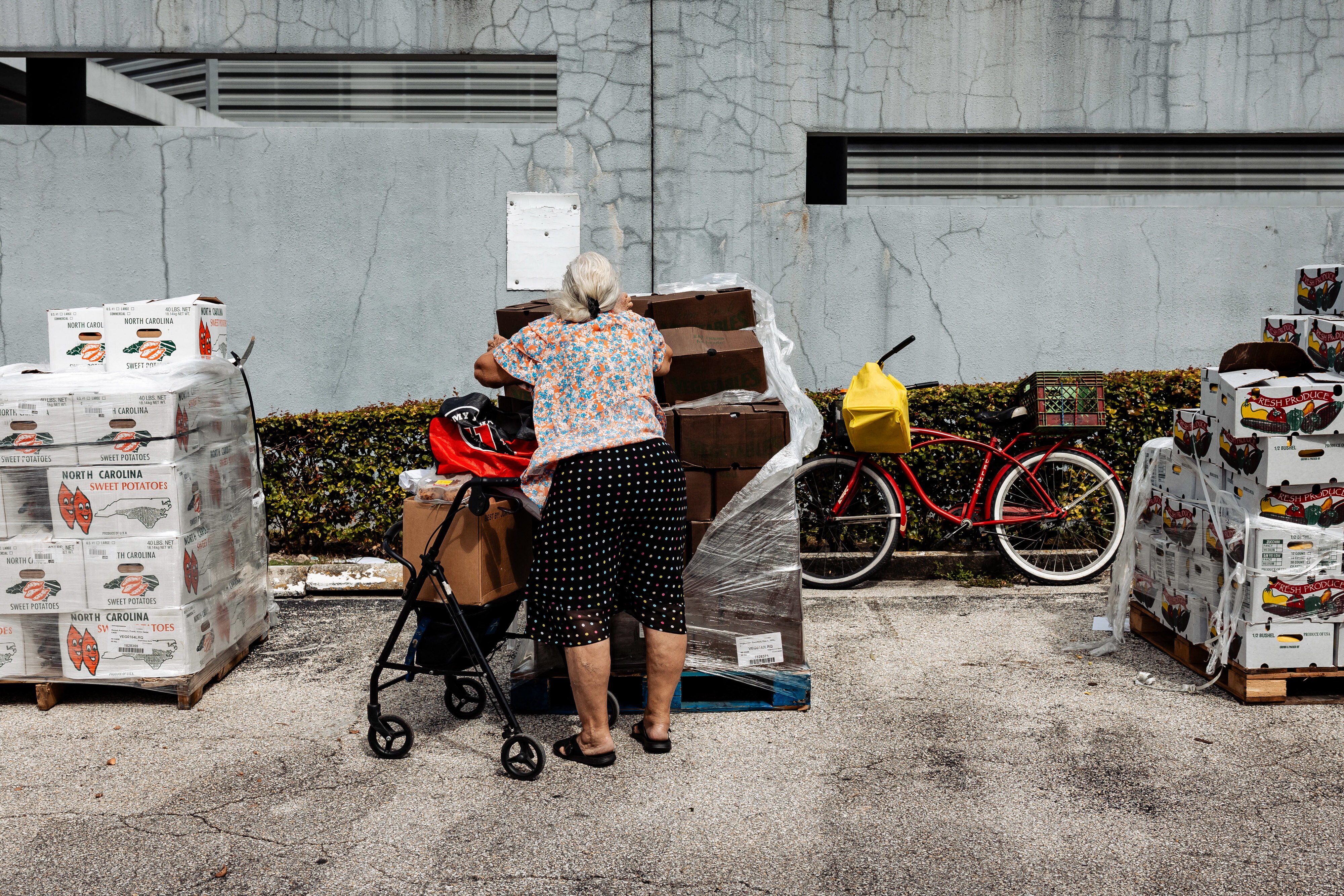
Despite lower poverty overall, the rate for seniors has been steadily rising in recent years. A new AARP survey sheds light on how those over 50 are struggling in the crucial time before retirement.
(Image credit: Eva Marie Uzcategui)

Source: NPR.

Despite lower poverty overall, the rate for seniors has been steadily rising in recent years. A new AARP survey sheds light on how those over 50 are struggling in the crucial time before retirement.
(Image credit: Eva Marie Uzcategui)
Source: NPR.
Mick Ferris was crushed when the 130kg window fell from The Corniche building in Vauxhall.
Source: BBC.
Mick Ferris was crushed when the 130kg window fell from The Corniche building in Vauxhall.
Source: BBC.
Dee Brock, the original director of the Dallas Cowboys Cheerleaders who helped mold the prototype for NFL sideline entertainment, died on Wednesday, the team said.
This post was originally published on NBC News.
Milania Giudice had a tense moment with her mother, Teresa Giudice, and her sister, Gia Giudice, at an airport … in a video she allegedly posted to her Instagram and then quickly deleted. On Wednesday afternoon, Milania shared a clip showing the…
From TMZ.
He was brash. Politically incorrect. An “outsider” political candidate who rose to the White House, out of nowhere, with a reputation as a “counter-puncher.” But Vice President Spiro Agnew was also something else… an active criminal whose secrets were about to be exposed. What happens when a “counter-puncher” in the White House suddenly sees his political future directly threatened by investigators inside his own Justice Department?
For a list of sources and references for this episode, see here.
MUSICAL JINGLE: My kind of man, Ted Agnew is! My kind of man, Ted Agnew is!
MADDOW: When Richard Nixon tapped Spiro Agnew — Ted to his friends — to be his running mate in 1968, this was the Ted Agnew the country was introduced to…
MUSICAL JINGLE: He’s your kind of man, Ted Agnew is! Taking your stand, Ted Agnew is!
Agnew was a fresh face in national politics. He wasn’t much known at all outside of Maryland where he had just been elected Governor. Heck, he wasn’t even all that well known in Maryland!
But he was an effective politician. His quick rise out of nowhere was thanks in large part to his “my kind of man” personal image. He was the son of Greek immigrants, he was an outsider. He forged a reputation as a straight shooter: hard-work, honesty, integrity.
RADIO AD — WOMAN: Well, I like him because he’s honest, he’s really honest. MAN: One thing that I can definitely say is Ted Agnew would make a perfect administrator for the state of Maryland WOMAN: Well, I think he’s going to be our next Governor. MAN: He’s my kind of man
Agnew got elected Baltimore County Executive in 1962. Four years after that, he became the Governor of Maryland. And two years after that, he found himself being tapped by Richard Nixon to be Vice President.
A virtual unknown in national politics, a man who Nixon himself barely even knew.
Here’s a reporter asking Nixon how Agnew reacted when Nixon called him to offer him the gig.
REPORTER: Mr. Nixon, was Mr. Agnew surprised when you called him? What did the Vice Presidential nominee say?
RICHARD NIXON: Oh! I think, well I think the best indication of surprise is when a lawyer has no words. Governor Agnew, as you know, is a lawyer and is a very articulate man, as you saw in his press conference. I’d say there’s about 20 seconds before he said a word!
Nixon had had a really hard time figuring out who to pick as his running mate that year. He had considered a close friend or two. He had considered one guy who ran against him in the primaries… a guy by the name of Ronald Reagan. But ultimately, Nixon had decided on Agnew. And the process had been stressful. And actually, the initial reaction to the pick was not great.
1968 HUBERT HUMPHREY “LAUGHTER” CAMPAIGN AD
This was a TV ad that was run by the Hubert Humphrey campaign during the 1968 election.
This was it. No words. Just a man laughing hysterically as the camera slowly pulled out to reveal words on the TV screen that read: “Agnew For Vice President?”
Spiro Agnew was a literal laughing-stock when the 1968 Presidential campaign got underway.
But as much as the Democrats might have wanted to keep laughing at him, Agnew soon became sort of a rock star on the right.
He was blunt. He was politically incorrect. He loved trashing liberals. And the press. And minorities. He shot down hecklers at his events with glee. He described them as “spoiled brats who never had a good spanking.”
AGNEW: Somewhere, somebody failed you. Your churches must not have gotten through to you because you don’t even know anything about the golden rule!
(hecklers booing)
AGNEW: I’m frankly ashamed of you. And I think you ought be ashamed of yourselves.
(hecklers booing)
During that campaign, Agnew stepped in it a number of times… often on the issue of race… and on ethnic stereotypes.
CHET HUNTLEY: Spiro Agnew took a day off from campaigning following a weekend of speeches in Hawaii. In one of his Monday appearances before a racially-mixed audience on the island of Maui, he replied to criticism of his having used slang labels “Polack” and “Jap” in referring to Americans of Polish and Japanese ancestry.
Agnew’s lack of filter when it came to racially-insensitive remarks, it sometimes got him in trouble with the press. But big picture, the campaign actually saw it as a plus. Rather than hurting him, that stuff actually seemed to solidify his support on the right.
Agnew the political outsider who didn’t care who he offended, that was a feature, not a bug.
AGNEW: And if you tell me that the hippies and the yippies are going to be able to do the job, I’ll tell you this: they can’t run a bus, they can’t serve in a governmental office, they can’t run a lathe in a factory, all they can do is lay down in the park and sleep or kick policemen with razor blades.
Spiro Agnew pushed the limits. He was deliberately outrageous, he defended his over-the-top rhetoric during that campaign by saying that he never hit first, he just hit back. He told reporters, “I guess by nature I’m a counter-puncher. You can’t hit my team in the groin and expect me to stand here and smile about it.”
A counter-puncher in the White House.
How exactly does a politician who is a self-styled counter-puncher react… when his own political survival is directly threatened?
When the full weight of his own Justice Department comes crashing down on him?
This is a story that is not well known. But it really should be… especially, maybe, now.
It’s the story of a criminal occupant of the White House… whose crimes are discovered by his own Justice Department…
Who then tries to hold onto power… by obstructing the investigation into his crimes, by smearing and threatening the prosecutors who are investigating him… and by trying to convince his legion of supporters across the country… that none of the allegations are true. That it’s all just a big witch-hunt.
And if that sounds familiar… it’s because history… is here to help! I firmly believe it.
I’m your host Rachel Maddow. And this is “Bag Man”: the wild and untold story of the Presidential line of succession, impeachment, indictment… and panic in the White House.
Episode 1: “An Unsettling Secret”
AGNEW: Ultra-liberalism today translates into a whimpering isolationism in foreign policy, a mulish obstructionism in domestic policy, and a pusillanimous pussyfooting on the critical issue of law and order (applause)
Spiro Agnew doesn’t exactly loom large as a political figure in U.S. history. His name barely registers as a political trivia question these days. But when Richard Nixon and Spiro Agnew won the White House in 1968…
Spiro Agnew– even though he doesn’t get the credit for it– he basically created the mold for the modern iteration of confrontational conservatism in America.
AGNEW: You know how it is with the radical liberals, you zing one of them– call his hand, cite his voting record, quote his speeches, tell America the harm he’s done– and he howls like a coyote with his tail caught in a snake hole! (eruption of applause)
Even though he was now Vice President of the United States, there had been no transformation from candidate Agnew into a less divisive public official Agnew. If anything, he got even more aggressive:
DAVID BRINKLEY: He was asked why he– more than other politicians– was accused of dividing the country. Agnew said it was because he was the foremost destroyer of liberal dogma, and that when liberals are attacked, they salivate like Pavlovian dogs.
Spiro Agnew was a flamethrower. He loved offending the press. His whole political brand was about offending liberals and Democrats and minorities. The more political norms he blew through, the stronger he got with the Republican Party’s hardline base and that was the only base and the only audience he ever tried to cultivate. Democrats were mystified. Republicans loved it.
After one comment in which Agnew publicly denigrated black leaders across the country… one of the most prominent African-American members of Congress– William Clay of Missouri– took to the floor of the House to deliver a condemnation of Agnew that was… almost Not-Safe-For-Work.
He said about the Vice President: “[He] is seriously ill. He has all the symptoms of an intellectual misfit. His recent tirade against black leadership is just part of a game played by him called mental masturbation. Apparently, Mr. Agnew is an intellectual sadist who experiences intellectual orgasms by attacking, humiliating, and kicking the oppressed.”
Imagine if there had been C-SPAN back then for that!
But the group that Agnew seemed to reserve the most venom for… his favorite target of all… was the press.
AGNEW: The purpose of my remarks tonight is to focus your attention on this little group of men who not only enjoy a right of instant rebuttal to every Presidential address, but, more importantly, wield a free hand in selecting, presenting, and interpreting the great issues in our nation.
During the first term of the Nixon Administration, Vice President Agnew took it upon himself to try to discredit the American news media. And all presidents — presumably most vice presidents, too — they all undoubtedly hate the press, they all think they’re covered in a way that isn’t fair. But Agnew set out on an overt campaign to try to turn the country against the press in a way that nobody had really done before from the White House.
In a series of speeches in 1969, with the seal of the Vice Presidency underneath him, Agnew delivered prepared attacks on the news networks, which he portrayed as a danger to the nation, as biased and untrustworthy:
AGNEW: A raised eyebrow, an inflection of the voice, a caustic remark dropped in the middle of a broadcast can raise doubts in a million minds about the veracity of a public official or the wisdom of a government policy … when a single commentator or producer, night after night, determines for millions of people how much of each side of a great issue they are going to see and hear, should he not first disclose his personal views on the issue as well? (applause)
Agnew’s assault on the press was sort of a shock to the system at the time. The President of NBC News took the rare step of appearing on NBC’s nightly newscast to push back:
JULIAN GOODMAN (NBC NEWS PRESIDENT): Evidently, he would prefer a different kind of television reporting, one that would be subservient to whatever political group happens to be in authority at the time. Those who might feel momentary agreement with his remarks should think carefully about whether that kind of television news is what they want.
The Vice President seemed to be stirring up something dangerous in the country.
The Washington Post wrote in December 1969: “One little noted and wholly unintentional result of Vice President Agnew’s speeches against the press and television is a renewed wave of public expression of anti-Semitism. It was noticeable at once in this city where local television stations were swamped for three days after Agnew’s first speech with obscene phone calls protesting ‘Jew-Commies on the air.’”
One Jewish newspaper editor in Louisville, Kentucky reported at the time that he was, “buried under an avalanche of sick [anti-Semitic] mail.”
A leading Jewish organization said Anti-Semitic groups across the country were: “using Agnew’s speeches to justify their hate campaigns and urging their followers to support him.”
And it’s not that Spiro Agnew himself ever directly espoused any of those beliefs, but something about his rhetoric seemed to give his supporters license to express these views that they hadn’t felt free to express before.
His attacks on “enemies” of the administration became so heated that Democrats– and even some Republicans– started to warn that if he didn’t tone down his rhetoric, somebody was going to get hurt.
Here’s Arkansas Democratic Senator William Fulbright:
SEN. WILLIAM FULBRIGHT (D-AR): He intimidates people, I don’t think there’s any doubt about him intimidating, he inspires other people to radical actions. I think these outbursts of threats through letters and telephone messages and so on is an outgrowth of this kind of a spirit.
That was Spiro Agnew the political figure.
He was a lightning rod. He was a demagogue. He had a devoted base inside the Republican Party that he seemed to be able to control in ways that other politicians couldn’t… in ways that seemed even dangerous at times.
And he was about to bring all of that to bear on members of his own Justice Department, who had just discovered that Agnew– in addition to all of that other stuff– also happened to be… an active criminal. Stay right there.
**************
DAVID BRINKLEY: Richard Nixon chose Governor Spiro Agnew of Maryland for his Vice President Until two years ago, he was unknown outside Maryland County politics.
When Richard Nixon tapped Spiro Agnew to become his Vice President, Agnew was on a very fast rise in Republican politics.
When Nixon picked him to be VP, Agnew had been Governor of Maryland for just a couple of years. Before that, he was a local elected official, he was Baltimore County Executive.
So, Agnew emerged onto the national scene basically out of nowhere. But his rise in Maryland… in famously corrupt Maryland… that came with some secrets that would slowly start to be revealed right at the height of the Watergate scandal.
GARRICK UTLEY: Good morning. The place: the Senate caucus room in Washington, this is Day 4 of the Senate Watergate hearings…
That Spring of 1973, as the country was in the grips of Watergate fever, a team of young, federal prosecutors based in Maryland had just launched a brand new investigation that had nothing at all to do with Watergate:
TIM BAKER (FMR. FEDERAL PROSECUTOR): It was based solely on, um, it was just kind of rumors.
That’s Tim Baker. He is one of the people at the heart of this story.
He was an Assistant U.S. Attorney in Maryland in 1973. And the rumors that he’s talking about there were basically whispers that Maryland politics at the time had a real bribery-and-corruption problem.
And that Spring, Tim Baker along with two of his fellow prosecutors, they decided they were going to dig into those rumors. Ron Liebman was another prosecutor on that team:
RON LIEBMAN (FMR. FEDERAL PROSECUTOR): In essence it was: follow the money, get the documents, follow the money.
If the Watergate era had a theme song, this was it, right? The FBI and Congressional investigators and intrepid reporters from The Washington Post, they were all busy “following the money”…
GARRICK UTLEY: And that brings us to the third major element in the Watergate story: money. Cash. Cash given to the President’s re-election committee secretly and, in some cases, illegally.
Following the money led to almost all of the most interesting stuff in the Watergate scandal, but in their unrelated, contemporaneous investigation in Baltimore, these young federal prosecutors from the U.S. Attorney’s office in Maryland… they, too, were following the money.
BARNEY SKOLNIK (FMR FEDERAL PROSECUTOR): Investigate! Which is like, you know, it’s like throwing catnip. I mean, you know, “Oh, okay, fine! You know, we’ll investigate!”
That’s Barney Skolnik, he was the senior prosecutor on this three-man team.
There are some people in this story you will come to know and love. Top of that list is these three young, scrappy federal prosecutors, they’re all around 30 years old at the time, they’re trying to take a bite out of political corruption in their state.
What Barney Skolnik and Tim Baker and Ron Liebman all started to find when they started following the money in Maryland… was a scheme. A bribery scheme where local elected officials took thousands of dollars in cash kickbacks from companies that got public contracts.
It was exactly the way that you imagine it: businessmen putting cash into plain envelopes… handing those envelopes full of cash to elected officials… and then walking away with a job to design that local bridge or that county building.
These three young prosecutors started lifting this rock in Maryland and what they found underneath it was an underworld of long-standing, local corruption. Basically small-time officials who were on-the-take.
That’s what this case looked like to them in early 1973.
Watergate may have been gripping the nation. President Richard Nixon looked like he might end up in deep trouble. But these guys had this local investigation going that was world’s away from all of that.
Until suddenly… it wasn’t.
AGNEW: I, Spiro Theodore Agnew solemnly swear…
Because that Spring, Richard Nixon’s Vice President Spiro Agnew– who came from this swamp of Maryland politics– he started hearing rumors of his own about this team of investigators who were now poking around in his old neck of the woods. And upon hearing that, Spiro Agnew did something that was sort of suspicious.
He went to go see the Attorney General of the United States himself. To ask the Attorney General about this local investigation that was underway in Maryland. At the time, the Attorney General didn’t even know about that investigation yet!
But that little visit from the Vice President, that sent alarm bells ringing with these three prosecutors in Baltimore. Because at that point– as far as they knew– their investigation had nothing at all to do with the sitting Vice President! Here’s Tim Baker and Ron Liebman.
BAKER: I immediately thought to myself, “Why is he so upset? He’s upset because he’s got something to hide.”
So I say in this meeting, “We’re going to get Agnew”
LIEBMAN: I remember Tim Baker telling me and Barney, in so many words, that he smelled a rat. It was way beyond our horizon. But Tim– to his eternal credit– smelled it first. He saw something
Their sleepy little investigation in Maryland… was about to change the country.
What these young prosecutors were about to discover was that the country didn’t just have a criminal President in power, but a criminal Vice President as well who, of course, was next in the line of succession.
BAKER: We have evidence that Vice President Agnew took bribes as County Executive, Governor and even as Vice President.
LIEBMAN: Not only is it Watergate, but he’s the Vice President and we have hard evidence of corruption.
BAKER: Fifteen $100 bills he gave Agnew in the basement of the White House. This was IN the White House!
SKOLNIK: It really was “We’re all in this together and we gotta figure out what to do for the country because this is, this is some heavy shit.”
This isn’t just the story of a political corruption scheme that got exposed… it is that.
But it’s also a story of how exactly a criminal occupant of the White House reacts and lashes out when his own Justice Department starts to zero in on him for his criminal behavior.
VICE PRESIDENT AGNEW: Because of these tactics which have been employed against me … I will not resign if indicted! I will not resign if indicted!
Spiro Agnew rose to national prominence as a lightning rod, as a flamethrower, as someone who wasn’t afraid to smear his opponents and roll around in the mud. He was quite willing to be dangerous to the country if it suited his own purposes.
And ultimately, he employed all of that for this fight.
To fight back against an investigation and a small team of investigators who were not-only threatening to remove him from the White House, they were threatening to throw him in jail:
MARTIN LONDON (VICE PRESIDENT AGNEW’S DEFENSE ATTORNEY): And that’s really, to use a legal expression, that’s when the shit hit the fan.
That’s Marty London, he was Spiro Agnew’s defense lawyer – we will spend a little more time with him later in this story – you’re gonna love him.
This scandal has somehow gotten itself forgotten. It barely registers, but it’s wild: a sitting White House occupant, under criminal investigation from his own government, pulling out every stop to survive, including obstructing that investigation and trying very hard to shut it down.
SKOLNIK: I mean, it was, it was, you know, that’s why I get sort of emotional about it.
BAKER: The pressure– and it was big pressure– the pressure was: get the guy out of the line of succession.
LIEBMAN: We were determined. You know, we’re kids, but we were determined to follow this case through.
Part of the reason we wanted to make this podcast now is because this is a story that I think is worth hearing for the first time… particularly right now!
But it’s also because now there’s new stuff to know about it.
The prosecutors themselves haven’t even been aware of the full story all these years. They’re going to hear it all… right here for the first time:
BAKER: Good night! No, I didn’t know this!
SKOLNIK: Oh my Lord!
LIEBMAN: 45 years later, and my blood still boils when I read stuff like that.
For the last several months, ace producer Mike Yarvitz and I have been digging back into this story, going through the archives, and interviewing the people who were involved in it.
What we learned, is that when law enforcement gets on a collision course with the White House… specifically with a criminal in the White House who is a self-styled counter-puncher… who seems to be able to command-at-will an entire base of supporters across the country… when that kind of collision happens, what we learned is that things get pretty thoroughly insane pretty quickly.
I’m Rachel Maddow, and that’s all ahead… on “Bag Man.”
“Bag Man” is a production of MSNBC and NBC Universal. This series is executive produced by Mike Yarvitz. It was written by myself and Mike Yarvitz. Editorial and production support from Jonathan Hirsch and Marissa Schneiderman from Neon Hum Media. And you can find much more about this story on our website, which is: msnbc.com/bagman
The post Transcript – Episode 1: An Unsettling Secret appeared first on MS NOW.
From MS Now.
These are the source references for Episode 2 of Rachel Maddow’s Bag Man podcast, which you can listen to here, or through your preferred podcasting service.
Books:
Witcover, Jules. “Very Strange Bedfellows: The Short and Unhappy Marriage of Richard Nixon and Spiro Agnew”, PublicAffairs, 2008
Cohen, Richard and Witcover, Jules. “A Heartbeat Away”, Viking Press, 1974
Agnew, Spiro T. “Go Quietly … Or Else”, William Morrow, 1980
London, Martin. “The Client Decides: A Litigator’s Life: Jackie Onassis, Vice President Spiro Agnew, Donald Trump, Roy Cohn, and More”, Eastlake Press, 2017
Coffey, Justin. “Spiro Agnew and The Rise of the Republican Right”, Praeger, 2015
Ehrlichman, John. “Witness to Power: The Nixon Years”, Simon & Schuster Publishing, 1982
Richardson, Elliot. “The Creative Balance: Government, Politics, and The Individual in America’s Third Century.” Holt, Rinehart and Winston. 1976
Articles:
“Agnew Successor In Baltimore Job Indicted In Bribes”, The New York Times (August 24, 1973)
“Texts of Charge Against Vice President and of Grand Jury Criminal Information”, The New York Times (October 11, 1973)
“G.S.A. Says Agnew Office Made Overtures on Pacts”, The New York Times (October 11, 1973)
“Head of the G.S.A. Says Agnew’s Office Recommended Companies For Contracts”, The New York Times, October 11, 1973 (Courtesy of The Weisberg Collection. Hood College. Frederick, MD, USA)
“Nixon Takes Blame As 4 Aides Quit Over Watergate Bugging”, The Atlanta Constitution Newspaper (May 1, 1973)
“Federal Grand Jury Indicts 7 Nixon Aides on Charges of Conspiracy on Watergate; Haldeman Ehrlichman, Mitchell On List”, The New York Times (March 2, 1974)
“Closing In on Agnew: The Prosecutors’ Story” by Aaron Latham. “New York Magazine” (November 26, 1973)
Archival Material:
NBC News Special Report/1973 Presidential Inauguration (January 20, 1973)
NBC Nightly News (August 23, 1973)
NBC News Archives (April 30, 1973)
NBC Nightly News (May 7, 1973)
Spiro T. Agnew 1966 Gubernatorial campaign radio ads (courtesy of the Richard Nixon Presidential Library)
H.R. Haldeman Audio Diaries, March 31, 1970 (Courtesy: Richard Nixon Presidential Library)
NBC Nightly News (June 14, 1973)
NBC News Special Report, Vice President Agnew Speech in Los Angeles (September 29, 1973)
NBC Nightly News (September 19, 1973)
The post Bag Man Episode 2 Sources appeared first on MS NOW.
From MS Now.
From The Hill
Australian Prime Minister Anthony Albanese on Thursday said he spoke with OpenAI CEO Sam Altman about an agent at the company breaching the commonwealth’s health department website in June. Albanese told reporters in New York City, on the sidelines of the United Nations General Assembly, that the agent gained access to the Medicare Statistics Reporting…
Sen. John Curtis of Utah went out on a lonely limb last week when he became the first and only Republican member of Congress to take an interest in the controversy surrounding the Russian oligarch who paid for Donald Trump Jr.’s wedding party. “It’s corruption,” Curtis said in a video posted to social media on Friday, adding: “This is a big deal.”
Earlier this week, the Utahn followed through, sending a letter to the leaders of the Senate Judiciary Committee, calling for an investigation and recommending a subpoena for the president’s oldest son.
“A toaster is a wedding gift,” Curtis added in an online statement. “A private-island party paid for by a Putin-connected oligarch is something else. Republicans nearly wore out the subpoena machine investigating Hunter Biden’s foreign relationships. We should not unplug it now. ‘Trust us’ was not enough then, and it is not enough now.”
To my great surprise, the senator actually picked up some support from within his own party in the days that followed. HuffPost reported:
Sen. Thom Tillis (R-N.C.), who is retiring, described Donald Trump Jr.’s acceptance of [gifts from Umar Kremlev, a Russian oligarch close to Vladimir Putin] as “colossally bad judgment at best,” per The Associated Press. In a separate interview with The Hill, he added: “If the House flips next year, you know there’s going to be an investigation one way or the other.”
Echoing those sentiments was Sen. John Cornyn (R-Texas), who told The Hill: “I’m with Sen. Curtis. I would support Sen. Curtis’s request.”
What’s more, Sen. Lisa Murkowski of Alaska told the AP, in reference to Curtis, “I’m glad he said what he said.” Earlier this week, Republican Sen. Bill Cassidy of Louisiana also conceded during an appearance on CBS’ “Face the Nation” that the circumstances surrounding the wedding controversy looked “really bad.”
I’m not suggesting that five GOP senators taking the matter seriously represents a dramatic shift in Republican politics, but after years of partisan indifference to Trump-related scandals, it’s heartening to see any GOP senators care.
For his part, House Majority Whip Tom Emmer scrambled to carry the White House’s water again, publishing an item via social media chiding “some senators” for wanting to “waste time creating a new Russia hoax and attacking Don Jr.”
The Minnesota congressman added that the president’s son “is a private citizen … so this unwarranted attack will go nowhere.”
There are a handful of important problems with Emmer’s pitiful defense. For one thing, the original Trump/Russia scandal was not a “hoax,” no matter how many times Republicans pretend otherwise. For another, private citizens receive congressional subpoenas all the time — as Emmer ought to know, given his celebration of subpoenas for Hunter Biden in the recent past.
But perhaps most important is the fact that the underlying allegations are hardly an “unwarranted attack.”
ProPublica reported last week that Kremlev had “secretly bankrolled” part of Trump Jr.’s recent wedding, footing the bill for “hundreds of thousands of dollars of wedding expenses” and even helping to plan the gathering.
“It’s not clear why Kremlev helped pay for Trump Jr.’s wedding,” ProPublica added. “The men appear to have met only recently.”
It was a tough story to shrug off for reasons that should have been obvious: A Putin-aligned Russian oligarch paid for the wedding party of the sitting American president’s oldest son, and it was an open question as to why that happened and what the Russian might want or expect in return.
If partisans such as Emmer want to present an argument as to why this is unworthy of scrutiny, I’d love to hear it. But so far, GOP leaders haven’t even tried to present such a case.
As for the groom’s father, President Donald Trump addressed the story for the first time on Friday, insisting that the arrangement was “totally allowed.”
As part of the same exchange, Trump said of his oldest son, “As I understand it, he paid him back.” He then hedged a bit on the timing, adding: “I understand that Don’s paying them back.”
There are not yet any details as to whether that has happened, whether it will happen, how much Trump Jr. intends to repay the Russian oligarch or why he would even bother if all of this was “totally allowed.”
This post updates our related earlier coverage.
The post GOP support grows for subpoenaing Donald Trump Jr. over wedding party controversy appeared first on MS NOW.
From MS Now.
Dr. Heidi Overton is appearing before a Senate committee on Thursday for her confirmation hearing as the next commissioner of the Food and Drug Administration.
Source: ABC News
Former “Teen Mom” star Mackenzie Edwards has been granted temporary custody of her two kids, whom she shares with ex-husband Ryan Edwards … and a judge ruled that he can only see them at his parents’ house after she claimed he relapsed on drugs.…
From TMZ.
In “Delirium” and “The Cherry Orchard,” experimental directors smash up and rebuild classic plays.
From The New Yorker