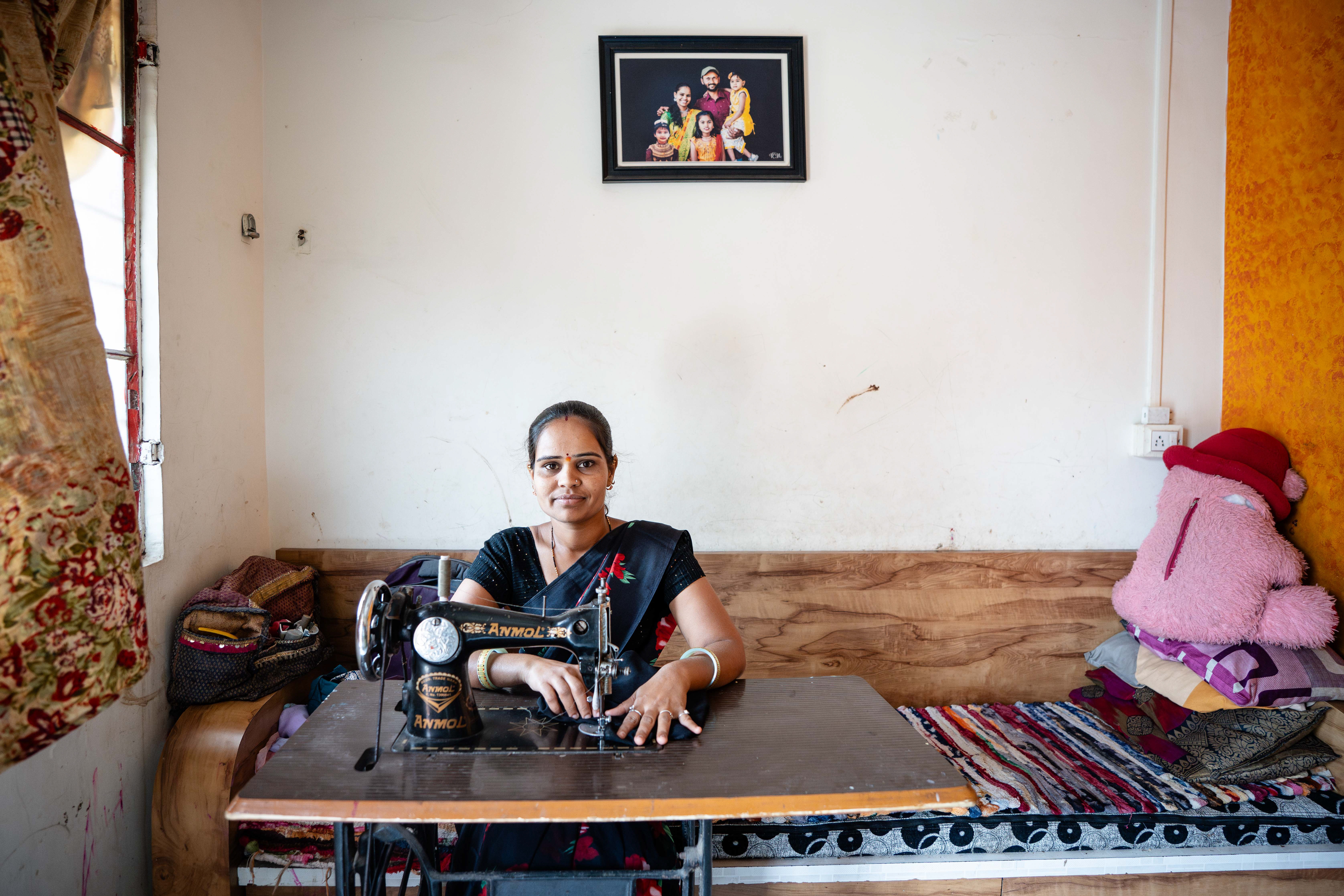
It’s a bold new experiment and it’s already won a prize. Residents in a jam-packed slum, many of them living in one-room tin shacks, help design their apartments in a brand new building.
(Image credit: Viraj Nayar for NPR)

Source: NPR.

It’s a bold new experiment and it’s already won a prize. Residents in a jam-packed slum, many of them living in one-room tin shacks, help design their apartments in a brand new building.
(Image credit: Viraj Nayar for NPR)
Source: NPR.
Amazon is quietly slashing prices on New Balance sneakers, with deals up to 61% off for men, women and kids. Shop the best discounts before they sell out.
This post was originally published on NBC News.
This post was originally published on Politico.
Democrats vying for a pair of deep-red Senate seats are facing increasingly desperate calls from within their party to step aside for more promising independent candidates.
But they say they won’t drop out — unless there’s divine intervention.
Democrats Alani Bankhead of Montana and Julian Beaudion of South Dakota both told POLITICO they have no plans to exit the race, despite pressure from national — and even some state — Democrats to step aside. Numerouspolls, coupled with strongerfundraising and campaign operations, show independents Seth Bodnar and Brian Bengs have a stronger — if still muddied — path to victory in
The FDA is poised to render a decision on Moderna’s mRNA-based flu shot, which could be the first of its kind to market. The decision is expected to reverberate throughout the biotech industry.
(Image credit: Maddie Meyer)

Source: NPR.

The International Criminal Court is in the trenches right now.
Last week, its chief prosecutor, Karim Khan, was voted out of his position. In a first-of-its-kind vote, 82 member states decided that he engaged in misconduct and a serious breach of duty. The vote comes after he was accused of sexual misconduct by a female colleague at the ICC, which Khan has denied.
It’s a mess, and it’s hitting the ICC at an inopportune time. On top of this internal turmoil, US Secretary of State Marco Rubio recently launched an all-out attack on the court.
In a Wall Street Journal op-ed earlier this month, Rubio wrote that the Trump administration’s goal is to “dismantle the ICC—brick by brick, if necessary,” citing the possibility that the court could “target” American citizens, such as Border Patrol agents or US soldiers.
The US is not a member of the ICC, and has a history of wariness about the organization.
Beth Van Schaack previously served as the US ambassador-at-large for global criminal justice, a role that led her to work directly with the International Criminal Court. She spoke with Today, Explained co-host Noel King about the decades-long tumultuous relationship between the US and the ICC. And they discuss whether, if the ICC is now weaker than ever, the Trump administration can actually break it for good.
Below is an excerpt of their conversation, edited for length and clarity. There’s much more in the full podcast, so listen to Today, Explained wherever you get podcasts, including Apple Podcasts, Pandora, and Spotify.
If the International Criminal Court is charged with dealing with people who have allegedly done very bad things and then trying them, why is the United States not a member?
The United States signed the treaty in the waning days of the Clinton administration, but never submitted it for ratification to the Senate. And one of the concerns is that the final treaty allows for jurisdiction over individuals who may commit crimes on the territory of state parties. And the United States has always been concerned about that principle because we have troop commitments.
Supporters of the court have always said the United States and its personnel are vulnerable regardless of whether you join. If US personnel are committing crimes on the territory of state parties, which we saw in Afghanistan, the response is to do those cases domestically and there’ll be no occasion for the International Criminal Court to consider those matters.
There’ve been peaks and valleys in the relationship between the ICC and the United States. So we’re in a frankly pretty deep valley right now with this new campaign that Secretary Rubio announced.
But back in the Bush administration, there was also very acute concern and it stemmed from this Afghanistan investigation. The Bush administration and Congress both put in place measures that they thought would be protective of US servicemembers. So that was one valley.
Now what’s interesting is in the second term of the Bush administration, many of these measures were dismantled because the Bush administration realized that the court was doing important work in some areas where it also cared about justice — in particular, Darfur.
Then, the Obama administration announced a reset in its relationship with the court, and that’s where I entered the picture. The Obama administration directed various executive agencies to look for ways to support the court where the work that it was doing was consistent with US policy.
Then, we had the first Trump administration, which reversed course almost immediately and eventually imposed sanctions on senior figures, including the prosecutor herself and one of her key aides.
Then, we get to the Biden-Harris administration. They pulled down those sanctions and again launched a reset of the relationship. At that point, there were a number of situations where the court was working, including following the brutal war of aggression by Russia against Ukraine.
Here we saw a remarkable rise of bipartisan support for the work of the court. You had senior Republican figures in Congress supporting the court. The late Sen. Lindsey Graham (R-SC) led a resolution that was supporting justice in Ukraine. Secretary Rubio, then Sen. Rubio, joined that resolution. There was new legislation passed that made it easier for the United States to support the work of the court.
Of course, with the second Trump administration, we have reversed course again, and in particular with Rubio’s announcement.
Well, let’s talk about the reversal. Secretary of State Marco Rubio is at one point on board with the ICC, and then recently he vows to dismantle it. What happened here?
It’s not clear what the precipitating event is, to be honest. There is no existential threat at present. Obviously, there’s always the concern that this is some kind of a distraction because matters are not going well in Iran and with respect to the economy — that this is something to pull eyeballs away from those matters onto something that he can look tough in. Is this just kind of red meat for anti-multilateralism or is there something that is not made public that is happening?
Is there anything actually that Marco Rubio or anyone else in the United States at the highest level could do to the International Criminal Court to put an end to it?
The International Criminal Court is part of a larger system of the rules-based order that we’ve been trying to build since World War II. Almost all of our friends and allies are members of this court and they care deeply about its success. They are committed to seeing a system of international criminal justice. So, no is the answer. The United States alone cannot dismantle this court.
Now, it can injure the court and it has already done so. There are already eight ICC judges, including judges who hail from some of our closest allies — France, for example — who have been subjected to brutal sanctions. They can’t use credit cards that pass through New York. They can’t make reservations online because of financial sanctions. They can’t travel to the United States because of travel bans, et cetera. The chief prosecutor and two of his two deputies have been sanctioned. Non-governmental organizations that are involved in human rights in Palestine have been sanctioned and a UN figure has been sanctioned. Those measures are already in place.
What his most recent campaign seems to announce is some diplomatic move to try and convince states to leave the court or to cease their cooperation with the court. And we have seen in recent days a couple of states announcing that they were withdrawing. These are mostly states within Africa, but also Venezuela, subject to investigation by the prosecutor’s office. The United States can certainly injure the court, but there’s no way that we could dismantle the court.
Most Americans don’t spend a lot of time thinking about the International Criminal Court, but they may know it because lately, it has gotten a lot of attention that the court has issued an arrest warrant for [Israeli Prime Minister] Benjamin Netanyahu. New York City Mayor Zohran Mamdani has said he would like to see Netanyahu arrested if he comes to New York.
Mamdani has said he does not have that power. He cannot order the NYPD to do it, but he would like for it to happen. What are the chances that Benjamin Netanyahu comes to the United States and is arrested?
Pretty close to zero, if not actually zero. This is a matter of federal law and international law. And the Headquarters Agreement between the United States and the United Nations, which placed the headquarters of the UN in New York, basically gives certain privileges and immunities to individuals who are coming to New York to attend official functions.
New Yorkers are a feisty bunch. So when word is out that Benjamin Netanyahu is in New York, can you imagine the protests that would happen? Can you imagine the embarrassment that he might experience when he’s supposed to be giving his remarks at the General Assembly High-level Week where all the heads of states convene to deal with transnational issues and his motorcade is ensnarled in protests protected by the First Amendment, calling for his arrest for various international crimes? If I were his lawyer, I would say, “There’s no chance you’re going to get arrested.” But honestly, it could be a miserable visit, given all of the strong support for accountability in this matter in the United States.
This is a lot of drama for a body that for a long time seems to have avoided a ton of very public drama. So who gets hurt in all of this? Is it the court? Is it the US and its reputation? Where do you think this leads?
Unfortunately, I think everyone comes out not looking great here. The court needs to put in place measures to be able to receive those complaints by witnesses, whistleblowers, victims themselves, process them quickly, but also fairly to all parties involved. The United States looks terrible as well, launching a campaign like this against an international organization whose mandate it is to deliver justice for the worst crimes known to humankind.
Source: Vox.
Source: CBS News.
French wine region under fire threat, latest on migrants entering Spanish territory, plus all about sake.
The 62-year-old was arrested at a petrol station and is due in court in September, police say.
Source: BBC.
The 62-year-old was arrested at a petrol station and is due in court in September, police say.
Source: BBC.
Italy has temporarily suspended the Schengen arrangement with Spain as Prime Minister Giorgia Meloni called scenes in Ceuta “shocking”.
Source: BBC.

Residents of the ancient town of Nabatiyeh in southern Lebanon have endured wars in the past, but the latest conflict with Israel is testing the limits of their endurance.
(Image credit: Diego Ibarra Sánchez for NPR)

Source: NPR.
10 years of the hottest trends, spotted outside the shows of Copenhagen Fashion Week
Source: Vogue

One of the most powerful forces in American politics is about to face a major test of its influence — and it may well come up short.
The American Israel Public Affairs Committee, or AIPAC, has for decades spent heavily to ensure that US policy remains strongly supportive of the Israeli government. The group has spent hundreds of millions of dollars on lobbying and elections to stock Congress with allies and keep them supportive of Israel’s policy priorities once they’re there. It also tries to defeat elected officials and candidates who, in its view, are too supportive of the Palestinian cause or too critical of Israel’s Gaza war.
Next week’s Democratic Senate primary in Michigan is AIPAC’s biggest-ever investment in a single election: The group has spent more than $30 million to defeat staunch Israel critic Abdul El-Sayed and to try to ensure Rep. Haley Stevens wins the Democratic nomination instead.
In the past, AIPAC has very often gotten its way. But this time may be different. El-Sayed has been explicitly running against AIPAC, arguing that the group’s heavy investment in the race discredits his opponent — and trying to capitalize on the Democratic base’s sharp turn against Israel due to the devastation of the Gaza war. And if polling is any indication, it seems to be working. Several recent surveys show El-Sayed with a double-digit lead.
If he wins, it would arguably be AIPAC’s worst-ever defeat. It could also mean we’re in a new chapter of politics, where the group’s heavy spending is less and less effective — and even potentially toxic to voters in the Democratic base.
What has changed, and how could these changes reshape politics?
To understand the influence of AIPAC — what it’s like to go up against the group, and also how its power may be ebbing — we spoke to a Michigan politician who ended up on their bad side, crossing the group on the Israel issue and then losing his seat. (In fact, he lost it to the very candidate AIPAC is boosting in next week’s Senate contest: Haley Stevens.)
Andy Levin was a two-term congressional incumbent and scion of a Michigan Jewish political dynasty — he succeeded his father, Sander Levin, who had served in the House for decades. Andy’s uncle, Carl Levin, had served in the Senate for decades as well; both held high-profile committee chairships.
But once in Congress, Andy Levin staked out positions on Israel that spurred furious pushback from AIPAC. A former president of the group declared he was “arguably the most corrosive member of Congress to the US-Israel relationship.
And when, after redistricting, he and his colleague Rep. Stevens ended up running against each other in the same primary, AIPAC spent more than $4 million to boost her chances, successfully knocking Levin out of Congress.
Levin is an enthusiastic supporter of El-Sayed, and was in the car on his way to canvas for him when we spoke Thursday. Our conversation, which has been condensed and edited, follows.

Tell me about your history and how you’ve thought about the Israeli-Palestinian issue over the years.
I guess the thing to understand is, I’m Jewish, right? You know what a mezuzah is? I had mezuzot on all my doors in Congress. I was the president of my synagogue until I won my primary, and then I felt I had to resign and turn that over.
I am a long, long, longtime human rights activist. My human rights grounding comes from my values as a Jew. Everyone’s created the image of God, you know, and all this. “Justice, justice shall you pursue.” Not a lot of words are repeated twice in the Torah.
So I was active on Tibetan human rights and Haitian human rights. I was in China during the Tiananmen massacre. I interviewed the Dalai Lama. In 1990, as a graduate student, I went to Israel and Palestine. We traveled all over Israel, and we could go in Gaza, there was no Hamas yet. We met the political leaders there and talked to everybody in the West Bank.
And I came home, and I wrote an article in the Detroit Jewish News that said, “Oh my God, 23 years of occupation, this is enough. It’s totally toxic. It’s bad for our soul as the Jewish people, and there’s no solution to the Israeli-Palestinian conflict without fully realizing the political and human rights of the Palestinians.”
My positions never really changed. But after a quarter century of Bibi [Netanyahu] being the Israeli government — he’s always been against the two-state solution, no question, but he pussyfooted around; he played a lot of games about it. But his government’s gotten more and more right-wing. And in this century, no president of either party has done anything significant to force the Israelis and the Palestinians into each other’s arms, or just to, like, really negotiate.
So you get elected to Congress in 2018. How did you earn the enmity of AIPAC?
I get to Congress. I get on the Foreign Affairs Committee. And the Gaza war before this one happens [in 2021]. It was like a pimple compared to this, but it was terrible.
In the House, there were eight more senior Democrats who worked on Israel and Palestine together. I was, like, the kid; they let me tag along. We were all J Street-aligned [J Street is a more progressive Israel advocacy group].
There were these meetings, and everyone was like, we have to do reconstruction of Gaza, we have to do aid. And I’m like, okay, I’m for all that. But this is just an endless cycle of violence. I want to focus on ending the cycle of violence and actually achieving peace.
So I wrote the Two-State Solution Act. And, dude, it was quite a milquetoast piece of legislation, if I may say so. It was not adequate in any way. But the preamble said, “whereas” — you know, all the “whereas”-es [rhetorical throat-clearing at the beginning of legislation], which aren’t an effective part of it — it said, whereas Gaza and the West Bank and East Jerusalem, under international law and United Nations resolutions, these are occupied territory.
The Democratic Majority for Israel pollster, Mark Mellman, attacked me, saying, Andy Levin says we shouldn’t be able to pray on the Western Wall. Because of that preamble, which said East Jerusalem was occupied territory arguably — it’s ridiculous.
But with the Two-State Solution Act — this is the stranglehold that AIPAC had. Some people are sort of more intellectually serious in Congress, and some are less. Some are more like, they study things themselves, but some are more staff-driven.
Some of the more serious people came up to me and said they read the Two-State Solution Act, and they said really nice things about it. And then they said, “But of course I can’t co-sponsor it, you understand.” One colleague came and co-sponsored, but because AIPAC said “dude, no,” he withdrew.

So then, in the 2022 cycle, there was redistricting, and you and your colleague Haley Stevens ended up running in the same district, and that’s when AIPAC tries to defeat you.
After the Census, Michigan went from 14 to 13 seats. Haley and I were mushed in together now. You could have argued that either of us should’ve run in the new, current, 10th district. Haley lived in the 10th district; she was more moderate, and that’s a more Republican or mixed district. I never represented any of that.
My case was, I lived in the center of the new 11th district; I still live there. My kids are the fifth generation of my family to live in the new 11th district. The whole Jewish community is almost all in the new 11th district, overwhelmingly.
But the former national president of AIPAC wrote this fundraising appeal for Haley and said, Andy Levin is the most corrosive member of Congress for the US-Israel relationship.
So the level of threat they saw in me — if you get a Rashida [Tlaib] or even if you get an Abdul [El-Sayed], they’ll fight against them. But I’m the Jewish guy, right? I’m the son of Sander Levin, the nephew of Carl Levin.
They were these two Jewish kids from Detroit, grandsons of immigrants, who rose to be, at the same time, the chair of the [House] Ways and Means Committee — my dad — and the chair of the [Senate] Armed Services Committee. So this is super threatening to AIPAC, right? So they targeted me.
So I got trounced by Haley. And I wondered afterward; I told Celinda [pollster Celinda Lake], I should have run in the new 10th district because this intramural fight was so horrible, so unpleasant. She said, I admit it would’ve been better — but I don’t admit you would’ve won in the 10th. Because AIPAC would have backed [Republican nominee] John James, and they would have spent any amount of money to beat you.

You lost your race, but it certainly seems like, four years on, your views are winning inside the Democratic Party. The party base increasingly seems to be siding with you and against AIPAC now. Take me through what changed since then.
Horrifying things caused the change. Genocide caused the change. Seventy thousand-plus Palestinians killed in Gaza caused the change. Most houses of worship, university buildings, hospitals, residential buildings being destroyed, and the US either providing the weapons for or even paying for a lot of this.
These huge bombs, which US military leadership said, we don’t use those in populated areas — we’re providing them to Israel, and not only was Israel using them like on apartment blocks, they were using them on places they told people to flee. Any parent seeing all these maimed and killed children — and, what’s happening on the West Bank is horrifying, right? That’s part of it.
But the other part is, it gets mixed in with the larger, horrifying phenomenon of dark money, and corporate money, and special interest money in our politics.
I mean, the idea that AIPAC is using mostly dollars from Republican centimillionaires and billionaires to be the biggest spender in Democratic primaries — that’s so gross, and it’s a huge problem for the Democratic Party and also for our democracy.
Most people don’t vote on Israel and Palestine at all; they vote on their pocketbook, on their kids, on their neighborhood, on inflation, on jobs. We’re at a really huge gathering crisis about income and wealth inequality in America.
So we need three things, really, in candidates this year: authenticity, boldness about policy proposals, and truth-telling. I think this year, people are so fed up with politics as usual. And can you imagine? Honestly, can you imagine Abdul could win when they’re spending $80 million to beat him?
Why do you think he’s able to pull that off — if he is? The election isn’t over, of course, but it’s on Tuesday, and the latest polling has shown him with a double-digit lead.
Sometimes the amount of money, it does become a little bit of a story in itself. Of the money being spent on Haley Stevens’s behalf, what percentage is going to be money she raised outside of AIPAC, and what percent is going to be dark money of one kind or another?
But one of my biggest things about this election is this notion about how to win in November, which drives me out of my mind. The idea is, the liberals are gonna vote for the Democrat. The MAGA people are going to vote for the Republicans. Therefore, it’s all about the independents. It’s all about the people in the middle. Therefore, we must run to the mushy middle to win.
It’s a static idea of the electorate, right? They call Michigan a swing state. What is a swing? The whole beauty of the swing — when you’re a kid, you go so high, you go all the way to the back, and you feel like you’re weightless for a second, and you go all the way to the front. That’s swinging.
That’s what Michigan does. [In presidential primaries], this state voted to nominate George Wallace in 1972. We voted to nominate Jesse Jackson in 1988. And Bernie Sanders in 2016.
Abdul can attract voters across the political spectrum who hate the system. He’s so different than Trump, but they look at him and are like, well, nobody’s going to fuck with him. I don’t think he’s going to kowtow to anybody or just do what anybody says. I think he’s gonna do his own thing, and it will be entertaining to watch this.
I think that actually Abdul can expand the electorate, and he’s the better candidate. We must win this seat in November. Abdul’s the better choice.
Source: Vox.