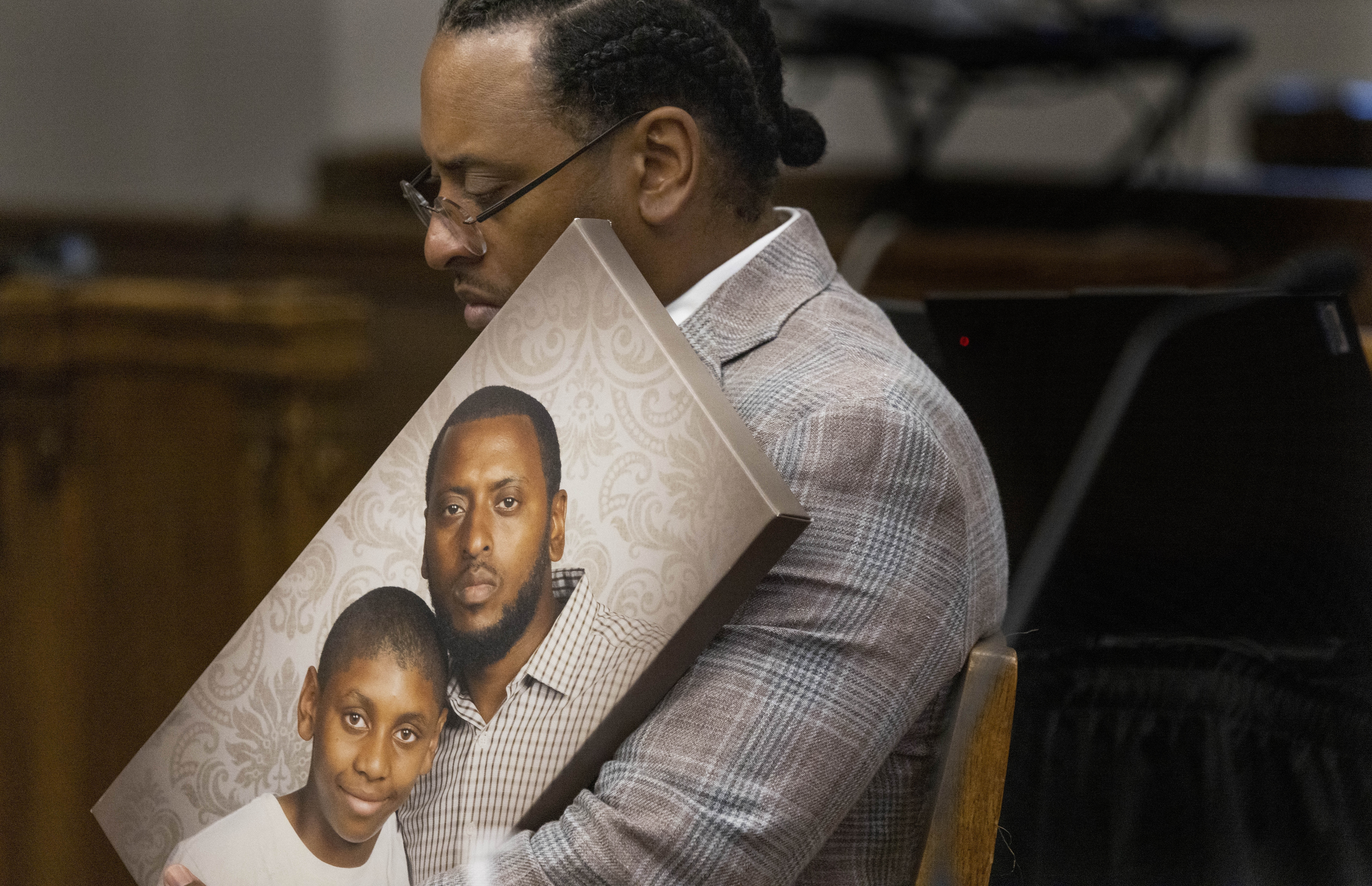
An 18-month investigation by The Seattle Times, KUOW and NPR’s Embedded podcast and a review of more than a dozen videos from the night of the shooting reveal the most comprehensive view to date of how the chaotic scene unfolded. And they show how a Black teenager who came to join the civil rights movement of his generation — in a zone abandoned by police — ended up killed by a protest movement that thought he was a threat.
WASHINGTON (AP) — U.S. President Donald Trump says he will order American forces to hold off on new strikes against Iran, claiming Mideast allies have reached the parameters of a deal to end the 5-month old war.
The emerging deal “would include the Immediate, Complete, and Total OPENING OF THE HORMUZ STRAIT, and an end to Iran’s nuclear threat,” Trump wrote in a Saturday evening social media post.
“Based on this request, I have agreed, for the future benefit of the WORLD and, likewise, the survival of a successful and prosperous Iran, to cancel the attack, subject to being able to rapidly make a DEAL,” Trump said.
Trump has announced halts to strikes in Iran on several occasions since the U.S. and Israel attacked Iran on Feb. 28, only for things to unravel and fighting to resume again.
Iran’s defense minister said on X that the country was “neither surprised nor passive” following Trump’s announcement and said Iran continues to remain alert in the face of concrete threats from the U.S.
Newest proposal would bring sides back to negotiating table
A regional official says the proposal announced by Trump over the weekend calls for the U.S. and Iran to return to negotiations and continue working out many of the issues that have stymied prior progress on the deal.
The official, who is involved in the mediation efforts, said the proposal calls for reopening of the Strait of Hormuz and halting attacks across the region, including by Iranian-backed militias in Iraq on the Arab Gulf countries and Jordan.
The U.S., in exchange, will end its naval blockade on Iran and allow Tehran to export its oil as stated in the tentative ceasefire deal, he said.
No deal has been reached yet, but mediation efforts are underway, said the official, who spoke on condition of anonymity because he wasn’t authorized to talk to the media.
Trump said that Israel is joining his commitment to end the war by implementing the ceasefire deal. Israel did not publicly comment on the announcement.
Saudis concerned about Iran retaliation
Saudi Crown Prince Mohammed bin Salman, the kingdom’s de facto leader, spoke with Trump by phone Saturday and raised concerns about the U.S. potentially escalating the conflict with Iran, according to the Saudi press agency.
The Saudis, according to the person briefed on the substance of the call but not authorized to comment publicly, are concerned that Tehran could respond with attacks on the energy infrastructure of the kingdom and other Gulf countries. The call happened before Trump’s social media announcement, the person said.
The crown prince sought clarity from Trump on what potential new action he was weighing to take against Iran, the person said.
A White House official, who was not authorized to comment publicly and requested anonymity, confirmed the leaders spoke Saturday but did not offer any detail.
Iran has repeatedly attacked vessels attempting to transit through the Strait of Hormuz without its authorization as part of its ongoing conflict with the U.S.
Overnight Israeli strikes kill 8 in Gaza, including two children, health officials say
In developments elsewhere in the Middle East, Israeli strikes on Sunday across Gaza killed at least eight Palestinians, including two children, and wounded over a dozen others, according to local health officials. Palestinians reported an increase in the scale of Israeli strikes across the enclave over the past few days.
A strike on a residential apartment in southern Gaza killed three family members, including their 4-year-old child, according to Nasser hospital, where the bodies arrived.
Another strike, also on a residential apartment, in Gaza City killed three family members, including their child, and wounded others, according to health officials at the Shifa hospital. The mother was six months pregnant, the hospital added. In central Gaza, a man and his wife were killed in an Israeli strike, which wounded four other people in the area, according to the main hospital serving central Gaza.
The Israeli military said the overnight strikes had targeted Hamas military operatives, without elaborating.
At least 1,222 Palestinians, including at least 260 children, have been killed since the October ceasefire, according to Gaza’s Health Ministry. Five Israeli soldiers have been killed in that time. Both Hamas and Israel continue to trade accusations of violating the ceasefire.
Elsewhere in the region
The State Department issued new security alerts on Saturday urging U.S. citizens in the region to prepare for the possibility of flight cancellations, temporary airspace closures and other travel disruptions. The warnings covered Bahrain, Israel, Iraq, Jordan, Kuwait, Lebanon, Oman, Qatar, Saudi Arabia and United Arab Emirates.
President Donald Trump on Saturday expressed displeasure with the Justice Department’s decision to drop a felony charge against a former Olympian accused of damaging the Lincoln Memorial Reflecting Pool, excoriating his handpicked U.S. attorney for the District of Columbia, Jeanine Pirro, on social media.
“I disagree 100% with Jeanine Pirro, the U.S. Attorney for the District of Columbia, on the Reflecting Pool. I don’t know what she was thinking?” Trump posted on Truth Social. “To me, it was a pure case of VANDALISM, that included the grass, which had a big 86 47 emblazoned in giant letters on it, and other elements of the surrounding area. There may have been some contractor difficulty, but the major damage was caused by VANDALS!”
Pirro filed a motion Friday evening to dismiss charges against former Olympic canoeist David Hearn after prosecutors determined that the damage to the Reflecting Pool’s liner was, in fact, due to the contractor’s “botched” work.
Interior Secretary Doug Burgum also insisted Saturday, “The evidence is clear, vandals have repeatedly caused damage to the Reflecting Pool. Some of these acts were even caught on camera.”
But Norm Eisen, a lawyer for Hearn who co-founded Democracy Defenders Fund, which represents people targeted by the Trump administration, said, “Trump and Burgum are attacking Pirro because she admitted what we established in our legal filings all along: Trump’s botched renovation was responsible for the damage — not Davey Hearn.”
The landmark had undergone a $16 million renovation at Trump’s behest in the spring, but problems arose almost as soon as the work was completed. The pool water turned green from algae, the liner at the bottom of the structure began coming off and the markings “86 47”— a phrase the Trump administration has labeled a threat to kill the 47th U.S. president — were seen nearby on the National Mall lawn.
Trump has repeatedly blamed vandals and other culprits — including “radical left lunatics” and an ABC News correspondent — for the pool’s issues.
His preoccupation with the matter continued on Saturday.
Along with his criticism of Pirro, Trump posted on Truth Social a four minute-long video of the structure with several people reaching into the water, and wrote: “Look for yourselves at the VANDALISM that took place at The Reflecting Pool. The material is being cut with a knife or a box cutter, for all to see!”
About 1 in 4 babies in the Pakistani fishing settlement of Rehri Goth are born prematurely. Researchers are trying to figure out how to bring the numbers down.
The Points Guy Brian Kelly is the top travel expert. He shares his essentials for every trip, including how he keeps his toddlers entertained on long flights.
In cities where space is tight, underused golf courses are, in theory, ideal canvases for new housing. | Patrick T. Fallon/AFP
Maybe it was never a great idea to build so many golf courses in the desert. But in the 1990s, when Tiger Woods mania was at its peak, Las Vegas went on a fairway construction spree, dotting the city with dozens of pristine, water-gobbling green oases, most woven around upscale master-planned suburbs.
One of those new fairways was the privately owned Badlands Golf Club, whose name now evokes huffs of frustration and wistful what-ifs from Las Vegans in the know. Opened in 1995 about 15 miles west of the Strip, the luxury course once wound its way around some of the city’s most opulent mansions and gated communities.
Key takeaways
An old golf course in Las Vegas is about to be transformed into the largest affordable housing complex in Nevada’s history.
If all 16,000 golf courses in America were turned into such housing, we’d have 22 million more affordable homes.
NIMBY urges can make such projects difficult, but the housing crisis makes it important to consider them.
By the time Woods crashed his car into a fire hydrant in 2009, the golf industry was in a crisis of its own. Many Americans had lost their appetite for the sport, which began hemorrhaging millions of players during the Great Recession and Woods’s fall from grace. Thousands of golf courses built during boom times shut down as a result — Badlands Golf Club among them.
Meanwhile, Las Vegas, like many American cities, needed more homes to help alleviate its brutally high housing costs. These days, Nevada needs 120,000 additional affordable homes, but it is running out of places to build them, in part because about 85 percent of the state is federally owned, meaning there’s little room left for its cities to grow or sprawl. Shuttered golf courses — which often had the advantage of being tied into existing urban infrastructure, unlike more undeveloped land — presented ideal spots for relatively low-cost development.
Not everyone was happy about the idea. To the ire of its affluent neighbors, the precious real estate of the Badlands Golf Club was slated for a new housing development in 2015. What came next was one of the worst land disputes in Nevada history, a decade-long legal tussle waged by the city of Las Vegas at the behest of wealthy locals. Las Vegas was forced to fork over $286 million to a developer last year — one of the largest such settlements in history, and more than the city’s entire annual municipal culture and recreation budget — for illegally denying applications and permits to build atop the Badlands, which by then sat empty, an abandonedeyesore. Eleven years after the fiasco started, a new developer finally began clearing the site for a new luxury housing complex earlier this year, while Las Vegas has had to enact hiring freezes and delay municipal projects to pay off its hefty bill.
In cities where space is tight, underused golf courses are, in theory, ideal canvases for new housing. These huge, repurposed tracts of land can fit thousands of new units — ideally, affordable ones — alongside other amenities like parks or basketball courts smack in the middle of some of the country’s most desirable and well-connected neighborhoods. This makes such developments much cheaper to build than creating a new suburb with all new roads and power lines from scratch.
Not every attempt to turn golf courses into housing lands is destined for financial calamity. Just last year, the city of Las Vegas approved a plan to convert a separate golf course, the city-owned Desert Pines Golf Club, into a 1,500-unit housing complex, the largest affordable housing project in Nevada history and a public-private partnership between the city, the Nevada State Infrastructure Bank, a private developer, and nonprofit partners. The project is a rare win for these kinds of developments, and may offer a blueprint for how they can be accomplished in the future. But even there, the challenges are still real.
“Everyone wants more housing at a regional level. Everyone acknowledges that we need more housing,” said Nicholas Irwin, research director at the Lied Center for Real Estate at the University of Nevada, Las Vegas. “But no one wants it near them, and that’s the tricky part.”
How to turn a golf course into housing
Desert Pines Golf Club opened in the heart of East Las Vegas in 1996, a lush, manicured 18-hole course, peppered with over 4,000 imported pine trees. Like nearly one in five fairways nationwide, Desert Pines was municipally owned, its pricey water needs subsidized by Vegas taxpayers.
With its rolling green hills, Desert Pines was, by far, the largest contiguous green space in the mostly working-class neighborhood that surrounds it. But while golfers flocked to the course, many local residents barely even knew it was there or likely assumed it was out of their price range, said Ángeles Ramos, a local organizer with the immigrant advocacy group Make the Road Nevada. “Only the wealthy wanted it for their own purposes,” she told me in Spanish, but “what we want, what we urgently need, is more affordable housing.”
There was a time when “we could just build anywhere and everywhere because the valley was underdeveloped,” Irwin said, but “now, we’re buttoned up against it. We are incredibly dense, because we’ve basically filled up the land we have.” Much of Nevada is undevelopable because the federal government has set it aside for other purposes like recreation, which explains the state’s bevy of tourist attractions like Lake Tahoe or Red Rock Canyon. But it also leaves the city with little space to build.
If all 16,000 golf courses in America turned all of their land — about 2.3 million acres — into housing with the same density as Desert Pines, it would be enough space to build 22 million homes. If you applied that approach to only those courses that are, like Desert Pines was, municipally owned, then you could still build 4.3 million affordable homes, which would make an enormous dent in the nation’s current shortage of about 7.2 million affordable homes.
That’s not to say that every golf course in every land-constrained city ought to be bulldozed to make way for new apartment buildings. Golfing, for the record, has made a bit of a comeback lately, much like its most famous star. And even if fairways were still closing at the rate they were a few years ago, there’s no way that they could solve Nevada’s housing gap alone, much less overcome the shortage nationwide. But they can still help close the gap.
Ramos, who is among the local leaders organizing community meetings around the Desert Pines redevelopment, believes it could be transformative for the community over time. She says that in her neighborhood it’s become a luxury for many families just to live alone with their spouse and kids, rather than doubling up in cramped apartments, pooling together money each month to keep up with rising costs.
When the Desert Pines redevelopment opens about a decade from now, it will include not just 1,500 housing units, but also a soccer pitch, walking trails, and a job training center. In East Las Vegas, the temperature often feels more than five degrees hotter than it does in the Badlands’ affluent suburbs, where residents enjoy over nine times as much parkland per person.
“This project brings a lot of hope,” said Ramos, who’s especially excited about the prospect of more accessible, kid-friendly green spaces. “We’re all human. We need equity, respect, and to live with dignity, and that’s why we urgently need trees too.”
As it turns out, you can do a lot with an old fairway. Even with all of those bells and whistles, the new development will still likely use less water than the golf course did. And, because the plot of land is already enmeshed within the community of East Las Vegas — close to existing sewer, water, and electricity lines — it will be much cheaper to build there than it would be to try doing so on the outskirts of the city, said Antonio Bermúdez, vice president of McCormack Baron Salazar, the developer working with the city and state government on the proposal.
“What I’ve seen so far in the state of Nevada is that the political will is there,” he said, though the question is, “how do we make this happen not just in Nevada and the city of Las Vegas, but everywhere else where affordable housing is needed.”
Not in my golfyard!
If the Badlands has become a brutal fable of bad governance and highly charged NIMBYism, then Desert Pines may prove to be the model of a golf course-to-housing project gone right.
It also enjoyed the privilege of being located in a welcoming neighborhood, filled with renters who could personally benefit from the project. By contrast, many other golf courses were instead built as a luxury perk embedded in master-planned communities, meaning they’re surrounded by homeowners who fear that losing a recreational amenity — especially if it’s replaced by less upscale housing — could affect their property value.
“Everyone wants more housing at a regional level. Everyone acknowledges that we need more housing. But no one wants it near them, and that’s the tricky part.”
Nicholas Irwin, research director, Lied Center for Real Estate
Just across the street from the Badlands is another golf course, Angel Park Golf Club, built on federal land granted to the city of Las Vegas. If the city ever tried to build an affordable housing complex like the one it’s planning in Desert Pines, it would almost certainly fail given the outrage with which the surrounding community reacted to a proposal for other high-end housing in their backyard.
Victoria Seaman, a former Las Vegas City council member, was elected in 2019 to represent the district that includes the Badlands, mid-lawsuit. Even the “big, beautiful two-acre lots” the developer originally envisioned for the site, she said, were not good enough for Queensbridge, an ultra-luxury gated community abutting the course that acted as a powerful lobbying bloc during the decade-long process, influencing the city’s illegal decision to block the original property owner from breaking ground.
The city of Las Vegas is still paying off the total $286 million settlement it made over its obstruction of the Badlands project, in part through funding cuts to projects like the Desert Pines redevelopment in East Las Vegas.
“These were expensive homes with beautiful planning,” Seaman said of the project planned for the former golf course, and yet somehow, “these very big donors in Queensbridge convinced the entire [homeowners association] that the developer would ruin the neighborhood.”
The fight over fairways is really a fight over who gets to live where
The Badlands example is particularly dramatic, but it also gets at the challenges faced by similar projects across the country. Even a decade after many fairways fell into decline, there are few other examples quite like Desert Pines, and certainly none as large. While dozens of cities — including Denver, New York, and Virginia Beach — have made overtures to turn golf courses into housing in recent years, almost all such projects have been met with upheaval and fierce resistance from locals.
To some extent, that’s understandable. In Sparks, Nevada, hundreds of local residents have flooded community meetings in recent months to oppose a proposal to raze the Red Hawk Golf and Resort and build over 700 new homes in its place. “Promises were made to this community,” Tom Ciesynski, one of those homeowners, told me, “these lots, these very nice homes, were sold with premiums added for those that were sitting on the golf course.” Now, he says, the fairway’s owner is trying to build “tract homes that just don’t fit the character” of a neighborhood that has come to see the Red Hawk as its centerpiece, where Ciesynski regularly goes to golf, and where his wife takes her yoga and pilates classes.
He understands that Sparks, like most of Nevada, faces a housing crunch. “Most people aren’t opposed to all new development, but there’s a right way to do it and a wrong way to do it,” he said, and there are other places within a “stone’s throw of where we live” where he thinks the developers ought to go and build instead.
He arguably has a point. Recreation spaces are important for livable cities, too, and it’s not fair that homeowners who were promised one thing when they bought their properties are now facing a new reality.
And yet, the most troubling trade-off is not the one that leaves a homeowner golf course-less but the one that leaves families in East Las Vegas unable to afford homes at all. It may be tempting to only build affordable housing in places that won’t put up a fight, which in practice, means avoiding most golf courses, especially those in wealthy neighborhoods that want to preserve the kind of exclusivity that many fairways were built to project in the first place. But cities can no longer afford that indulgence — and in any case, they shouldn’t be digging in their heels to protect it.
When people talk about a new development not fitting the character of a neighborhood, “what they’re describing is an amorphous feeling,” said Irwin of the University of Las Vegas, “and if you make policies based on feelings and vibes, you get bad policy.”