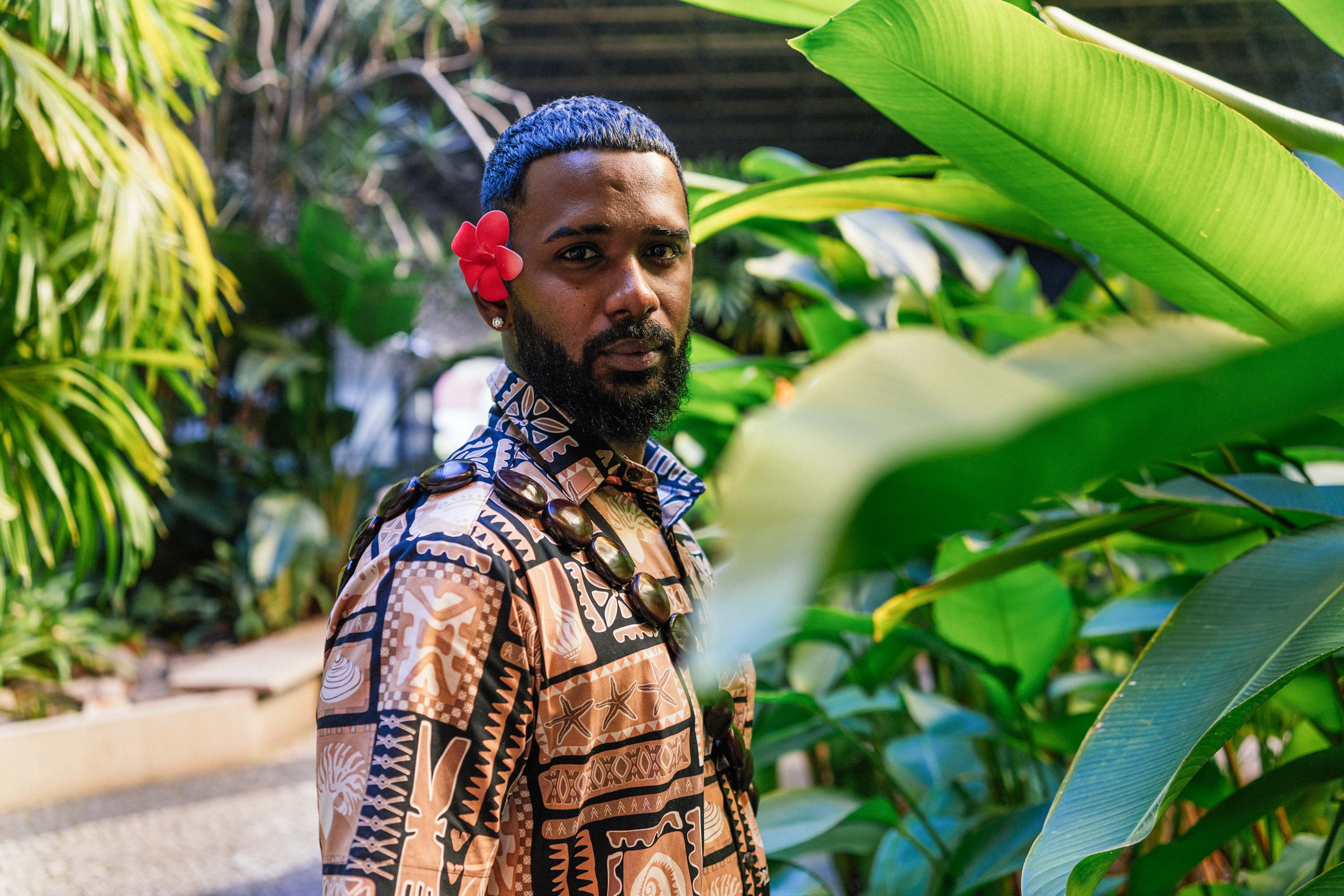
‘Holding Blue,’ a new exhibit of Catherine Opie’s photography, opens May 28 at Regen Projects in L.A. Her work will also appear at the Autry Museum, Hauser & Wirth and others.
Category: Uncategorized
-
‘Jury Duty’: ‘Company Retreat’ star Anthony Norman reveals his post-stardom plans
Norman’s unscripted reaction to the show’s climactic setup surprised even the series’ creator, Lee Eisenberg: ‘It took my breath away,’ he says.
-
Column: Welcome to the most underwhelming Emmy race in years
With many past winners and popular contenders out of the running this year, the 2026 Emmys are likely to be heavy on TV that’s just … fine, our columnist writes.
-
Tech titans prepare for blockbuster IPOs in new front of AI race
Three of the world’s leading AI companies are racing to go public, opening yet another front in the high stakes competition over the technology. SpaceX, OpenAI and Anthropic are all expected to make their stock market debut with hefty valuations, as investors are eager to get in on the companies at the heart of the…
-
Trump friction with GOP senators may imperil his agenda, say senators
Senate Republican sources say that President Trump’s agenda for the rest of the year is in serious trouble, including a budget reconciliation package to fund immigration enforcement operations through 2029, after tempers erupted at a meeting between GOP senators and acting Attorney General Todd Blanche last week. GOP senators say that Trump has no chance…
-
The most powerful woman in Washington is out of Trump’s reach
There are few things President Donald Trump hates to hear more than “no.” So imagine his outrage when he learned that Senate Republicans’ long-awaited budget bill would no longer include money for his White House ballroom project. The $1 billion in Secret Service funding, including $200 million specifically for the ballroom, had to be removed after a ruling that it failed to comply with Senate rules.
The ruling on the funding didn’t come from Senate Majority Leader John Thune, R-S.D., or any other elected member of Congress. It came from Elizabeth MacDonough, the Senate parliamentarian. Trump has demanded that Thune fire MacDonough for standing in his way — but her job isn’t at risk. For the moment, at least, MacDonough may be the most powerful bureaucrat in Washington that Trump can’t touch.
For the moment, at least, MacDonough may be the most powerful bureaucrat in Washington that Trump can’t touch.
After weeks of internal debate, Senate Republicans decided to keep the budget reconciliation bill narrowly focused on funding for Immigration and Customs Enforcement and Border Patrol. The money would backfill a gap left in this year’s Department of Homeland Security appropriations bill to appease Democrats opposed to Trump’s anti-immigrant crackdown.
Reconciliation bills have the benefit of not being subject to the filibuster or the associated 60-vote threshold. But because of how much reconciliation bills short-circuit the normal legislative process, the Senate has written guidelines into the budget law governing them. In short, anything packed inside must deal with federal spending, adjusting the amount of money the government takes in as revenue or spends as outlays. There are also provisions ensuring that spending bills match up with the instructions in the budget framework that kicks off the reconciliation process, including which committee will be filling in the details the framework leaves blank.
In making sure that nothing in the bill goes against those rules, the bill is presented to the parliamentarian. MacDonough goes through the text with a metaphorical red pen to pick out anything that violates the so-called Byrd rule — named for former senator Robert Byrd — that governs the budget reconciliation process.
In this case, MacDonough ruled that the White House ballroom project funding tucked into the Judiciary Committee’s part of the bill goes beyond the committee’s jurisdiction. If the funding remained in the bill, it could be taken out on the floor via a point of order and would be subject to the 60-vote threshold to be placed back in.
Just because MacDonough ruled out the funding did not mean it was doomed. It’s not unprecedented for provisions to be revised after the parliamentarian’s review and later reincluded in a reconciliation bill. Thune and other Senate GOP leaders initially said they would work to revamp the language to produce something viable — but it wouldn’t be surprising if they didn’t work too hard. The ballroom request put Republicans in a tough spot, placing the onus on them to sign off on a controversial project Trump repeatedly promised wouldn’t cost taxpayers a dime. In the end, GOP senators determined it was more important to move forward on immigration enforcement without the ballroom funding.
Trump was, of course, furious. He reportedly called Thune and demanded that MacDonough be fired. When Thune seemed cool to the idea, Trump then turned to Truth Social, blasting her as someone who “has been brutal to Republicans, but not so to the Dumocrats — So why has she not been replaced?” He added that Democrats “cheat, lie, and steal, especially when it comes to Votes in Elections, but stick together, whereas the Republicans allow the Elizabeth MacDonoughs of the World to stay in power, and brutalize us.”
Trump’s demand that she be fired also almost certainly will go unheeded — though not because it’s unprecedented.
It’s true that MacDonough has ruled against Republicans’ wishes before. Some GOP lawmakers called for her firing over related rulings she made last year on the One Big Beautiful Bill, which was passed through reconciliation. But MacDonough has given Democrats plenty of headaches over the years. Most crucially, in 2021, she refused to allow Senate Democrats to raise the minimum wage to $15 as part of the American Rescue Plan. A provision that would have provided a pathway to citizenship was also deemed out of order for the stimulus bill. While some Democrats griped about the rulings, MacDonough remained in place.
Trump’s demand that she be fired also almost certainly will go unheeded — though not because it’s unprecedented. In 1987, Senate Democrats dismissed parliamentarian Robert Dove after winning control of the chamber. When Republicans retook the Senate in 1995, they reinstated Dove — only to dismiss him six years later after rulings that hurt Republican efforts to slash taxes.
MacDonough will likely keep her job because she has remained popular overall with senators during her time in the role, despite having to deliver bad news to both sides. More importantly, Thune has stuck with her even as Trump has railed against her judgements. Without Thune’s backing, there’s no way for Trump to force MacDonough from her perch at the front of the Senate chamber. The Senate could also overrule her rulings rather than replacing her outright, but doing so would open the door to ending the filibuster altogether, something most GOP senators oppose.
It’s a rarity in this day and age for anyone in Washington to be considered truly neutral — but MacDonough seems to fit the bill. Even during times when she has blocked policies that would help millions of Americans, she has done so without malice or favor. MacDonough earned Trump’s ire by being his exact opposite, keeping the Senate honest with itself and preventing senators from discarding their own rules when convenient.
The post The most powerful woman in Washington is out of Trump’s reach appeared first on MS NOW.
-
Fox Station Vet Patrick Paolini Named Tegna CEO As It Battles Through Nexstar Merger Litigation
EXCLUSIVE: Tegna has named Fox Television Stations veteran Patrick Paolini CEO as the station group looks to resolve litigation seeking to undo its merger with larger rival Nexstar. Paolini spent 26 years at the Fox stations, including most recently as EVP of ad sales, departing the company last week. Before assuming the role at Fox […]
-
Amoako Boafo Drew on Venice’s Rich Creative Heritage for His First Solo Show in Italy
Produced by Gagosian, “Amoako Boafo: It doesn’t have to always make sense” opened this May at the Museo di Palazzo Grimani during the 61st Venice Biennale and is on view through November 22.
-
Eight Truths About Long-Term Desire, According to Esther Perel’s ‘Mating in Captivity’
From how to maintain desire in a long-term relationship to whether heightened intimacy always make for good sex, the renowned psychotherapist’s seminal work still feels fresh 20 years later.
-
I asked a billionaire about his environmental philanthropy. It didn’t go well.

Earlier this year, a billionaire investor and philanthropist named Tom Kaplan auctioned off a small Rembrandt drawing of a lion at Sotheby’s in New York City. It sold for nearly $18 million. A press release prior to the auction noted that Kaplan would donate the proceeds of the sale to an environmental organization that he co-founded, called Panthera, which conserves wild cats like lions and jaguars.
At face value, Kaplan’s gift is extraordinarily generous. Kaplan, owner of the world’s largest private collection of Rembrandts, is redeploying wealth that could have stayed locked up in a private collection or bank account to support the conservation of threatened felines and their habitats across the globe — all at a time when environmental causes are facing a massive funding shortfall. This seemed like a feel-good story all around. And that’s how it was pitched to me by a PR agency.
My colleague Sara Herschander and I went to the auction in early February, and I spoke one-on-one with Kaplan the following week. I was expecting a fairly straightforward conversation about philanthropy and what he sees as the responsibility of billionaires, told through the lens of his recent gift. But instead, our chat exposed a more complicated and sometimes troubling side of big-money environmental giving.
Kaplan became a billionaire through exploring for, mining, and investing in natural resources, including silver, gold, and natural gas. He remains active in metals mining to this day. Kaplan is the founder and chair of The Electrum Group, an investment firm focused on mining precious metals, and the chair of the gold mining company NovaGold Resources, which is developing a mine in Alaska that it expects to be the largest single gold mine in the US.

That work sits awkwardly next to what Kaplan told me is his primary passion: wildlife conservation, and in particular, the big cats that Panthera works to protect. Mining is, by any measure, an unusually destructive industry for the environment and for wildlife. So I asked Kaplan: Does he see, in any way, his environmental philanthropy as a counterweight to the impact of his industry?
It seemed an obvious question to me, but not to Kaplan. “You know, people don’t ask me these questions,” he told me over Zoom from a car. “First of all, I’m not going to spend time on educating you about why mining has a very, very tiny footprint when you compare it to agriculture and climate change. Everyone knows that if it’s a choice between my business and Panthera, I’m always choosing Panthera. With all due respect, I’m busy, so do you have anything [else] that you’d like to discuss?”
I pressed further, explaining that the public often sees a tension between mining and conserving wildlife. “You’re wrong,” Kaplan told Vox. “Please don’t make things up. When you say this is the public tension, with all due respect, it doesn’t exist. You’re making it up. It’s a very hack journalist thing to say, ‘How do you answer, you know, the criticism of X, Y, and Z.’ I’ve never faced it, ever, nor should I have.”
Kaplan went on to say that mining has no detrimental impact on wild cats — a claim disputed by four mining experts we later interviewed. Mining metals can destroy habitat, leach chemicals into the environment, and accelerate other threats, such as deforestation, that in turn impact wild animals, including big cats. Panthera itself, the group Kaplan cofounded, lists mining as a threat to at least two wild feline species: the flat-headed cat and the Andean cat. Meanwhile, the International Union for Conservation of Nature and Natural Resources (IUCN), the global authority on endangered species, lists “mining and quarrying” as a threat to 19 cat species including jaguars, Andean cats, and tigers.
After I pressed Kaplan about the impact of his mining work, he said we could talk more about it another time. But when I reached out a week later to set something up, he declined. Vox shared a detailed list of our reporting with Kaplan before publishing this, and he declined to comment further.
The point is not that Kaplan’s particular mines are uniquely harmful within the broader extractive industry. They’re not — Kaplan appears to now operate primarily in North America, which means his mines are under a comparatively strict environmental regulatory regime. But there is no denying the fact that mining of any kind at scale has real, documented environmental impacts. (And for metals that are key to renewable energy technologies, those costs may be well worth paying.)
The point is that a man who has spent decades profiting from an industry that experts say harms wild animals — and who has also spent decades now giving tens of millions of dollars to protect them — doesn’t see any connection between the two.
And he is not alone.
Get in touch
Got a tip or feedback on this story? Reach out to reporter Benji Jones at benji.jones@vox.com.
What our conversation highlighted is a bigger problem with environmental philanthropy. For every dollar spent to protect nature, the UN recently reported, more than $30 goes toward destroying it, largely from private industries like energy, agriculture, and mining. The giving, as generous as it sometimes seems, isn’t close to enough on its own. And the people writing the checks are often the same people making business decisions across industries that cause environmental harm in the first place — whether they acknowledge that fact or not.
An open secret in environmental philanthropy
Kaplan, of course, is not the only billionaire in this category.
Amazon founder Jeff Bezos is, perhaps, the most well-known example. He’s committed $10 billion to fighting climate change and protecting nature through his Bezos Earth Fund, a foundation. (His net worth, as of this writing, is about $275 billion.) At the same time, his company produces an extraordinary amount of carbon and plastic pollution — which is fueling some of the same problems Earth Fund seeks to fix.
Meanwhile, the billionaire owners of MSC, the world’s largest shipping company, use philanthropy to help restore coral reefs. And yet MSC produces more carbon emissions each year than a small European country, and carbon emissions are a leading threat to reefs globally.
Kjell Inge Røkke, the billionaire chair behind Aker ASA, an investment firm focused in part on oil and gas exploration, has donated some of his wealth to clean the ocean of plastic. Plastic is, of course, made from oil.

It’s not exactly surprising that these sorts of big-money philanthropists might insulate themselves from uncomfortable contradictions, whether they do so purposefully or not, said Stephen Prince, a multimillionaire who made his fortune from a gift-card printing company. As the wealthy get wealthier, he told Vox, they become “increasingly enshrouded in a bubble of protection that allows them to ignore reality.” Prince, who’s vice-chair of Patriotic Millionaires, a group of wealthy people calling for higher taxes on themselves, ditched his private jet in 2023 because of its enormous environmental footprint.
A number of philanthropy experts we spoke to echoed this view — that philanthropists tend to avoid addressing the tensions between their source of wealth and their charitable giving. “What you’re describing is very, very common,” said Glen Galaich, author of the recent book Control: Why Big Giving Falls Short, and executive director of the Stupski Foundation. (The foundation is rooted in the wealth of Larry Stupski, the former president and chief operating officer of Charles Schwab Corp.)
But among the financial elite, ignoring reality has far-reaching consequences. When billionaires fail to reckon with this contradiction — between their source of wealth and the target of their donations — they can indulge in a kind of feel-good eco-savior complex while attention is diverted from the much bigger environmental problems that they perpetuate.
Truly fixing those problems, such as rising temperatures and rates of extinction, requires enormous reforms in industries like agriculture, energy, and mining. It’s hard to see that happening if industry leaders who care about nature don’t acknowledge their own culpability, no matter how much money they donate to charity.
“The philanthropy world is quite keen to put so much weight on what they’re giving, but they minimize what they’re taking,” said Jessie Bluedorn, a young philanthropist and environmental organizer, referring to the environmental exploits of philanthropists.
Rich by inheritance from a family fortune made largely in the HVAC industry, Bluedorn funds climate justice organizations through her foundation, the Carmack Collective. She sees her philanthropy as a form of wealth redistribution. “People need to be a bit more honest about the balance sheet of their contribution to our society,” she said.
It should be said that billionaires don’t have to donate anything. A mining mogul could just mine and mine and not support philanthropic causes, whether environmental or not. Many of them do. From one perspective — long the dominant one in philanthropy — choosing to support a cause like wildlife conservation instead of making oneself that much richer is generous. Donating the proceeds from a beloved $18 million drawing is generous.
It’s also true that choosing to be a philanthropist can open up a billionaire to criticism that their less generous peers don’t face. There are dozens of billionaires on the Forbes Billionaires List whom you’ve probably never heard of, perhaps because they’re not giving money away publicly. And sure, billionaires may donate, in part, because they’re chasing positive attention. But those who privately hoard wealth do less good in the world while more easily avoiding accusations of hypocrisy.
Put another way, “the folks who are super interested in destroying everything aren’t philanthropists,” said Tamara Toles O’Laughlin, CEO of the Environmental Grantmakers Association. EGA is a network of over 200 private foundations, most of which are funded by wealthy families, that support environmental causes.
Meanwhile, many philanthropists are “breaking their backs to figure out how they can change their relationship to the money they got and what that money is going to do,” O’Laughlin said.
And there’s another important point: Environmental groups could really use the cash. In 2023, less than 2 percent of global philanthropy — a high-end estimate of $15.8 billion — went toward mitigating climate change, according to the ClimateWorks Foundation. That’s compared to the $78 billion that US higher education reeled in last year. At the same time, the Trump administration has yanked loads of federal funds for conservation and climate groups. (Government grants, however, typically make up a smaller share of an environmental nonprofit’s budget, relative to philanthropy.)
Senowa Mize-Fox, a climate justice organizer at the National Committee for Responsive Philanthropy, is a sharp critic of the kind of donors who give to climate-related causes without addressing their own, sometimes troubling environmental records. “These billionaires are so self-absorbed, and so far removed from the reality of the majority of people on this planet, that they think that…giving that money away is going to solve everything,” she said. “It’s not. It will not. It never will.”

But even Mize-Fox has at times opted to accept money from imperfect donors. In a previous job, the organizations she worked with got a big grant opportunity from Bezos Earth Fund.
“It is all blood money, and the faster that we can divest from the billionaires and reinvest that money into frontline solutions is what matters to me,” Mize-Fox said, noting that most wealth is tied to some kind of exploitation, whether it was last year or 100 years ago.
So then, does it really matter where the money came from if it’s put to good use?
A new generation of climate advocates — and some philanthropists themselves — are starting to think so.
A slow reckoning is underway
In the last decade or so, some billionaire donors and their foundations have finally begun to grapple more explicitly with the source of their wealth and the harm it’s caused, often with the help of donor advocacy groups like Patriotic Millionaires and Resource Generation.
Perhaps the clearest example is the Rockefeller Brothers Fund. It’s one of several foundations started by heirs to John D. Rockefeller’s gigantic Standard Oil fortune. In 2014, the fund pledged to divest its endowment from fossil fuels like coal and tar sands. Its aim was to align its investment practices with the climate justice efforts it has supported since the 1990s.
In 2020, the much larger Rockefeller Foundation similarly decided to untangle its endowment from fossil fuels. It was a remarkable statement from an organization founded from a $100 million cut — worth about $3.3 billion in today’s dollars — of one of history’s largest oil fortunes.
“The weight of this legacy is not lost on us,” Chan Lai, the Rockefeller Foundation’s chief investment officer, told Vox in a statement. The divestment was “in part a form of accountability,” he said, for the source of the Rockefellers’ fortune.
A number of other major foundations have similarly decided to divest from fossil fuels, spurred in part by the murder of George Floyd. Protests in 2020 pushed grantmakers to more publicly acknowledge the damaging roots of their riches, fund more climate justice work led by people of color, and align their endowments — the investment funds they use to grow their wealth — with their charitable missions.
Some living billionaires have made similar moves. California gubernatorial candidate Tom Steyer has spoken publicly about his pivot from investing in fossil fuels to funding climate solutions.
“I went from being somebody who was blithely investing in everything in the economy to, ‘No, no, no, no, that’s not okay,’” he said in a recent interview on the podcast Heated. “And I need to leave billions of dollars on the table to make sure that I’m actually doing the right thing.”
More than a decade ago, Nicky Oppenheimer, Africa’s fourth-richest person and heir to the massive De Beers diamond fortune, sold his family’s $5.1 billion stake. Since then, he’s invested heavily in wildlife conservation.
Is giving enough?
Given the sheer scale of environmental problems — and the gaping hole in funding to fix them — it is, perhaps, a terrible idea to criticize any environmental philanthropist. Vox, itself, relies on grant funding for some of our environmental coverage, including this very piece. Implying that a philanthropist could do more for the planet when they’re already donating a lot is, as Kaplan put it in our call, “an unusual take on things.”
Yet that response, again, belies a more fundamental issue. The economic system we live in today, which billionaires help perpetuate, is not working. For the roughly $220 billion spent to save nature in 2023, more than $7 trillion went to activities that destroy it, such as subsidies for fossil fuels, according to a recent UN report.
Environmental philanthropy comes nowhere close to balancing the scales — especially if it does nothing to shrink the larger half of that equation. To borrow an analogy from groups fighting plastic waste, it’s like trying to mop up from an overflowing bathtub without turning off the faucet.

To truly solve the world’s big environmental problems, harmful industries need to change the way they do business. They need to redirect financial flows that dwarf philanthropy toward less harmful activities — from mining coal to building solar panels, from cutting trees for cattle to investing in plant-based protein.
“Foundations in the US give away a grand total of $100 billion a year,” Galaich, the Stupski Foundation executive director, told Vox. “[But we] are talking about multitrillion-dollar problems.”
Just ask Bezos, who told CNBC in an interview this month: “If I do my job right, the value to society and civilization from my for-profit companies will be much, much larger than the good that I do with my charitable giving.” Bezos was referring to the value he sees generated by companies like Amazon and his space tech company Blue Origin, which may be debatable, but the point is that the scale of for-profit industry is so great that what is done there matters more than what can be done in philanthropy.
Maybe the companies that Kaplan has invested in are leading the way in sustainability — in making the metal mining industry less harmful to ecosystems and the cats that he adores. The gold company he chairs has a whole page dedicated to its environmental efforts. That’s a question we planned to ask him in a follow-up conversation, though answering it would have required being open to the contradictions at the heart of so much environmental philanthropy.
Ultimately, it’s hard to understand how an industry will stop creating environmental problems if even its leaders who are most passionate about the environment — so much so that they are giving away their prized possessions for it — don’t first acknowledge that they exist.
-
Several killed as train and school bus collide in Belgium, local media report
Seven children, a chaperone and the minibus driver were on a level crossing when the accident happened, broadcaster VRT reported.
-
WATCH: Americans remember and honor the heroes who gave their lives on Memorial Day
This Memorial Day, Americans from coast to coast gathered to remember and honor the brave men and women who made the ultimate sacrifice for our freedom.