
Before dawn on Carnival Monday, Yvette Noel-Schure stands at the Botanical Gardens Roundabout in St. George’s, Grenada, wearing a black bodysuit, her skin coated first in baby oil and then charcoal, a cow-horn helmet on her head. She is preparing to confront a childhood fear by stepping into and embracing a tradition she had avoided her entire life.
At 64, Noel-Schure is playing mas for the first time, beginning with the tradition she spent six decades working up the nerve to face. Yet even in a moment that belongs to her, her instinct is to care for the people around her. She moves through the crowd rubbing oil onto the skin of friends and family before anyone can do the same for her. I am standing close enough to see it, and it strikes me immediately. Even here, on the morning she has spent years preparing for, she is taking care of everyone else.
Then something shifts.
“I felt it when the ancestors came and sat between us,” she recalls. “It just felt right.”
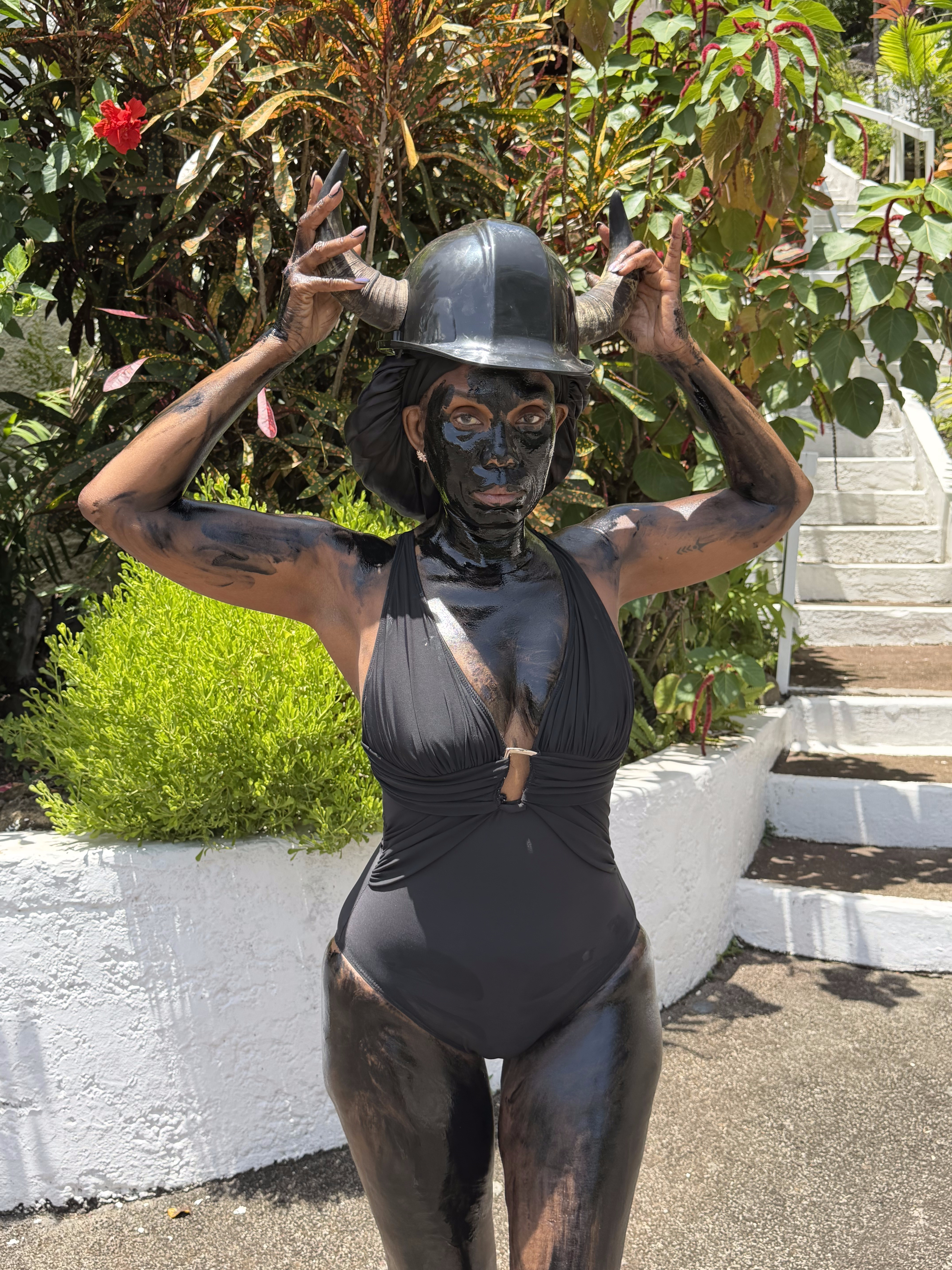
She was about to play Jab Jab, a traditional yet often misunderstood post-emancipation masquerade rooted in freedom and resistance. Formerly enslaved people took the degrading image their oppressors had created of Black people as demonic and inferior, exaggerated it and carried it into the streets. By blackening their bodies, wearing horned helmets and carrying chains, masqueraders mock what was once meant to demean them, transforming it into an expression of freedom and defiance.
For more than three decades, Noel-Schure has been a commanding presence in the entertainment industry, building a celebrated career as a music executive and publicist and representing some of music’s most influential artists, including Beyoncé, Prince, Kelly Rowland and Kes the Band. Yet beneath that public confidence, the proud Grenadian had carried a fear of the traditional masquerade known as Jab Jab since childhood.
A few months before her 65th birthday, she returned home for Spicemas, Grenada’s carnival, determined to confront that fear by playing mas for the first time. Spicemas unfolds over several weeks, with fetes, pageantry and music competitions building toward Carnival Monday and Tuesday, the season’s culmination on the road. Noel-Schure attended Dimanche Gras and the Soca Monarch m competition, where Sabrina Francis became the first woman to win Grenada’s Groovy Soca Monarch title with “Honor You,” and Snakey claimed the Power Soca crown with “Raging Seas.”
Playing mas became a self-care ritual. For months, she conditioned her mind and body, studied the culture she had feared, built strength, changed how she ate and learned when to rest.
“Self-care is not just your body. Self-care is your mind,” she shares with ESSENCE. “Breaking the chains of fear was my self-love to me.”
She played tennis, stretched daily and practiced getting low enough to keep pace on the road. After years as a vegan, she reintroduced fish for protein. She prioritized hydration and sleep. When exhaustion set in on Carnival Monday, she left after a few hours and skipped Monday Night Mas rather than force her body through every event.
“I knew I needed to sleep,” she shares. “If you’re going to be good on Tuesday, you could only do a couple of hours on Monday. And that’s OK.”
By Tuesday, she felt the results. “I felt stronger than I did as a 30-year-old,” she says. “I felt much more brave than I did as a 20-year-old, and I felt more focused than I ever did as a 40-year-old executive in my prime.”
Her decision reflected an understanding that time, health and freedom cannot be deferred. Her father, a “jump-up man” who worked hard and played harder, suffered two strokes at 48. Mental illness, she shares, changed much of her mother’s life. Approaching 65, their experiences sharpened her determination to stop postponing what she wants for herself.
As a child in Grenada, the sound of chains and conch shells sent her beneath the bed. No one explained the history behind the blackened bodies and horned helmets she saw coming down the hill before dawn. The fear followed her to New York at 14 and remained through more than five decades of return trips to the island.
Her cousin Ian Charles, co-founder and CEO of Jambalasee Grenada, eventually helped her understand the tradition that had once frightened her. Through his guidance, she recognized its values as ones she had embodied throughout her life.
“The Jab mentality is go for broke,” she explained. “It’s all about community. It’s all about being audacious. It’s all about being strong. It’s all about understanding where you come from and honoring that.”

“I felt like in that mirror I was seeing everything I’m made of that’s usually covered by the rouge of blush or the stain of lipstick,” she recalls. “It was literally dust to dust. It was really the ashes. And in that moment, I was very alive, but also felt my mortality at the same time.”
Without lashes or lipstick, she says she felt more beautiful playing Jab than she later would in the jeweled bodywear and feathers of Pretty Mas.
“Jab was not preparation of the face,” she shares. “It was about preparation of the soul.”
On the road, the chains became a symbol of the fear she was releasing and the freedom she was claiming. By the time trucks arrived with sand to absorb the oil left behind by the masqueraders, Noel-Schure says she could approach others without the fear she had carried since childhood.
“I said, ‘I’m not afraid anymore,’” she recalls. “It felt like I had conquered something.”
That release was self-care, too: not an escape from what frightened her, but a deliberate movement toward it, supported by knowledge, family and community.
If Jab was about confronting fear, Pretty Mas the following day was a tribute to her mother, whom Noel-Schure remembers as beautiful, expressive and every bit a Carnival queen, though she never had the opportunity to play mas herself.
“Pretty Mas was for my mommy,” she shares. “She was a Carnival queen to me. She was so beautiful, and when she spoke, she was so expressive.”
For years, Noel-Schure felt that because her mother never played mas, she could not either. Choosing Pretty Mas let her honor her mother while doing what she never had the chance to do.
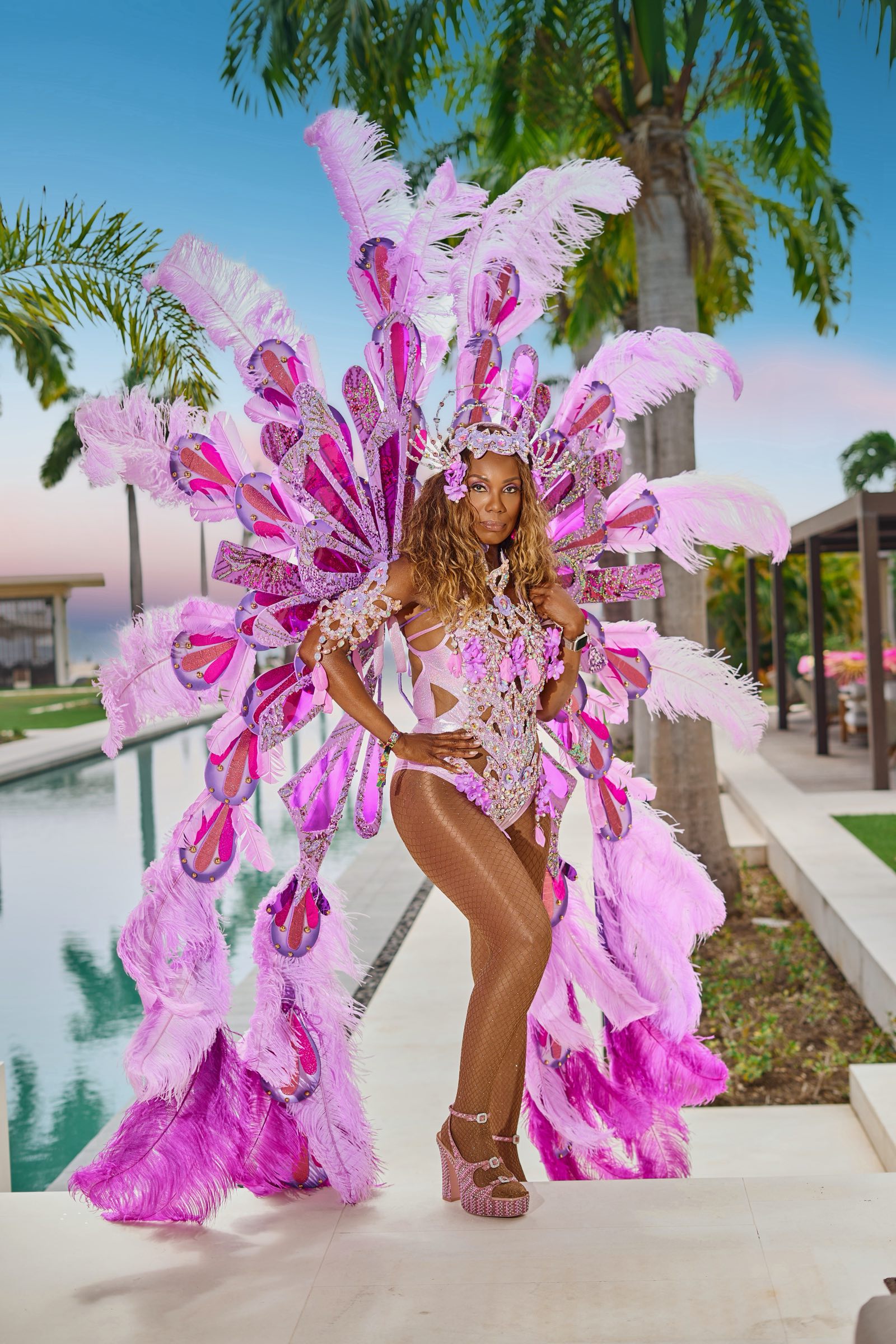
She joined the band Vibe Mas in a purple frontline costume with pink accents, jeweled bodywear and a sweeping feathered backpack designed by Christian Chow Chung.
When the backpack was placed on her shoulders, it became a way to carry her mother with her.“I carried my mother from the time I hit the road until the last lap,” she shares.
Her niece Jasmine joined her for both Jab and Pretty Mas. With Jasmine beside her and her mother on her mind, she felt three generations of her family come together on the road.
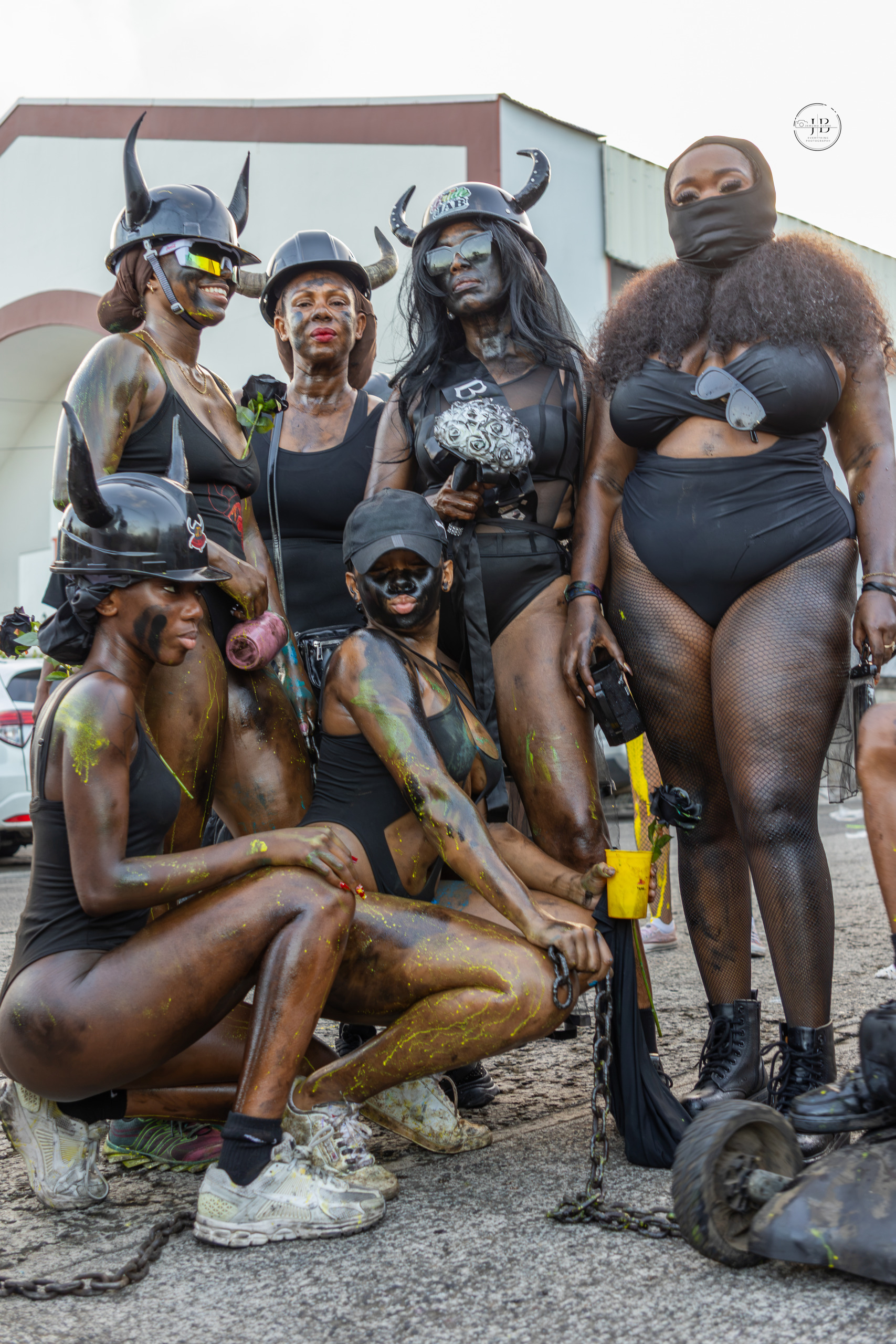
The experience showed her that Carnival has “no age gap,” Noel-Schure says. “Carnival is for the eight-month-old baby and it’s for the 80-year-old woman.”
The body she had conditioned for months became part of the celebration. In the costume, she felt beautiful, confident and fully recognizable to herself. She also thought about the little girls watching from the roadside.
“I wanted to make sure that those little girls on the side watching Pretty Mas thought of me the way I thought of those queens that I saw,” she explained. “This was their fairy tale, and the queen looked like them.”
The images she shared from the road resonated with women across generations. Women over 50 wrote to say they now felt ready to play mas themselves. Those in their 20s and 30s told her she had expanded their vision of what their own futures could hold.
“The young girls, the 20-year-olds and the 30-year-olds, were like, ‘You stopped me dead in my tracks, and now I have a vision board for when I’m getting older,’” she recalls. “I did not expect that.”
By choosing herself publicly, she reminded other women that they can feel beautiful, move with confidence and try something new at any age. The experience also affirmed that self-care need not happen alone. Her family understood its emotional weight, while her community grounded her in the culture, watched over her and gave her room to surrender to the experience.
That care also came with responsibility. Noel-Schure is clear that embracing Carnival means respecting its traditions. Jab and Pretty Mas cannot be flattened or turned into a spectacle; every element carries meaning, and preserving that meaning requires education.

She believes children should learn Carnival history early and that visitors who do not understand a tradition should be willing to observe before participating.
What began as a milestone she wanted to reach before turning 65 became a new understanding of what it means to care for herself.
“There’ll always be more carnivals,” she reflects, “but there’ll never be Spicemas 2026 for me. Nothing will top it because it was the first time.”
Back home, she plans to frame her Jab helmet alongside photographs of herself in Jab and Pretty Mas and keep the display on her desk.
“I have to remind myself every day what I’m made of,” she says.
After a career spent protecting and advancing other people’s stories, playing mas gave Noel-Schure the space to step fully into her own.

Author: Melissa Noel
Read the original article on Essence.
Leave a Reply