
Salli Richardson-Whitfield never planned on becoming a director. Now, she is making history as one—again.
For much of her career, audiences knew Richardson-Whitfield from in front of the camera. Her résumé stretches back to the early 1990s, with roles in A Low Down Dirty Shame, Eureka and I Am Legend. Directing wasn’t part of some master plan, but the possibility only entered her mind after Ava DuVernay recognized something Richardson-Whitfield had yet to recognize in herself while they were making I Will Follow.
“I think you’re a director and you don’t know it,” DuVernay told her. What followed was a second career whose success has surpassed even her own expectations. In 2024, her work on HBO’s Winning Time: The Rise of the Lakers Dynasty made her the first Black woman nominated for the Emmy for Outstanding Directing for a Drama Series. Now, she has entered the record books again. Her nominations for Task and The Gilded Age make Richardson-Whitfield the first woman to receive two directing nominations in the category in the same year. She is also nominated as an executive producer on The Gilded Age, which is up for Outstanding Drama Series.
Her path also says something about who gets to imagine themselves behind the camera in the first place. Richardson-Whitfield spent decades working primarily under male directors. Seeing DuVernay directing her own feature gave her a reference point she hadn’t previously had. Now, Richardson-Whitfield has become one herself.
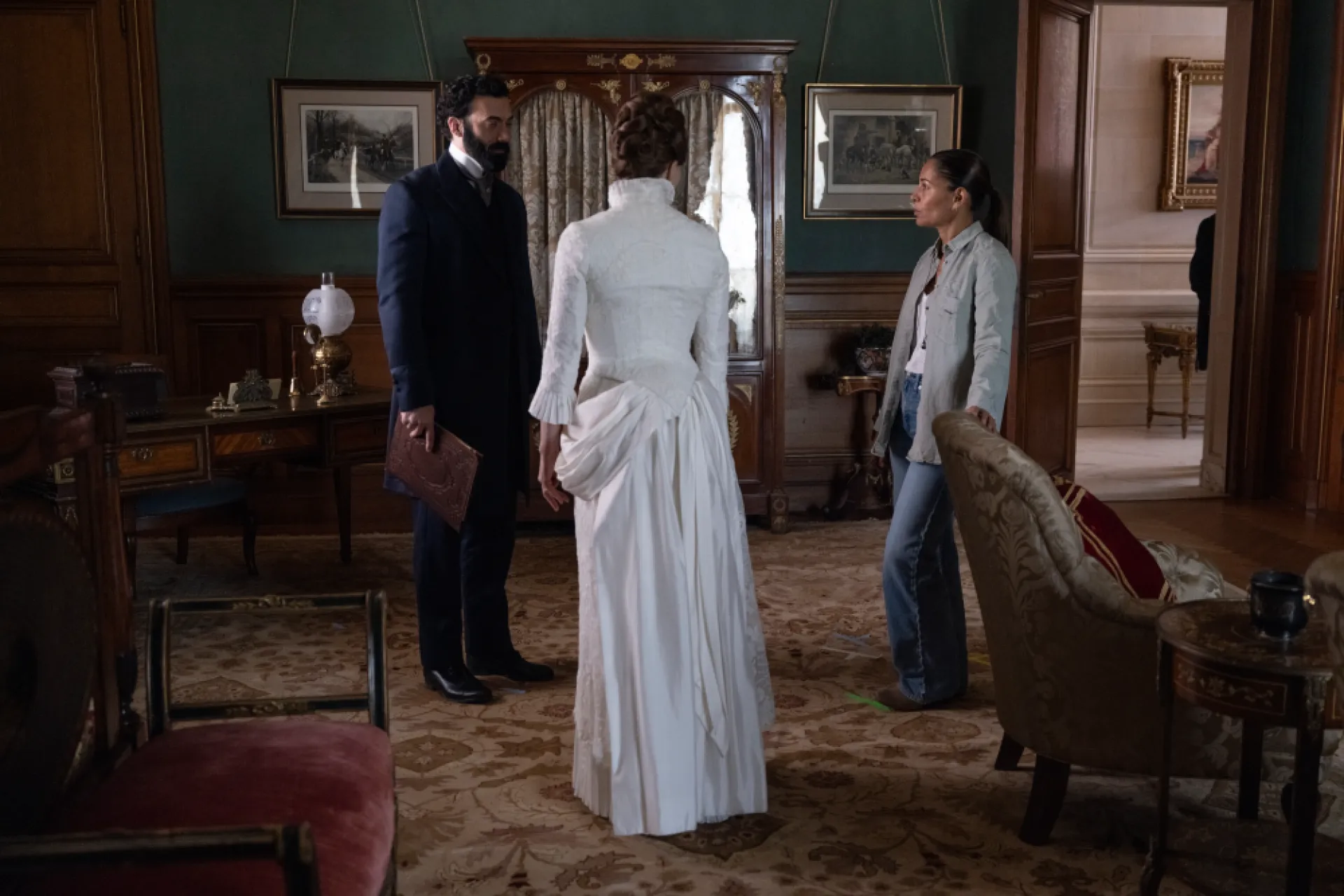
At 58, she understands her success differently than she did when she first stepped behind the camera. Awards are important to an extent, but so does what her presence can make possible for another Black woman trying to get access to the same rooms. Richardson-Whitfield now sees her own career as evidence of what can happen when someone is given the opportunity to prove what they can do. “The work that I do will help the next girl come along and it won’t be so hard for her to get that job because they know how good work we can do as women, and as women of color,” she says.
On the eve of awards season, Richardson-Whitfield spoke with ESSENCE about her unlikely road to directing, making Emmy history twice and why opportunity remains one of Hollywood’s biggest barriers.
ESSENCE: Just to let you know—Task was my favorite show of 2025.
SRW: I appreciate that. I think that it’s one of those really special shows where you have this great writing and great storytelling that comes together with amazing actors, and then you have HBO; so they give you a little bit of money so you can make it good. And then hopefully I come in and I don’t mess it up. (Laughs.)
You directed three episodes of Task last season, and you’re an EP as well. What drew you to this series?
SRW: I’ve always wanted to do a darker crime drama like this. And then obviously it’s Brad Inglesby and he did Mare [of Easttown] and Mare was so amazing, the storytelling in it. And then you have Mark Ruffalo. So it’s like, how do I say no to that? And it became one of those things I sat down with Brad and we just felt like it was a good fit. And I was very excited to get to do the particular episode that I did—you don’t get opportunities like that very often.
When you’re working on a series with several directors, what’s your process like?
SRW: Well, in Task, it’s just me and Jeremiah. So we really sat down and talked about our vision for what the show should be. And it’s really about trusting that neither person is going to go rogue from what we’ve talked about. And we’ve had drawings, we have pictures, we have inspiration boards, we’ve talked to Brad, and I’ve kind of gotten used to doing this on other shows. It’s easier when it’s just one other director because we really can check in with each other. But I think that we both respected each other’s work enough and what Brad wanted to be done, that it wasn’t as hard as you would think it was. Jeremiah and I, we are so different in the way we approach things. But somehow at the end of the day, and I can’t really explain the whole process, we were able to do something that felt like one cohesive piece.
I mean, you’ll see a little bit of different style stuff just because we’re different people. I have a little bit of a different style than him, but not enough that the average viewer would really notice.
Congratulations on your Primetime Emmy nominations once again.
SRW: Thank you.
What was your reaction when you received this year’s Emmy nods?
SRW: Well, I think it’s two years ago for Winning Time; this would be the first year that I actually kind of thought about it and hoped that I would get nominated, because Winning Time was so out of the blue that the show had been canceled. There was nothing in my mind. I don’t even think I put it up, but I think HBO did. This year, I knew both shows were in contention, and I thought they were shows that were worthy of the attention and the episodes were worthy of the attention, but nowhere in my imagination would I get both shows. That’s crazy talk.
In fact, when I got the message from my manager, I was confused. He goes, “Salli, you got nominated for both.” I went, “okay, well obviously one of the shows [was nominated] for best show because I’m a producer, so I get that. And then I got one for directing. Surely you don’t mean both shows.” So I think I’m still stunned. Of course, I’m competing against myself. I don’t know if that’s the best thing in the world, but it’s also a great story and it’s very exciting. I can’t be mad about making history. And it’s very hard for me to even dream of winning.
You made history in 2024, now you’re doing it again. Have you actually thought about that, the historical aspect? I’m hoping that you win, but even if you don’t, it’s still you’re in history. I know. How does that feel?
SRW: Well, I don’t think that any of us start out thinking we’re going to make history. We just want to do what we love. We want to feed our family. And I think I’m starting to understand the impact a little bit more. I was just made an honorary member of AKA Sorority, Incorporated. And being in that room with all these women who are so inspired by what I’m doing and feel like I am breaking ground for them, the young girls who want to be in the industry, I think it has more of a profound effect on me now because I understand the legacy that I’m building and why it’s important to them. I take it very seriously. The work that I do will help the next girl come along and it won’t be so hard for her to get that job because they know how good work we can do as women, as women of color, all of those things. So I’m starting to understand what this means more. I think about my children more when I think of the history of it and that they’re proud of me and what their mother is accomplishing and they know what they can go out and do in the world.
Legacy. Yes, that’s very, very important. Now, on to The Gilded Age. How do you think that show allowed you to stretch yourself creatively as opposed to your previous work?
SRW: Gilded was my first show that I did at HBO. And jumping in that first season, I was given so much trust and freedom to just do me. And that grew me so much as a filmmaker. And as the years have gone on, I’ve been able to even infuse more of my style into the show. And again, it just builds my confidence and my work as a filmmaker. I’ve just had the opportunity to grow so much there. But it’s obviously a whole different show than Task.
I always say it feels like kind of an old school movie because it’s this romantic way of shooting with all these beautiful sweeping shots. And when I think about last season with Peggy, her engagement, I’m like, “I’m going to embrace fairytale filmmaking. What would be every cliché that I could do in this scene that would make it so romantic for the audience?” And then also in historical and respectful to the Black community, to our community of the legacy and the history of what a sequence like this means. It was just so much that I could infuse into that sequence. And then also the pageantry of both balls and putting them, tying them together. As a filmmaker, I love the challenge of tackling something new. And that’s what I was able to do at Gilded last season. I think it’s one of our biggest things that we’ve done in the show that to date, except for next season, we’re about to hit them hard.
I look forward to it. So, you began your career in front of the camera. When did directing come into play for you?
SRW: Well, I was doing Ava Duvernay’s first film. She had done documentaries before that, but this was her first feature. And during that process, I was probably talking a little too much. And at some point she said, “I think you’re a director and you don’t know it.” And that simple statement really made me think. I am always asking questions. I am wondering, watching other directors, saying, why are they doing it like that? They should do this and this. And I was on a show called Eureka at the time. And I went to talk to them about directing the show. Of course, Ava gave me some books and some videos when I told her I was interested. There was a director I really admired who I shadowed, and he taught me a lot of things.
Also, I had three decades of experience that I didn’t really realize, and Eureka gave me the opportunity. And after somewhere within the first day or two of directing Eureka, I went, “Oh, I get this.” My 30 years of acting was my training ground to do what my real purpose is, and it’s to be a director.
When you look back on that moment, was that the first time you ever thought about directing?
SRW: That was the first time I ever thought about it.
If you had asked me that before, I would’ve said no. I would’ve said, “I would like to produce some things.” But it’s one of those things, and when we talk about history and legacy, my whole career, I’ve been only directed by men, and usually mostly white men—that’s the field. And I’ve been lucky because I started out and I had Mario Van Peeples and Keenan Ivory Wayans. But normally it would never just be all men. So I don’t know if I saw it. I didn’t know if I saw that that could be something I could do. But seeing Ava doing it and then her speaking those words to me, I went, “I can do this.” And so when we talk about history and legacy, I think that that’s what it means. Now it’s not so far away. Young girls can go, “Hey, she’s doing this. She’s getting Emmy nominations. She’s been able to work at HBO. I can do that too.”
Adding to that, how do you feel about the current climate of these Black women filmmakers and what progress would you like to see in film and television as far as representation?
SRW: I mean, we always find ourselves back at the same place. I know there’s room for us all. There’s room for more of us. And what I’ve learned through getting these Emmy nominations, it’s that some of it is just about getting the right material and access to it. If you don’t get good projects, you can’t get nominated. It’s not that there aren’t other Black women out here who are very talented and can do some of the work that I’m doing, but if you don’t have access to good stuff, then there’s nothing you can do from there. So what I’m hoping is that other women will get the opportunity to get the access to do the great work that they are capable of.
Would you be able to speak more about the “access” part of it? For example, Task—is that something that you sought out or is that something that came to you? How do you receive these projects?
SRW: Well, I have an overall deal at HBO, and HBO has been a great champion of me. They have been so supportive. I’m always at the top of their list of the people that they trust to shepherd their shows. And that’s because when they gave me the opportunity, I took it and I did a good job for them. So, I get access to it because of that. And to HBO’s credit, they gave me a shot. So they’re doing the things that you ask people to do. I had done some big shows before, but not necessarily some of these HBO shows. And Francesca Orsi and Casey Bloys saw something in me and gave me an opportunity with Gilded, and it’s worked out for me and it’s worked out for them.

Author: Okla Jones
Read the original article on Essence.