
In 1972, filmmaker William Greaves assembled some of the most influential figures of the Harlem Renaissance inside Duke Ellington’s New York townhouse. Many of the guests had helped establish an era of Black artistic achievement decades earlier, and Greaves wanted to preserve their experiences while they were still alive to recount them. With four cameramen documenting the gathering, the filmmaker captured conversations among people whose contributions to American history were not always fully acknowledged. The resulting footage would become Once Upon a Time in Harlem, a documentary completed more than five decades after its original filming.
Greaves, whose career included the groundbreaking television series Black Journal and the experimental documentary Symbiopsychotaxiplasm, considered the project among his most important undertakings. He continued filming additional material throughout the following decades, hoping to create a comprehensive examination of the Harlem Renaissance through the people who experienced it. However, the film remained unfinished when he died in 2014. His son, David Greaves, and granddaughter, Liani Greaves, eventually assumed responsibility for completing the documentary, continuing a project involving three generations of their family.
David, who also worked as a cameraman during the original 1972 gathering, felt that finishing the documentary became necessary after the deaths of his father and stepmother, Louise Archambault Greaves. Louise had secured funding to restore the footage and spent years protecting the material while seeking a path toward completion.
“It was a decision that sort of fell to us after my father had passed and after my stepmother had passed, and she had secured the initial funding to restore the footage,” David said. “So when she had passed and we had this restored footage, it was just something that had to happen.”
Louise played an essential role in preserving her husband’s work, keeping the footage in storage and carefully controlling who could view it. According to David, her efforts eventually brought the material to the attention of John Goff, who introduced it to Darren Walker, then president of the Ford Foundation. Walker provided funding toward the restoration, while additional financial support followed a review by critic Richard Brody.
The documentary’s completion required the family to determine how best to honor William’s original plans. His written proposals outlined a film examining the significance of the Harlem Renaissance, although his approach evolved as he continued collecting material. Liani, who serves as a producer, understood those documents became an essential part of the filmmaking process.
“We spent a lot of time early on with being sure about that, understanding his written material,” she explained. “So we would read a lot of his notes. And so we had an understanding of what we wanted it to be in the end, which was something that would work to help raise the consciousness of the people that would view it.”
William’s original concept included additional interviews with contemporary figures, including Sidney Poitier and Brock Peters. The completed documentary instead concentrates primarily on the people gathered at Ellington’s home, allowing their conversations to provide the film’s narrative. David says his father’s approach to documentary filmmaking also influenced how the family assembled the footage.
“And as he says in his writing, in his concept, he says that the director doesn’t know what he has because it’s cinéma vérité,” David explains. “So you don’t know what you have until you’re in the editing room. And that’s where we put it together, going through all of the footage.”
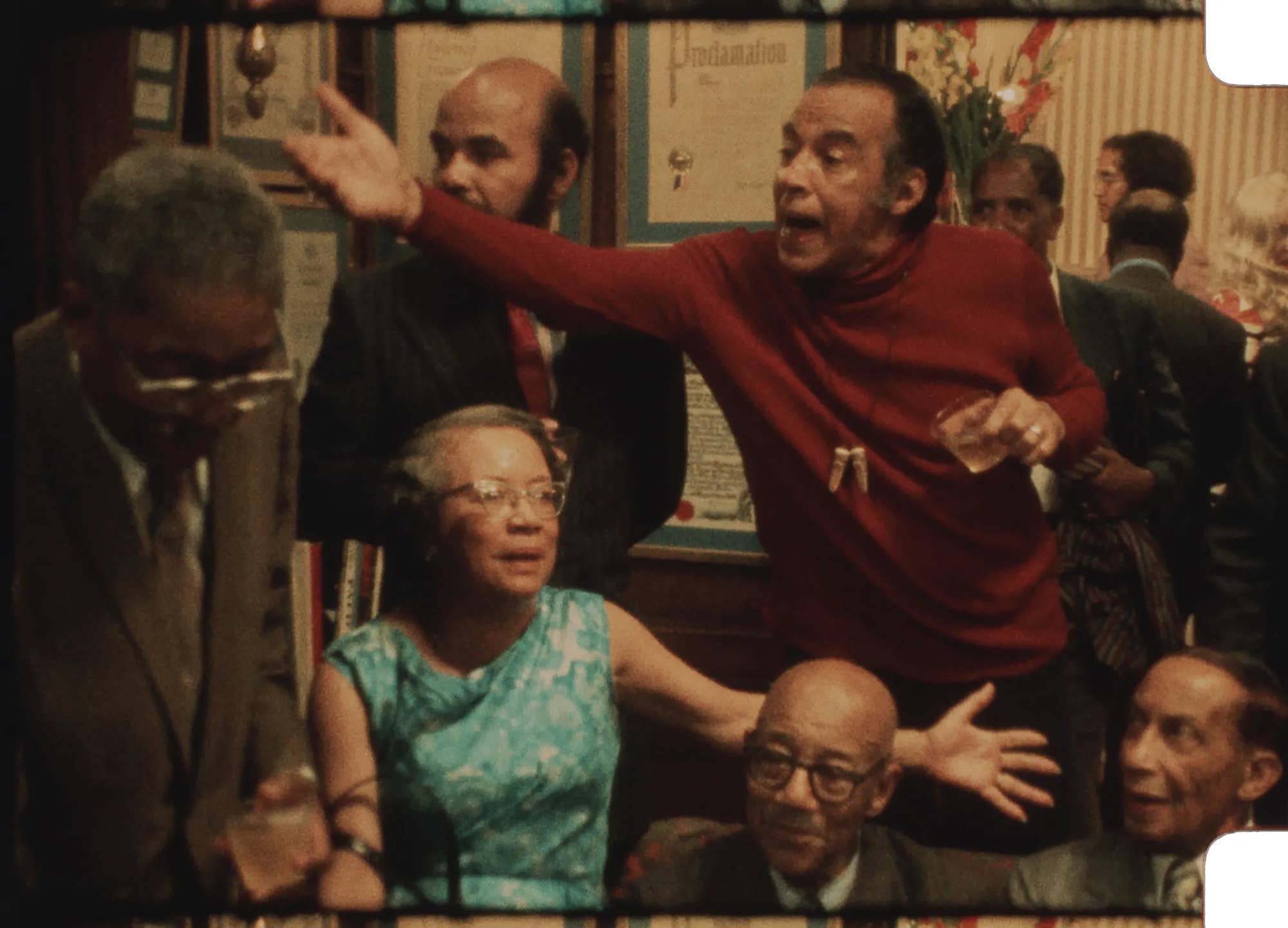
The documentary opens with guests arriving at Ellington’s townhouse, including poet Arna Bontemps, pianist Eubie Blake, and painter Aaron Douglas. Although Ellington was ill and unable to attend, his composition “Black Beauty” provides an introduction to the gathering. As the guests settle into the house, Greaves encouraged them to discuss their experiences during the Harlem Renaissance and reflect on the people who helped establish its legacy.
Among those featured are Richard Bruce Nugent, editor Gerri Major, and actor Leigh Whipper. Their conversations also revisit figures who had already died, including Zora Neale Hurston and Augusta Savage. The documentary provides an opportunity to hear firsthand accounts of an era frequently examined through historical scholarship rather than the recollections of its participants.
David was only 26 when he joined the camera crew documenting the gathering. Despite having witnessed the event firsthand, he admitted that operating the camera prevented him from fully appreciating everything happening around him. “I don’t remember much of anything being in the room back then because I was working,” he said. “I couldn’t be the fly on the wall everybody wants me to be, saying, ’Oh, well, tell me about this person. What did they…’ No, I was just looking at what was in the camera at the time.”
Revisiting the footage decades later helped him recover memories of the production. Seeing himself reflected in mirrors or captured by other cameras reminded him of particular encounters, including those involving Blake and Whipper. His experience illustrates how the documentary serves as a personal record for the Greaves family as well as an account of the Harlem Renaissance.
Liani’s connection to the project developed differently. She grew up knowing about her grandfather’s unfinished film and later worked at his production company. She also served as first assistant director on his 2005 Symbiopsychotaxiplasm sequel. Following his death, she began studying his writings to better understand the ideas behind his filmmaking. Completing Once Upon a Time in Harlem ultimately became one of the most significant experiences of her career.
“It’s meant the world. I mean, it’s the greatest work of my life so far, for sure,” she said. “Early on, it felt heavy because I understood how important it was, not just for my own family, for my grandfather and for my grandmother and what they had wanted in the world.”
The film has since reached audiences through festival screenings, including Sundance, where its reception reinforced the family’s belief in the importance of making the footage publicly available. Liani says watching people discover the documentary has changed her relationship with a project she initially approached with considerable responsibility. “It’s been a gift when I hear creative people like yourself, the people that we’ve met throughout all these festivals, when I hear them talk about how important it is for them to see it,” she noted.
Thus far, David has been elated with the audience’s response to his father’s labor of love. Rather than simply congratulating the filmmakers, viewers frequently express gratitude for the opportunity to encounter people whose experiences might otherwise have remained inaccessible. “They feel like they have received something,” he said.
More than half a century after William Greaves brought his guests together, their conversations can finally reach the audiences he hoped would encounter them. Liani felt that the documentary’s continued circulation offers an opportunity for younger generations to recognize themselves in the people onscreen.
“We want so much for people to see it, for young people to see it, for them to bring their grandparents to see it, for the elders to see it,” Liani said. “We want for them to see themselves in the stories and to look around and be like, ’This feels like where I am. This feels like home.’”

Author: Okla Jones
Read the original article on Essence.
Leave a Reply