
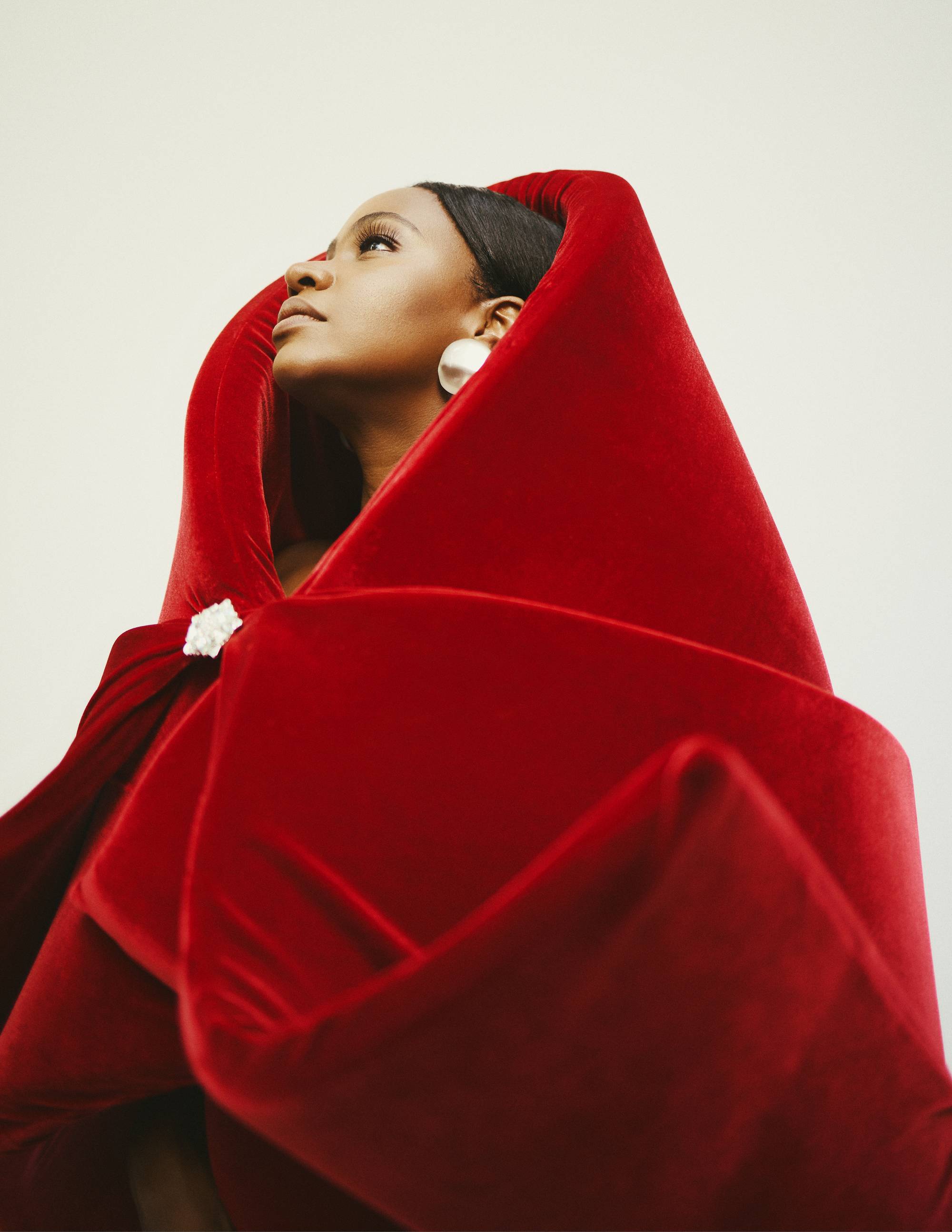
Stop the presses, everyone—Teyonah Parris is back. Since appearing as Dawn Chambers on Mad Men, the South Carolina native has established herself in Hollywood through projects such as Spike Lee’s Chi-Raq and the Marvel Cinematic Universe, where she portrays Monica Rambeau. Her filmography also includes They Cloned Tyrone, the Netflix science-fiction comedy starring John Boyega and Jamie Foxx. Now, she is preparing to introduce audiences to another character in Matchbox: The Movie, an upcoming action-adventure film that finds her working alongside John Cena in a story inspired by the popular toy cars.
Directed by Sam Hargrave, Matchbox: The Movie follows a group of childhood friends whose reunion takes an unexpected turn when Sean, a CIA operative played by Cena, returns to their lives. His arrival leads to an international adventure that places the group in circumstances far removed from their everyday routines. Parris portrays Charmaine, a journalist and helicopter pilot whose professional experience becomes particularly useful as the situation develops. The film also stars Jessica Biel, Sam Richardson and Arturo Castro, bringing together a cast whose characters must rely on their individual abilities to navigate an increasingly dangerous situation. The project represents another opportunity for Parris to work within a large-scale production, although its comedic approach offers something different from her previous experience with superhero films. With much of the action taking place outside traditional studio environments, the production also brought the cast to Morocco, where several sequences were filmed on location.
With Matchbox: The Movie, Parris adds another major production to a résumé that continues to grow. Nearly 15 years after her breakthrough on AMC’s critically-acclaimed drama series, she has reached a point in her career where the opportunities available to her are considerably different from those she encountered as a young actress. During our conversation, Parris spoke candidly about her experiences in Hollywood and how her perspective on the industry has evolved. She also discussed her latest project and what she hopes audiences will enjoy about the film.
ESSENCE: Teyonah, what initially attracted you to Matchbox: The Movie?
Teyonah Parris: Well, the script was a group adventure. These five very different people who go on this extraordinary adventure together. And I also loved that the characters were everyday heroes. These are people who, in their own communities, are… We had just characters, an EMT worker, a teacher, construction, myself, an aerial journalist. So these are people who are very active in their community and love what they do, and these skills end up serving them and saving the world. So that was really fun. I just thought it was a really fun premise.
The character of Charmaine specifically, what did you enjoy most about playing her?
TP: She is a woman who, like I said, she loves what she does. She’s a journalist, and she studied to do that, and she flies helicopters. How cool is that? And then she also has this husband who she adores, but he is so very different from her. And what makes him happy, which are simpler things in life and being present and just being able to love one another, are not the things that fully make her happy. Those add to her joy, but she wants to see the world. She wants to experience things she’s never experienced. And so figuring out how to juggle those two things at this point in their marriage, I thought would be a fun task to take on.
You brought up the film being a group adventure. What was it like working with the rest of the cast?
Teyonah Parris: Man, my cast was so dope.
I bet.
TP: They were so fun. We really did become a little friend group and just enjoyed, really enjoyed each other. Sam and Arturo are so funny in real life and on screen, but also just in real life. When I tell you, they would crack jokes for hours. I’m not exaggerating when I say that. So it was always just a fun time. Jess is just awesome and kind. And John, same, they’re both great leaders. All of us had the same idea of just wanting to come do great work, have fun and give people… Well, I can’t say what they wanted, but I wanted to give people a chance to escape, two hours of fun just to escape and enjoy themselves, go on an adventure with us.
I’ve seen a good amount of your previous work, and I was thinking about your role in The Marvels, but I feel like this kind of leans more into the comedy aspect. What was the most challenging part of participating in the film with this level of action as well as comedy?
TP: It really didn’t have anything to do with the comedy or, for me, not the action because my action is in a helicopter, so a lot of my stuff was on a green screen in a studio in a hangar. So I was very safe and in a really controlled environment.
Now then you have John, he did very practical stunts. Jess really drove the car, really drove under a truck. John really ran up the side of the chain bridge and jumped onto a helicopter. That’s other-level stuff. (Laughs.) So I’m used to, like you said, in The Marvels, in the MCU universe, I also do a lot of stage work with blue screens and things like that. So I was familiar with what it would take for me to bring Charmaine to life. And so doing stunts, filming a film, all of that adds different levels of challenges, but we got through it safely.
…So, staying on your filmography, with such a wide range of roles behind you, what do you look for for a project at this stage in your career?
TP: Now, I’m trying to think of some of the things that are the same for earlier in my career and this part of my career is, is this a story I want to tell? Is this a character that I find interesting? How does this contribute to adding narratives and points of view to stories that center the diaspora or characters in the diaspora? In my career overall, I want to tell all types of different stories. And so at this point, is there something I haven’t told already and I want to, or something I haven’t gotten to do?
Things like that. Is it going to be fun? And that doesn’t always mean comedies. There are dramas and serious things that I could work on that are still fun in the aspect of getting to work on my craft in different ways. Who are the people I’m working with? Are they good people? Are they cool to be around? You don’t have to be all super cheery or nothing, but you just have to be a decent person.
At this point in my life, I’m leaving my family, you’re leaving your family, the crew, everybody’s left their family to come do this, to work towards this goal. And you want to be around people who are kind, who also are grateful and just want to do good work. So that matters to me, too. And on Matchbox, we definitely were all, I feel confident saying, just a really good group of people, just very kind, want to be there, very optimistic group, and just want to tell good stories.
I never really thought about that perspective either. You’re leaving your family for long periods of time. It needs to be around a group of people that really want to be there. So I appreciate that answer.
TP: Yeah, you know what the opposite feels like, where you’re like, “Dang.”
With Matchbox: The Movie, I think of childhood and imagination, too. What were some of your favorite childhood memories growing up?
TP: Oh man, some of my favorite childhood memories. So some actually do center around these Matchbox cars. Me and my brothers definitely played with them. We also rode bikes and roller skates down by the river in Columbia, South Carolina—but I’m from Hopkins. So that is still some of my favorite memories, is when we would go down there as a family with our skates or our bikes and just ride, come home with calluses full of the liquid just because we were doing it for hours all on your feet.
That’s some of my favorite memories. Also, I played softball growing up, and so I learned a lot in team sports and yeah, that’s some of my favorite memories. And then as far as toys, it really was those cars. I had the Matchbox cars, but then I also had, I don’t even know what it’s called, but I would make jewelry. There were stones, gems, things like that. I read a lot of books. I was a little bit of a bookworm, book nerd, so a lot of workbooks. Those are fond memories.
It seemed like a very active childhood.
TP: It was very active. I grew up in the ’90s, 2000s, so we were still outside playing.
Yeah, it’s a big difference now.
TP: It is.
I was introduced to you in Mad Men. Looking at your career now and just everything you’ve accomplished, what would you tell the younger version of yourself about pursuing their dreams?
TP: I would tell my younger self that it’s okay to prioritize yourself even in the pursuit of a career and work, that it is okay to disappear in some ways for amounts of time. I think early on in our career, or in my career, I would be afraid to leave, to go live life. Living life is a part of what I need to do in order to be able to tell human stories. You have to experience life.
So it’s like, oh, I don’t want to go on this vacation with friends or this hangout because I think I might have to audition or something like that. It was a lot of putting life on hold for work. And someone did tell me that very early on, but I think it doesn’t hurt to hear and tell myself that again. So I would definitely tell my younger self that, and that it’s okay to take risks and live outside of your comfort zone, even in the craft.
A lot of it was just wanting, because I am so intentional and I do want to tell stories that my community is proud of and finds value in, I think sometimes I would be a bit scared to tackle some types of stories because you’re afraid of whatever it might be, backlash, will people like it, this, this or that, or just being misunderstood.
And so I would say, go for it. It’s art. You can tell the types of stories you want to tell. It doesn’t have to look a certain way. As long as you’re proud of it, you can stand behind it and talk about what it means to you and for you and why you felt value in it for the community, then you should go for it. And some things might just be for you. It might not be for other people. It might be for you, and that’s okay, too.
“Disappearing for a little while,” that kind of intrigued me. Because that’s something I feel that a lot of creatives, even myself, struggle with. When did you understand that concept?
TP: I don’t know that I have a distinct year, time, event that it happened. It was a point in my career where I had been fighting, trying to get this, trying to do this, and those things happened. Whatever it was, it happened. It happened just as I had prayed for, and I was so grateful. And then when I got into whatever it was, I was so miserable.
I was like, “Oh my gosh, how could something I wanted so bad and I prayed for so hard, how can I be so miserable in it?” I was so sad, a bit depressed in the midst of it, and I realized that, one, our words are powerful, our prayers are powerful, and God can and will give you your heart’s desire, and two, you better make sure that’s your heart’s desire, and you better be specific on what it is you’re asking for.
I was about to say, my mom always tells me that: “Be specific in your prayers. God will give you what you want, but you have to be specific in what you’re asking for.”
TP: Exactly. And I realized, wow, in that moment, I can have the exact thing I prayed for, hoped for, fasted for, and still be miserable. I was like, “You know what? It’s okay for me to live. What is actually important to me is the relationships I have, the relationship I have with God, the relationships I have with my family, my friends, and my joy, my joy. I am prayerfully going to continue working in my career choice and my passion, and I need to loosen up a little bit.”
I’m sure there’s a way more profound way to say that, and I will continue to think about a more profound way to say that. But honestly, it’s like you can get exactly what you want and still be miserable. So what really matters is my family, my friends, my relationships, and my faith. I focused on that and everything else. I was like, “Okay, this might be good. It might not be good. I might enjoy it. I might not. What are the things that I know I could take off? Is this something fun that I’ll have fun doing? Is it something I’m interested in doing, something I want to spend time talking about?”
From there, I think everything else has a little less pressure around it.

Author: Okla Jones
Read the original article on Essence.
Leave a Reply